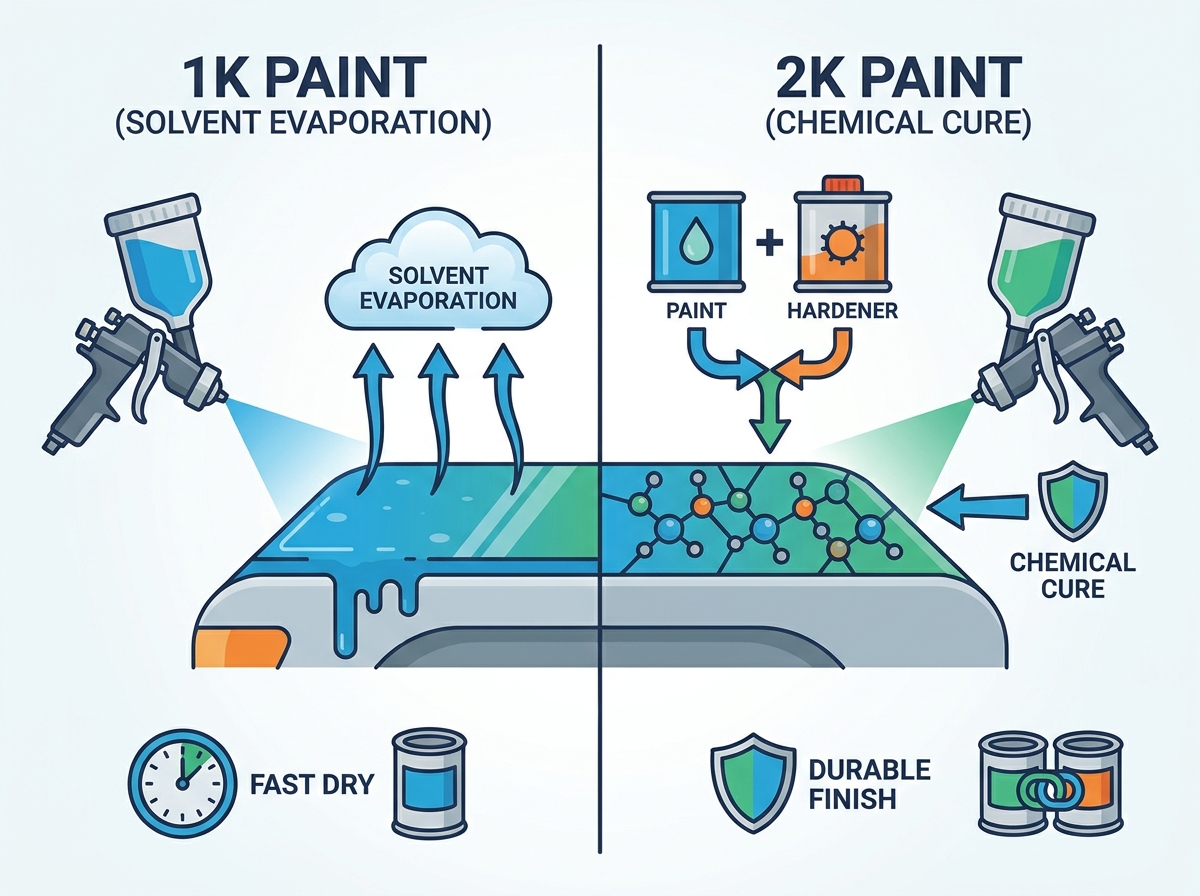
Every automotive restoration, collision repair, or DIY project faces a critical decision point. You must balance fast application speed against long-term finish durability. Often, this choice hinges entirely on the paint chemistry you select. A one-component system requires no activator or hardener. It dries exclusively through solvent evaporation. This creates a vastly different workflow compared to chemically cured two-part systems.
Choosing the right 1K Car Paint requires you to carefully align your project requirements. You must evaluate your available timeline, budget, and spray equipment. Then, you need to weigh those factors against the distinct chemical and physical limitations of a one-component system. We will explore how these single-component paints work at a molecular level. We will also examine where they excel in practical applications and how you can avoid common finishing mistakes.
Key Takeaways
- 1K car paint dries through solvent evaporation, eliminating the need for a separate activator or hardener.
- It offers superior convenience and a longer pot life but sacrifices the chemical and UV resistance found in 2K paints.
- Ideal applications include minor touch-ups, interior components, door jambs, and budget-conscious cosmetic repairs.
- Buyers must evaluate technical specifications like flash times, VOC compliance, and topcoat compatibility before committing to a 1K system.
- Proper surface preparation and strict adherence to recoat windows are non-negotiable to prevent wrinkling and lifting.
Understanding 1K Car Paint: Chemistry and Mechanics
The Evaporation Process
You must understand how these systems transition from liquid to solid. One-component paints do not undergo cross-linking. Cross-linking is a chemical reaction. It typically occurs when you mix a resin and a hardener. Instead, a single-component system relies strictly on evaporation. The manufacturer suspends solid paint pigments and binders in liquid solvents. When you spray the material, those thinners and solvents flash off into the air. The remaining solids interlock on the panel. This leaves behind the final color coat. Drying time depends entirely on air movement and ambient temperature.
Format Availability
Manufacturers deliver these paints in highly convenient formats. Professional body shops often buy ready-to-spray (RTS) quarts or gallons. You can pour RTS products directly into an HVLP (High Volume Low Pressure) spray gun. You do not need to measure reducers. Many brands also package these products in pre-mixed aerosol cans. Aerosols provide an excellent solution for mobile repair technicians. They also empower home hobbyists who lack dedicated air compressors. Both formats utilize the exact same evaporation mechanics.
Re-solubility Factor
One major limitation requires your attention. A one-component finish remains soluble indefinitely. It never achieves a permanent chemical cure. If you wipe a fully dried panel using strong solvents like lacquer thinner, the surface will reactivate. The solvent dissolves the binders. The color will wipe off onto your rag. This re-solubility dictates how you maintain the vehicle later. You must keep harsh chemicals away from unprotected single-component finishes. Otherwise, the coating will quickly degrade.
![1K car paint application and professional automotive touch up techniques]()
1K vs. 2K Automotive Paint: Evaluating the Trade-Offs
Durability and Hardness
You must compare mechanical strength before choosing your materials. Single-component products are inherently softer. They suffer from chipping and scratching much faster than catalyzed two-part systems. A 2K product utilizes a hardener. This creates a dense, interlocking polymer matrix. It deflects road debris easily. Conversely, evaporation-based paints yield a flexible but vulnerable film. You should not use them on high-impact areas like front bumpers unless you accept frequent touch-ups.
Chemical and Environmental Resistance
Environmental factors routinely attack automotive finishes. Single-component paints show significant vulnerability here. Gasoline spills near a fuel door will stain or melt the finish. Harsh alkaline car wash soaps can dull the shine over time. Prolonged UV exposure presents another major threat. Without a protective UV-blocking two-part clear coat, these base colors often oxidize. They fade much faster than chemically cross-linked alternatives.
Workflow and Efficiency
Despite durability limitations, single-component systems dominate shop efficiency. You never calculate complex mixing ratios. You avoid the stress of short pot lives. In a two-part system, mixed material hardens inside your spray gun if you stop working. Single-component materials stay liquid in a sealed cup. You simply pour leftover material back into the tin. This eliminates wasted paint. It saves significant money on minor jobs. You gain immediate usability from the moment you open the can.
Health and Safety Compliance
Toxicity differences play a huge role in product selection. Two-part hardeners contain isocyanates. These chemicals are highly toxic. They attack the respiratory system and require supplied-air respirators. Single-component products generally lack these hazardous isocyanates. They remain safer for home garage use. However, you must still wear proper PPE. Evaporating solvents still demand a high-quality organic vapor respirator. Good ventilation remains completely non-negotiable.
Comparison Chart: Paint System Characteristics
| Feature | 1K Paint System | 2K Paint System |
| Curing Method | Solvent Evaporation | Chemical Catalyst (Hardener) |
| Mixing Required | None (Ready to use) | Yes (Precise ratios needed) |
| Pot Life | Indefinite (in sealed container) | Limited (2 to 8 hours typically) |
| Mechanical Hardness | Low to Moderate | Very High |
| Chemical Resistance | Poor (Vulnerable to solvents/fuel) | Excellent |
Critical 1K Car Paint Specifications for Buyers
Dry Times and Flash Times
Mastering flash times ensures a flawless finish. You cannot rush the evaporation timeline. The specifications generally break down into three distinct phases:
- Dust-free time: The surface usually dries to the touch in 10 to 15 minutes. Dust particles will no longer stick to the panel.
- Handle time: This varies heavily by ambient temperature. Typically, you can carefully handle the part after 30 to 60 minutes.
- Full cure: It can take several weeks for all deep solvents to escape. The film continues shrinking slightly during this extended outgassing period.
Coverage and Build
Film thickness capabilities differ greatly from catalyzed products. Single-component formulas contain high amounts of solvent. Once that solvent evaporates, very little solid material remains on the panel. You typically need more coats to achieve the same mil thickness as a high-build two-part product. If you try to spray one thick coat, you invite massive application failures. We recommend applying multiple thin coats. This strategy builds coverage safely.
VOC Compliance
You must verify local regulations before purchasing solvent-heavy materials. Volatile Organic Compounds (VOCs) contribute to air pollution. Regulatory bodies like the EPA dictate national standards. Regional agencies, such as CARB in California, enforce even stricter limits. Many traditional single-component formulas fail modern VOC tests. You might need to buy waterborne alternatives depending on your location. Always check the safety data sheet. Confirm the VOC limit matches your local laws.
System Compatibility
Primer and clear coat compatibility requires strict attention. You cannot blindly mix different paint chemistries. You can apply a strong solvent-based 2K clear coat over an uncured single-component base. However, this often causes catastrophic lifting. The aggressive solvents in the clear coat attack the soft base layer beneath it. We advise waiting for complete evaporation. Allow the base to fully flash before applying any catalyzed topcoats.
Best Use Cases: When to Specify 1K Paint
Minor Touch-Ups and Blending
These products excel during localized repairs. You often encounter rock chips or small bumper scuffs. A fast, localized fix takes priority over full-panel longevity in these scenarios. You can easily blend a single-component aerosol into the surrounding area. The thin film edge melts nicely into existing finishes. It provides a highly acceptable cosmetic repair for budget-conscious vehicle owners.
Low-Impact Automotive Components
We highly recommend these paints for protected areas. Interior trim pieces face minimal abuse. Engine bay accents perform beautifully if you select a heat-rated formula. Brackets, hinges, and trunk interiors rarely see direct sunlight. They never encounter harsh road debris. For these applications, the ease of a single-component spray far outweighs the necessity for a diamond-hard exterior shell.
Classic Car Undercarriages
Restorers frequently utilize these finishes on chassis components. Classic cars usually sit in climate-controlled garages. The undercarriage components avoid daily driving hazards. Single-component chassis black paints look authentic. Furthermore, the ease of reapplication remains unmatched. If a suspension arm gets scratched during mechanical work, you simply clean it and respray it. You avoid mixing tiny batches of catalyzed paint.
DIY and Mobile Repair
Home hobbyists heavily favor this chemistry. You do not need expensive commercial ventilation systems. You skip the bulky compressed air setups. Mobile scratch repair technicians also rely on these products. They travel from dealership to dealership. They need to set up quickly. They repair minor lot damage in minutes. Single-component aerosols and touch-up bottles make this rapid workflow entirely possible.
Application Risks and Implementation Realities
Solvent Trap and Shrinkage
You risk trapping solvents if you apply coats too heavily. When you spray a thick layer, the top surface dries quickly. It forms a skin. The solvents trapped underneath cannot escape easily. Eventually, they force their way out over weeks or months. This causes the entire paint film to shrink dramatically. We call this phenomenon die-back. Die-back reveals deep sanding scratches. It destroys the smooth gloss you initially achieved.
The "Wrinkle" Effect (Lifting)
Missing your recoat window brings severe consequences. Every manufacturer specifies exact recoat times. You must spray the next coat within minutes, or wait several days. If you apply additional coats at the wrong time, the fresh solvents soak downward. They reactivate the semi-dried layers beneath them. The layers swell at different rates. The entire finish suddenly wrinkles like a prune. You must strip the panel to bare metal if this occurs.
Adhesion Failures
Mechanical adhesion keeps the coating attached to your car. These paints lack the chemical bite found in catalyzed epoxy primers. They cannot etch themselves into bare steel. You must provide a physical scratch profile. We recommend precise scuffing using 400 to 600 grit sandpaper. Following the sanding phase, thorough degreasing becomes mandatory. Any lingering wax or finger oils will completely block adhesion. The paint will peel off in large sheets later.
Conclusion
Single-component systems deliver a highly efficient, user-friendly solution for automotive painting. They simplify the process entirely. You avoid mixing ratios, toxic hardeners, and wasted materials. However, you must accept their inherent limitations regarding mechanical hardness and chemical resistance. They work flawlessly for protected components and rapid cosmetic touch-ups.
Base your final purchase decision on logical parameters. Evaluate your durability requirements first. Then, look at your applicator equipment level. Finally, check your local VOC laws. If the project demands maximum UV protection on an exterior hood, reconsider your choice. If you just need to detail a trunk interior, this chemistry fits perfectly.
Take actionable next steps before spraying your project. We highly recommend purchasing a compatible 1K primer first. Prepare a scrap piece of metal. Test your colors on this sample panel. This practice verifies your flash times in your specific garage temperature. It also confirms your color match. It ensures you understand the evaporation mechanics before touching your actual vehicle.
FAQ
Q: Can you put a 2K clear coat over a 1K base coat?
A: Yes, this is standard in many base/clear systems. However, the base must be fully flashed. All solvents must evaporate completely. If you rush, the aggressive solvents in the 2K clear will wrinkle the softer base beneath it.
Q: How long does 1K car paint last?
A: Longevity depends entirely on UV exposure and clear coat protection. A standalone single-component finish on an exterior panel may fade or degrade within 2 to 4 years. Conversely, interior applications can easily last the lifetime of the vehicle.
Q: Does 1K paint need a primer?
A: Yes, especially for bare metal or plastic. This paint chemistry requires a properly prepped surface. You must use a compatible primer to ensure strong mechanical adhesion. It lacks the chemical etching power to bond directly to slick substrates.
Q: Why is my 1K paint easily scratching off?
A: This usually indicates insufficient surface prep. You likely skipped sanding or degreasing. It also happens if you apply it over an incompatible substrate. Alternatively, the paint has not yet fully dried and outgassed, leaving it temporarily soft.
Q: Is 1K paint fuel resistant?
A: Generally, no. Spilling gasoline or brake fluid on this finish will likely stain, soften, or dissolve it entirely. Because it dries via evaporation and lacks a chemical cure, aggressive solvents easily reactivate the binders.