Achieving a flawless automotive finish relies heavily on selecting the right materials. At the foundation of many refinishing projects lies one-component paint. Industry experts commonly define it as a ready-to-use coating. It cures entirely through solvent evaporation rather than a chemical catalyst. Professionals and DIY enthusiasts frequently face a difficult dilemma in the mixing room. They must choose between the unmatched convenience of single-component systems and the robust durability of catalyzed systems. Making an uninformed choice often ruins hours of meticulous prep work.
This guide provides an evidence-based framework to help you navigate this critical decision. You will learn how to evaluate when these specific formulations serve as the optimal choice. We will explore project scope, upfront cost tolerances, and specific application environments. Understanding these factors ensures your next automotive paint job succeeds.
Key Takeaways
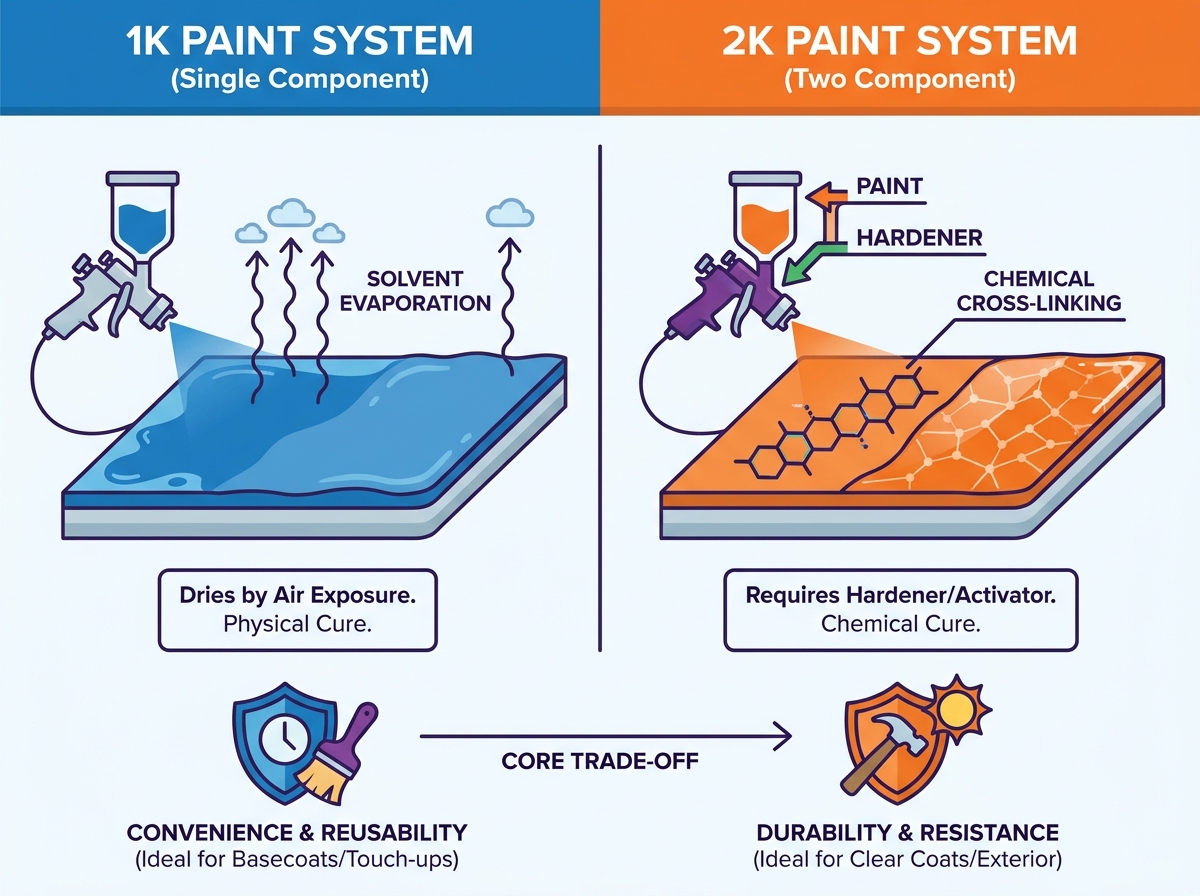
- Definition: 1K paint requires no hardener or activator; it dries naturally as solvents evaporate into the air.
- Primary Use Case: Best suited for basecoats, color-matching, minor touch-ups, and interior automotive panels where high chemical resistance is not strictly required.
- Core Trade-off: Offers unmatched convenience, ease of use, and longer pot life at the expense of maximum UV resistance and structural hardness compared to 2K paints.
- Compatibility Risk: Layering 2K clear coats over 1K basecoats requires strict adherence to flash-off times to prevent solvent entrapment and wrinkling.
The Mechanics of 1-Component (1K) Systems
Understanding the physical behavior of your materials prevents costly application mistakes. Let us explore how these single-component systems actually work on a chemical level.
Curing via Evaporation vs. Catalyzation
The physical drying process defines single-component paints. Once you expose the liquid mixture to air, the carrying solvents begin to flash off. They evaporate rapidly into the surrounding atmosphere. This evaporation leaves the solid resin and pigment behind on the body panel. No chemical cross-linking occurs during this phase. The paint simply dries as the liquid carrier disappears. You can contrast this directly with catalyzed systems. Two-component products require a hardener to trigger a permanent chemical reaction. Because single-component products rely solely on evaporation, they remain susceptible to re-wetting if exposed to strong solvents later.
Shelf Life and Pot Life Realities
Operational advantages heavily favor single-component systems. They offer an incredibly forgiving pot life. You can open a premixed quart, pour exactly what you need, and seal the container securely. The remaining product stays fresh for months. It will not harden inside the closed can. Aerosol cans excel in this specific category. You simply clear the spray nozzle after use and store it safely on a shelf. Conversely, two-component products harden rapidly once mixed. You must discard any unused catalyzed material. This reusability makes single-component options highly attractive for intermittent touch-up work.
Environmental & Safety Baselines
Safety remains paramount in any painting environment. Volatile Organic Compounds (VOCs) release heavily into the air during the evaporation phase. You must establish strict safety baselines in your garage or shop. Many users mistakenly believe single-component products pose no respiratory danger. They lack the highly toxic isocyanates typically found in catalyzed hardeners. However, the evaporating solvents still present severe health risks. You must wear a high-quality respirator. Proper ventilation in your workspace remains strictly necessary. You must protect your lungs and skin regardless of the underlying paint chemistry.
![Automotive paint application process in a professional spray booth]()
1K vs. 2K Car Paint: Core Evaluation Criteria
Selecting the right material requires comparing specific performance metrics carefully. Let us evaluate the core differences determining your project's success.
Performance Comparison: 1-Component vs. 2-Component Systems
| Feature/Metric | 1-Component (Evaporation Cure) | 2-Component (Chemical Cure) |
| Curing Method | Solvent evaporation only | Chemical cross-linking via hardener |
| Chemical Resistance | Low (vulnerable to gas, brake fluid) | High (resists harsh automotive fluids) |
| Application Difficulty | Very easy (ready-to-spray) | Moderate (requires precise mixing ratios) |
| Pot Life | Extended (can be resealed and reused) | Short (hardens in the cup within hours) |
Durability and Chemical Resistance
Catalyzed systems form dense, cross-linked polymers during their chemical cure. This reaction creates an incredibly tough outer shell. Single-component finishes remain significantly softer by comparison. Their resins sit on the surface rather than chemically locking together. You must assess your specific environment carefully. Automotive fluids pose a massive threat to softer finishes. Gasoline spills and brake fluid will quickly eat through an unsealed single-component layer. Harsh shop degreasers dissolve them rapidly. UV degradation also breaks down these unprotected pigments much faster over time.
Application Complexity and Turnaround Time
Convenience heavily favors single-component products. Their ready-to-spray efficiency eliminates complex preparation steps entirely. You skip the tedious process of measuring mixing ratios. This simplicity dramatically reduces human error in the mixing room. Incorrect hardener ratios ruin countless paint jobs every year. Turnaround time decreases rapidly for quick touch-ups. You can grab an aerosol can and finish a minor repair in minutes. Cleaning heavy spray gun equipment becomes completely unnecessary for small tasks.
Cost Efficiency for Short-Term vs. Long-Term ROI
Consider your upfront budget and overall project goals. You certainly save money initially using single-component materials. They cost less per ounce. Your equipment needs are considerably lower. However, you must factor in long-term ROI. High-wear exterior areas degrade rapidly without catalyzed protection. Upfront savings quickly vanish if you must repaint a fading bumper every two years. Calculate the actual value of your labor. Reapplications cost valuable time. Weigh initial affordability against the long-term necessity of repeated maintenance.
Ideal Applications: When to Choose 1K Car Paint
Knowing exactly where to apply these products maximizes their value. High-quality 1K Car Paint excels brilliantly in very specific scenarios.
Basecoats and Color Layers
The automotive refinishing industry relies heavily on single-component formulations for color application. It serves as the undisputed industry standard for basecoats. You lay down the brilliant pigment first. This layer provides the visual color before you seal it. A durable catalyzed clear coat then handles the environmental protection. The single-component base flashes off quickly. It lays flat and smooth across the panel. It provides the perfect, predictable foundation for the final glossy topcoat.
Touch-ups and Smart Repairs
Minor scratches and localized bumper scuffs rarely warrant a full spray gun setup. Single-component aerosol usage shines brilliantly here. Smart repairs blend small panel areas quickly. You avoid mixing tiny batches of catalyzed clear. Setting up an air compressor and cleaning guns feels economically unviable for a two-inch scratch. Aerosols deliver excellent atomization for these micro-repairs. You achieve acceptable visual blending while keeping repair costs incredibly low.
Interior Components and Engine Bays
Not every car part faces harsh weather conditions. Interior door panels and dashboard trims remain entirely shielded from direct UV rays. Engine bays stay protected under the heavy metal hood. They rarely see road salt or direct sunlight. The structural durability constraints become negligible in these sheltered environments. You get excellent color matching. You easily avoid the overkill of mixing expensive catalyzed products for hidden brackets.
The Limitations and Implementation Risks of 1K Systems
Every material possesses inherent weaknesses. Understanding these specific limitations prevents catastrophic paint failures.
The "Clear Coat" Constraint
Professionals firmly warn against using single-component clear coats on exterior panels. High UV radiation tears down these un-catalyzed layers rapidly. Mechanical abrasion from automatic car washes dulls the finish almost immediately. Moving parts like hoods and roofs absorb intense heat. They will oxidize, turn yellow, and peel much faster than catalyzed clear coats. You should strictly reserve these clears for door jambs, interior trims, or display models.
Shrinkage and Sanding Limitations
Solvent evaporation causes the film thickness to shrink significantly as it dries. This mil-build shrinkage occurs slowly over several weeks. It often reveals underlying sanding scratches you thought you filled. Wet-sanding these systems proves highly difficult. The softer layer tends to gum up your sandpaper quickly. It rolls into tiny abrasive pills. Machine polishers easily generate too much heat. The resulting friction burns straight through the thin coat, destroying your repair completely.
Sensitivity to Weather Conditions
Ambient climate dictates your evaporation success heavily. High humidity traps moisture in the surrounding air. This moisture interferes directly with the drying process. Extreme cold dramatically slows the evaporation rate to a crawl. These rapid weather shifts cause severe visual defects. You might experience solvent pop, where trapped gas bursts through the surface. You might see blushing, leaving a milky, cloudy haze on your finish. Controlling your booth temperature remains absolutely vital.
System Compatibility: Can You Spray 2K Over 1K Paint?
Mixing different chemical families always introduces risk. You must navigate layering carefully to avoid disaster.
The "Wrinkling" Risk
A highly active catalyzed solvent attacks uncured base layers aggressively. This chemical bite causes a rapid, violent reaction. The underlying paint lifts away from the primer. It wrinkles heavily, resembling crumpled tissue paper. Painters often describe this as "frying" the underlying paint. The strong solvents in the topcoat essentially dissolve the weaker single-component layer beneath it.
Best Practices for Layering
You must follow a strict risk mitigation framework when mixing systems. Implement these steps carefully to ensure success:
- Ensure the basecoat is one hundred percent fully flashed off and outgassed.
- Allow double the recommended drying time if working in cooler temperatures.
- Apply a very light initial "tack" coat of the catalyzed topcoat.
- Let this tack coat flash off completely to build a physical chemical barrier.
- Apply your subsequent medium-wet coats only after the barrier sets firmly.
Rushing the first wet coat guarantees a wrinkling disaster.
Isolation Layers
Unknown existing paint jobs pose massive compatibility risks. You rarely know what the previous owner sprayed. You need specific barrier primers in these uncertain situations. High-quality 1K Car Paint sealers act as excellent isolation layers. They lock down the unknown, sensitive layers below. They prevent the aggressive topcoat solvents from penetrating downward. Using a dedicated sealer prevents adverse reactions before you commit to spraying expensive color coats.
Conclusion
Single-component auto paint serves as an indispensable tool in any modern shop. It excels brilliantly for base-coloring and low-impact localized repairs. It delivers unmatched convenience and speed. However, it cannot substitute catalyzed coatings when structural durability defines your success metric. Take action by assessing your current project needs carefully. If you are painting a basecoat or an interior bracket, proceed confidently with single-component systems. If you are applying a final protective clear coat to an exterior panel exposed to the elements, upgrade to a catalyzed system immediately. Match your chemistry to your environment for lasting results.
FAQ
Q: How long does 1K car paint take to dry?
A: Surface dry times typically range from 15 to 30 minutes, depending on the brand. However, full outgassing takes significantly longer. It can take several hours to a few days for all solvents to evaporate completely. Ambient temperature heavily impacts this process. Warmer, dry conditions accelerate evaporation, while cold or humid environments delay it.
Q: Do I need a respirator for 1K spray paint?
A: Yes. You absolutely need a high-quality respirator. While single-component paints do not contain highly toxic isocyanates found in catalyzed hardeners, they release harmful aerosolized solvents and particulates. Proper PPE protects your lungs from these dangerous volatile organic compounds during application and drying.
Q: Can I clear coat over 1K paint?
A: Yes. Single-component basecoats are specifically designed to be clear-coated. The most important factor is observing proper flash times. You must allow the basecoat to outgas completely before applying the clear coat. Applying clear too early traps solvents, leading to wrinkling or solvent pop.
Q: Is 1K paint fuel resistant?
A: No. Single-component paint lacks chemical cross-linking, making it highly susceptible to automotive fluids. Gasoline will quickly dissolve or stain an unprotected layer. You should strictly avoid using it around gas caps or motorcycle tanks unless you seal it thoroughly with a fuel-resistant catalyzed topcoat.