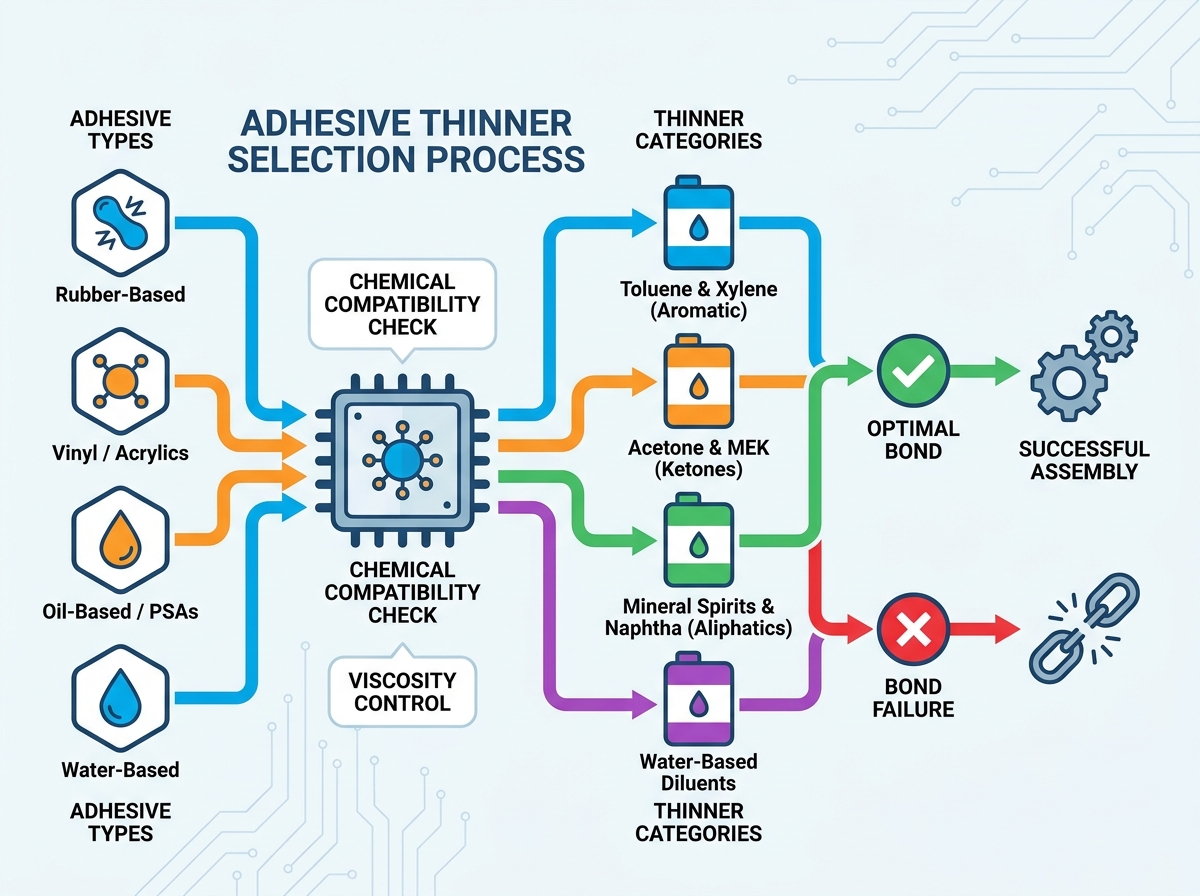
Unregulated viscosity in adhesives creates massive production bottlenecks. It leads to inconsistent application, poor bonding, and severe equipment clogs. Selecting the wrong solvent compromises the chemical structure of your adhesive. You risk bond failure, extended cure times, and serious safety compliance liabilities. We provide a definitive framework for evaluating and applying these chemical agents. You will learn how to optimize production efficiency while maintaining structural integrity and strict safety standards. By understanding how different solvent bases interact with specific polymers, you can prevent coagulation and ensure durable bonds. We will explore chemical compatibility, evaporation rates, and rigorous testing protocols to safeguard your production line.
Key Takeaways
- Matching the solvent base of the adhesive thinner to the specific adhesive polymer (e.g., polyurethane, epoxy, rubber) is critical to prevent coagulation and bond degradation.
- Evaporation rates dictate application methods; fast-evaporating thinners suit spray applications, while slow-evaporating variants are better for brushing and rolling.
- Over-thinning reduces the solid content of the adhesive, directly impacting the final load-bearing capacity and durability of the bond.
- Compliance with local VOC (Volatile Organic Compound) regulations and facility safety capabilities must strictly guide the procurement process.
The Role of Adhesive Thinner in Production and Assembly
Manufacturers often face viscosity challenges when adapting adhesives for various application methods. You cannot simply force a thick adhesive through a fine spray nozzle. It requires precise modification. This is where chemical diluents become invaluable for modern assembly lines.
Viscosity Control
Lowering viscosity is the primary reason facilities modify adhesives. It enables uniform spray applications, seamless automated dispensing, and finer brush coats. A properly thinned mixture maintains the fundamental properties of the base polymer. It alters only the flow characteristics. You achieve better coverage rates without compromising the ultimate tensile strength of the cured bond. This precise flow control minimizes material waste and ensures consistent adhesive film thickness across large surface areas.
Substrate Penetration
Porous materials demand deep penetration for optimal mechanical interlocking. Wood, unglazed ceramics, and certain fibrous composites require the adhesive to flow into microscopic crevices. Modifying the viscosity improves the wetting out process. It allows the liquid polymer to saturate the substrate surface thoroughly. The resin locks into the cellular structure of the material once the solvent evaporates. This creates a mechanical bond far stronger than a mere surface attachment.
Equipment Maintenance
Production equipment requires constant upkeep to prevent costly downtime. A high-quality Adhesive thinner serves a dual purpose on the factory floor. It acts as an aggressive line-flushing agent and an effective tool cleaner. Pumping the correct solvent through automated dispensing lines prevents cross-linking inside hoses and nozzles. It clears residual resins before they cure. This proactive maintenance prevents cross-contamination between different adhesive batches and significantly extends the lifespan of expensive dispensing hardware.
The Vital Distinction: Thinning vs. Stripping
Many operators confuse thinners and removers, leading to disastrous production errors. A thinner is formulated to integrate seamlessly into the liquid adhesive. It dilutes the mixture without breaking the polymer chains. Conversely, a stripper or remover contains aggressive chemicals designed to attack and break down fully cured chemical bonds. Using a stripper as a diluent will destroy the structural integrity of your adhesive, rendering it completely ineffective.
Solution Categories: Matching Thinner to Adhesive Chemistry
Chemical compatibility dictates the success of any dilution process. Mismatching solvent families causes immediate precipitation, where the solid resins fall out of suspension. You must pair the solvent base precisely to the adhesive polymer. Industry standards classify these solutions into four primary chemical families.
Toluene & Xylene (Aromatic Hydrocarbons)
Aromatic hydrocarbons deliver exceptional solvency power. They aggressively dissolve complex polymer structures. They are best for rubber-based adhesives, contact cements, and tough silicone sealants. However, they demand intense scrutiny regarding facility safety. Toluene and xylene carry high flammability ratings and pose significant health risks upon inhalation. They require strict ventilation protocols, explosion-proof extraction systems, and comprehensive personal protective equipment (PPE).
Acetone & MEK (Ketones)
Ketones represent the fast-acting segment of chemical diluents. Acetone and Methyl Ethyl Ketone (MEK) exhibit extremely fast evaporation rates. They are best for vinyl, acrylics, and certain epoxy resins. Their rapid flash-off time makes them excellent for high-speed spray applications. However, they present unique environmental challenges. Fast evaporation cools the surrounding substrate rapidly. This temperature drop often pulls moisture from the air, causing "blushing" or micro-condensation on the adhesive surface in high-humidity environments.
Mineral Spirits & Naphtha (Aliphatics)
Aliphatic solvents offer a more controlled, slower evaporation profile. They are less aggressive than ketones or aromatics. They are best for oil-based synthetics and pressure-sensitive adhesives (PSAs). Their slower evaporation rate extends the open time of the adhesive, allowing manual adjustments before mating parts. Furthermore, mineral spirits emit a lower odor profile. They are generally safer for manual applications and brushing techniques in moderately ventilated spaces.
Water-Based Diluents
Environmental regulations have pushed many industries toward aqueous systems. Water-based diluents are best for Polyvinyl Acetate (PVA), aqueous polyurethanes, and acrylic dispersions. When thinning these systems, you cannot use standard tap water. It contains trace minerals and salts that disrupt the polymer emulsion. You strictly require deionized or distilled water to prevent mineral contamination. These diluents are strictly reserved for water-borne adhesive systems.
| Chemical Family | Common Solvents | Best Suited For | Evaporation Profile | Primary Considerations |
| Aromatic Hydrocarbons | Toluene, Xylene | Rubber, Contact Cements, Silicones | Moderate to Fast | High solvency power; requires strict PPE and ventilation due to flammability. |
| Ketones | Acetone, MEK | Vinyl, Acrylics, Epoxies | Extremely Fast | Ideal for spray systems; high risk of moisture blushing in humid conditions. |
| Aliphatics | Mineral Spirits, Naphtha | Oil-based, PSAs | Slow | Extended open times; safer handling profile for manual applications. |
| Aqueous Systems | Deionized Water | PVA, Aqueous Polyurethanes | Very Slow | Zero VOCs; highly susceptible to mineral contamination from untreated tap water. |
![Adhesive thinner application]()
Evaluation Criteria: A Procurement Framework
Procuring the correct solvent requires more than checking the price per gallon. It demands a rigorous technical evaluation. You must align chemical properties with your specific production environment, local laws, and performance standards.
Chemical Compatibility (TDS Verification)
Never rely on guesswork when mixing chemicals. Always begin by cross-referencing the Technical Data Sheet (TDS) of the base adhesive. The manufacturer explicitly lists approved solvent bases. Using an unapproved chemical can permanently disrupt the cross-linking agents or deactivate the curing mechanism. The TDS verification process guarantees the solvent will blend seamlessly without degrading the polymer matrix.
Evaporation Rate (Flash-Off Time)
The solvent's flash-off time must perfectly align with your production cycle times. You face a delicate balancing act. Fast evaporation speeds up production throughput but severely limits open time. Operators must assemble parts immediately. Conversely, slow evaporation requires longer clamping and pressing times. It delays downstream processing. Measure your facility's ambient temperature and choose a solvent matching your required assembly window.
Safety and Environmental Compliance
Regulatory adherence is non-negotiable. You must evaluate flash points and OSHA handling requirements before introducing any volatile chemical. Local VOC emission limits heavily influence procurement. Agencies like the EPA or CARB enforce strict caps on atmospheric emissions. Select solvents keeping your facility safely below legal thresholds. Investigate exempt solvents if local regulations restrict traditional aromatics or ketones.
Impact on Solid Content
Adding liquid diluents directly reduces the solid content ratio of your adhesive mixture. High dilution requires applying more total fluid to achieve the necessary dry film thickness (DFT). You must calculate the exact yield ratio. If you dilute a 50% solids adhesive by 20%, you leave significantly less resin on the substrate after evaporation. Operators must calibrate spray equipment to apply heavier wet coats to compensate for this mathematical reduction.
Implementation Best Practices and SOPs
Translating technical specifications into floor-level procedures ensures consistency. Standard Operating Procedures (SOPs) prevent human error from compromising product quality. Implement strict guidelines for mixing, agitating, and testing your formulated compounds.
Mixing Ratios and Tolerances
Precision is paramount when altering adhesives. Facilities must adhere strictly to manufacturer volume and weight limits. Industrial guidelines typically cap solvent addition at 5% to 15% maximum by volume. Exceeding these limits compromises the resin structure. Weighing components offers greater accuracy than volumetric measuring, especially when ambient temperatures fluctuate. Standardize all measuring equipment across your facility.
Agitation Protocols
Hand stirring is insufficient for industrial-scale mixing. You must utilize mechanical mixers to ensure homogenous blending. Stratification frequently occurs if heavier solvents mix poorly with high-viscosity adhesives. The solvent floats, or the resins sink. Low-shear mechanical agitation integrates the chemicals uniformly without introducing excessive air bubbles. Ensure mixer blades reach the bottom corners of mixing vessels to prevent unmixed dead zones.
Phased Rollout & Testing Framework
Never introduce a modified compound directly into full-scale production. Implement a strict three-step validation protocol. Before integrating a new Adhesive thinner, run these crucial tests:
- Small-Batch Compatibility Testing: Mix a small sample in a clear glass container. Observe the fluid for 24 hours. Check meticulously for cloudiness, gelling, or layer separation. Any visual change indicates chemical incompatibility.
- Destructive Peel and Shear Testing: Apply the thinned mixture to actual production substrates. Cure them fully. Subject the joints to mechanical stress tests. Measure the failure point against your established quality control baselines.
- Environmental Curing Observation: Test the application under actual facility temperature and humidity conditions. Monitor the flash-off time and final cure state. Ensure environmental factors do not induce blushing or extended tackiness.
Managing Risks and Troubleshooting Failures
Even with strict SOPs, variables in the production environment can trigger failures. Recognizing the symptoms of improper dilution allows operators to correct issues before they cause massive scrap rates. You must train quality control teams to identify these three specific risks.
Risk: Over-Thinning (Starved Joints)
Operators frequently add excess solvent to make application easier. This practice creates starved joints. Adding too much liquid leaves insufficient solid resin behind after the evaporation phase. The resulting bond line lacks the polymer density required to transfer mechanical stress. The parts appear glued, but they break easily under minimal load. Always maintain the minimum required solids content to ensure a robust, durable matrix.
Risk: Solvent Entrapment
Applying thick wet coats of heavily thinned adhesive creates a dangerous trapping mechanism. The exposed surface skins over rapidly upon contact with the air. This solid film traps wet solvent underneath. As the entrapped liquid slowly attempts to vaporize, it builds pressure. This phenomenon leads to aggressive blistering, localized bubbling, or delayed delamination weeks after assembly. Apply multiple thin coats rather than one heavy coat to prevent entrapment.
Risk: Polymer Shock
Adhesives react violently to rapid thermodynamic or chemical changes. Shocking the adhesive occurs when you add cold diluents too rapidly into a dense resin matrix. The sudden change causes the polymers to precipitate, curdle, or clump into unusable masses. You cannot reverse polymer shock. The solution relies entirely on prevention. Gradually introduce the solvent at room temperature while continuously stirring the mixture. This slow integration allows the polymer chains to untangle and absorb the liquid smoothly.
Conclusion
- Sourcing and utilizing the correct adhesive thinner is not merely about achieving a workable consistency; it is a critical engineering decision that dictates product reliability and facility safety.
- Always match the chemical family of the solvent to the base polymer of the adhesive to avoid precipitation and bond failure.
- Control your mixing ratios strictly, rarely exceeding the 15% threshold, to maintain optimal solid content and load-bearing capacity.
- Review your current adhesive TDS to identify approved solvent bases before making any procurement decisions.
- Request technical consultation or sample batches from your chemical supplier before integrating a new thinner into your standard operating procedures.
FAQ
Q: Can I use any solvent to thin my adhesive?
A: No. Using an incompatible solvent can permanently destroy the adhesive's curing mechanism, cause immediate coagulation, or severely weaken the final bond. Always match the chemical family.
Q: How much adhesive thinner should I add?
A: As a general rule, add only the minimum amount necessary to achieve the desired viscosity. Most industrial guidelines suggest starting at 2-5% by volume and rarely exceeding 10-15%, unless specifically instructed by the manufacturer.
Q: Does thinning an adhesive increase its curing time?
A: Yes. Additional solvents must fully evaporate (flash off) before the adhesive can properly cure or be mated. Using a fast-evaporating thinner minimizes this delay, but environmental factors (temperature, humidity) will heavily influence the exact timeline.
Q: Can I use adhesive thinner as a surface prep cleaner?
A: Often, yes. Many adhesive thinners (like Acetone or MEK) double as excellent degreasers for substrate preparation. However, ensure the solvent completely evaporates before applying the adhesive to avoid accidental dilution at the bond line.