Industrial procurement often demands a delicate balance. Facilities require rigorous structural protection alongside highly specific visual standards. You cannot simply compromise on one to achieve the other. Off-the-shelf commercial products rarely satisfy both criteria. You need engineered industrial coatings mixed to precise aesthetic parameters. They must deliver exact hues without sacrificing corrosion resistance or durability. Standard paints simply lack the chemical resilience required for heavy-duty environments. This is why specialized formulations become necessary.
This article explores the five most critical applications for Custom color paint in industrial settings. We will look at why specific environments demand exact matching. You will learn how to balance visual standards with harsh physical realities. We also provide a comprehensive decision framework. This framework will help you evaluate batch consistency, formulation performance, and supplier capabilities. You can then make informed purchasing decisions for your facility.
Key Takeaways
- Custom color paint in industrial settings is primarily driven by regulatory compliance, 5S facility organization, and strict OEM brand guidelines—not just aesthetics.
- Evaluating custom coatings requires balancing precise color matching (measured in Delta E) with the chemical realities of epoxies, urethanes, and zinc-rich primers.
- Minimum order quantities (MOQs), batch-to-batch consistency, and environmental testing (e.g., UV degradation) are the primary risk factors when transitioning from standard to custom formulations.
1. Safety, Hazard, and OSHA Compliance Marking
Safety marking presents a major challenge in industrial spaces. Standard safety colors often fail to meet OSHA or ANSI Z535 standards. Dark substrates alter their appearance. Harsh industrial lighting also shifts how we perceive these hues. This discrepancy creates serious compliance liabilities. If an inspector deems a hazard marking unclear, your facility faces fines. You need exact matching to ensure universal recognition of hazards.
Evaluating these coatings requires careful attention to opacity and hide. You must look at the coating's ability to achieve true color. It should do this without requiring excessive coats. Applying five layers of standard yellow over industrial gray steel wastes time. It also wastes labor. A properly formulated Custom color paint provides high-hiding pigments. Standardization is another critical dimension. You must match exact RAL or federal standard color codes across different resin types. For example, a facility might need an epoxy for the floor. They might need a polyurethane for the wall. The safety yellow must match perfectly across both materials.
Implementation comes with distinct risks. UV fading in safety yellows and reds is common. It can cause a facility to fall out of compliance over a short period. We typically see this happen within three to five years. Sun exposure degrades standard pigments rapidly. To prevent this, always specify UV-stable topcoats. Aliphatic polyurethanes offer excellent resistance to this type of degradation.
![Industrial equipment painting and customization process]()
2. OEM Heavy Machinery and Fleet Standardization
Original Equipment Manufacturers (OEMs) face unique branding hurdles. Logistics fleets share this problem. They require exact corporate color matching across varied substrates. You might paint steel, aluminum, and fiberglass in the same assembly run. Furthermore, manufacturers build these components in different facilities. A tractor hood made in Ohio must match a chassis painted in Texas. Any visual mismatch harms brand perception immediately.
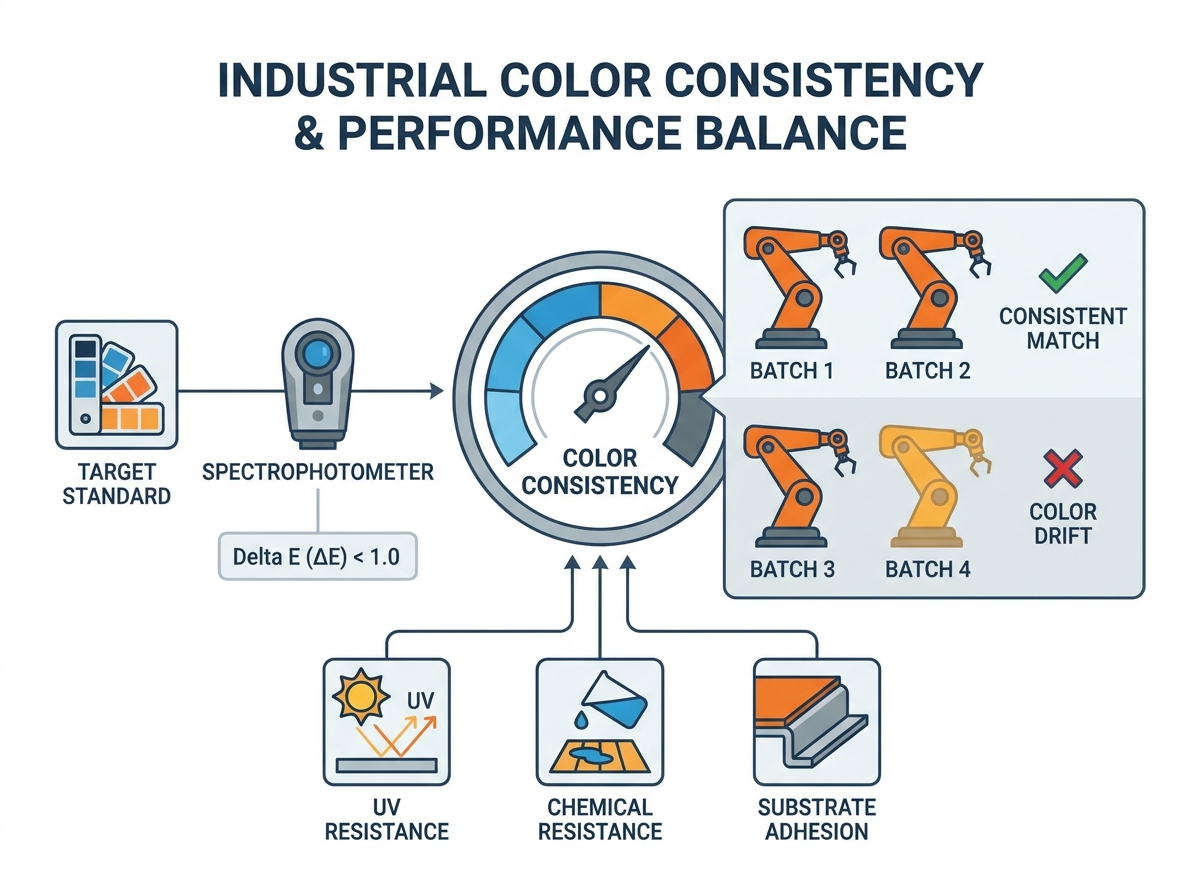
Batch-to-batch consistency stands out as an essential metric. Assembly lines require frequent touch-ups. Success here relies on precise scientific measurement. The industry defines this using a Delta E (ΔE) color variance. A Delta E of less than 1.0 is generally invisible to the naked eye. Performance outcomes also matter heavily. The coating must maintain color integrity under extreme duress. Heavy machinery faces gravel impact. It suffers operational wear. It endures hydraulic fluid spills. The paint system must resist all these forces.
Substrate absorption rates frequently change color perception. This is a massive implementation risk. A porous fiberglass panel absorbs resin differently than cold-rolled steel. Custom formulations must account for the specific primer being used. They must adjust for the underlying material.
Table 1: Influence of Substrate on Perceived Match
| Substrate Type | Absorption Characteristic | Mitigation Strategy for Accurate Matching |
| Cold-Rolled Steel | Low absorption, highly reflective | Apply high-build epoxy primer to standardize surface texture. |
| Fiberglass / Composites | Variable absorption, micro-porous | Use a dedicated surfacer/sealer prior to topcoat application. |
| Aluminum | Zero absorption, prone to oxidation | Utilize wash primers or chromate-free etching primers first. |
3. 5S Lean Manufacturing and Wayfinding Systems
High-traffic industrial floors require intuitive zoning. You need color-coded areas for forklift lanes. Pedestrian walkways must stand out visually. Staging areas require clear boundaries. This level of organization optimizes workflow. More importantly, it ensures facility safety. Relying on basic tape often fails. Heavy machinery tears up tape within weeks. A permanent, specialized coating serves as the best solution.
To implement an effective 5S system, you must evaluate chemical and tire resistance. Floor coatings are usually epoxies or polyaspartics. They must resist hot-tire pickup. When a forklift stops, the heat from its tires can melt standard paints. The coating must also survive chemical spills without the pigment degrading. Scalability represents another critical evaluation dimension. You might need to reorder the exact custom formulation two years later. Facility expansions or localized repairs require perfect matching. You want to avoid visual patching that ruins the clean 5S aesthetic.
Here is a typical 5S color zoning structure used in modern facilities:
- Traffic Yellow: Aisles, pedestrian walkways, and forklift traffic lanes.
- Danger Red: Scrap areas, defect zones, and fire equipment clearances.
- Safety Green: First aid stations, eye wash areas, and secure staging zones.
- Alert Orange: Machine guarding clearances and energized equipment boundaries.
Adding slip-resistant aggregates creates a hidden implementation risk. Aggregates alter light refraction. This changes the perceived shade of the final cure. A vibrant yellow might look dull once silica sand mixes in. Formulations must undergo testing with the aggregate included.
4. Municipal and Critical Infrastructure Integration
Bridges, water towers, and storage tanks present massive engineering challenges. These structures must adhere to local municipal aesthetic guidelines. Sometimes, they need to blend into natural landscapes. A water tower in a forested area might require a highly specific woodland green. Simultaneously, these assets require extreme anti-corrosive properties. They face harsh weather year-round.
Resin compatibility dictates the success of these projects. You must ensure that custom tinting does not compromise the base. Industrial moisture-cured urethanes rely on complex cross-linking. Fluoropolymers provide massive protective barriers. The wrong tinting agent will destroy these chemical bonds. Longevity also drives the evaluation process. The coating must provide 15 to 20 years of color retention. It must survive in C4 or C5 corrosive environments. This extended durability justifies the initial investment in a custom-batch formulation.
Pigment separation poses a massive implementation risk. This happens during storage or application. High-performance industrial bases are notoriously difficult to tint evenly. Field-tinting often leads to disastrous, streaky results. Factory-tinting is almost always required. A controlled factory environment ensures optimal dispersion of the pigment.
5. Proprietary Anti-Counterfeiting and Asset Tracking
Manufacturers of high-value industrial components face a growing threat. Supply chain counterfeiting destroys profit margins. It also creates dangerous warranty fraud. Specialized pipe fittings or pressure valves often look identical to cheap knock-offs. When a counterfeit valve fails in a pipeline, the original manufacturer often takes the blame. You need a verifiable way to prove component authenticity.
This is where Custom color paint evolves into a security tool. Evaluation focuses heavily on embedded security features. Suppliers integrate proprietary UV-reactive pigments into the batch. They might add micro-taggants or highly specific metallic flakes. Counterfeiters find it impossible to replicate these elements using off-the-shelf products. Authentication becomes seamless for your team. Field inspectors can visually verify authentic parts. They simply use UV lights or specialized lenses to check the controlled, non-commercial formulations.
These complex formulations carry significant implementation risks. They frequently require strict application environments. Temperature and humidity controls must remain exact. If the environment fluctuates, the security pigments might not cure correctly. If they fail to cure, they remain unverifiable in the field.
Specifying Custom Industrial Paint: The Buyer’s Evaluation Framework
Choosing the right supplier dictates the success of your custom coating project. You cannot simply hand over a color chip and hope for the best. You need a structured evaluation framework.
First, assess supplier capabilities rigorously. Ask technical questions. Do they utilize advanced spectrophotometers for exact matching? A visual match under office lighting will fail in the field. Can they provide lab-verified drawdowns before large-scale production? You should always demand a physical sample on your specific substrate.
Next, understand MOQs and lead times. Custom batches require significant formulation and testing time. Minimum order quantities vary wildly between manufacturers. Evaluate whether the supplier can support both large initial runs and smaller maintenance touch-up batches. Economical touch-up batches save facilities from massive future headaches.
Here are several testing and validation requirements you should enforce:
- Salt Spray Testing: Request documentation on ASTM B117 results specifically for the tinted batch.
- Accelerated Weathering: Demand QUV testing to ensure the specific pigment will not fade prematurely.
- Adhesion Testing: Verify that the tinting process has not altered the primer's ability to bond to the substrate.
Conclusion
Specifying precise hues in industrial environments demands a balance of rigorous structural protection and exact visual science. It goes far beyond simple aesthetics. From OSHA compliance to supply chain security, specialized formulations solve complex operational problems.
Partnering with the right manufacturer makes all the difference. You must work with a supplier that controls both the resin technology and the pigment dispersion. This control guarantees that chemical resistance remains intact after tinting. It also ensures long-term consistency across different batches.
Your next step should focus on validation. We recommend you request a physical drawdown sample from your supplier. Schedule a lab consultation to test color accuracy directly against your facility's requirements. Test substrate adhesion thoroughly before committing to a full production run.
FAQ
Q: Does tinting an industrial paint affect its protective qualities?
A: Yes, improper tinting can severely compromise a coating's chemical resistance and durability. Field tinting often introduces incompatible solvents or breaks cross-linking bonds. We strongly recommend factory tinting. Manufacturers ensure that the specific pigment dispersion seamlessly integrates with the base resin without sacrificing protective properties.
Q: What is the standard lead time for a custom color industrial batch?
A: Lead times typically range from 2 to 6 weeks. The exact timeline depends heavily on the resin type and the matching complexity. Standard epoxies might process faster, while highly specialized fluoropolymers or UV-reactive security batches require extensive lab validation before production.
Q: How do manufacturers ensure color consistency across different orders?
A: Manufacturers utilize digital spectrophotometry to match hues mathematically. They establish strict Delta E (ΔE) tolerances, usually keeping variations below 1.0. Additionally, quality control teams retain wet and dry batch samples from every order to physically verify consistency against future maintenance runs.
Q: Can high-temperature or fire-retardant paints be custom colored?
A: Yes, but with strict technical limitations. High-heat applications restrict pigment availability because many organic pigments suffer thermal degradation at extreme temperatures. Fire-retardant intumescent coatings also have limited tint bases to ensure the chemical reaction required for fire expansion remains unhindered.