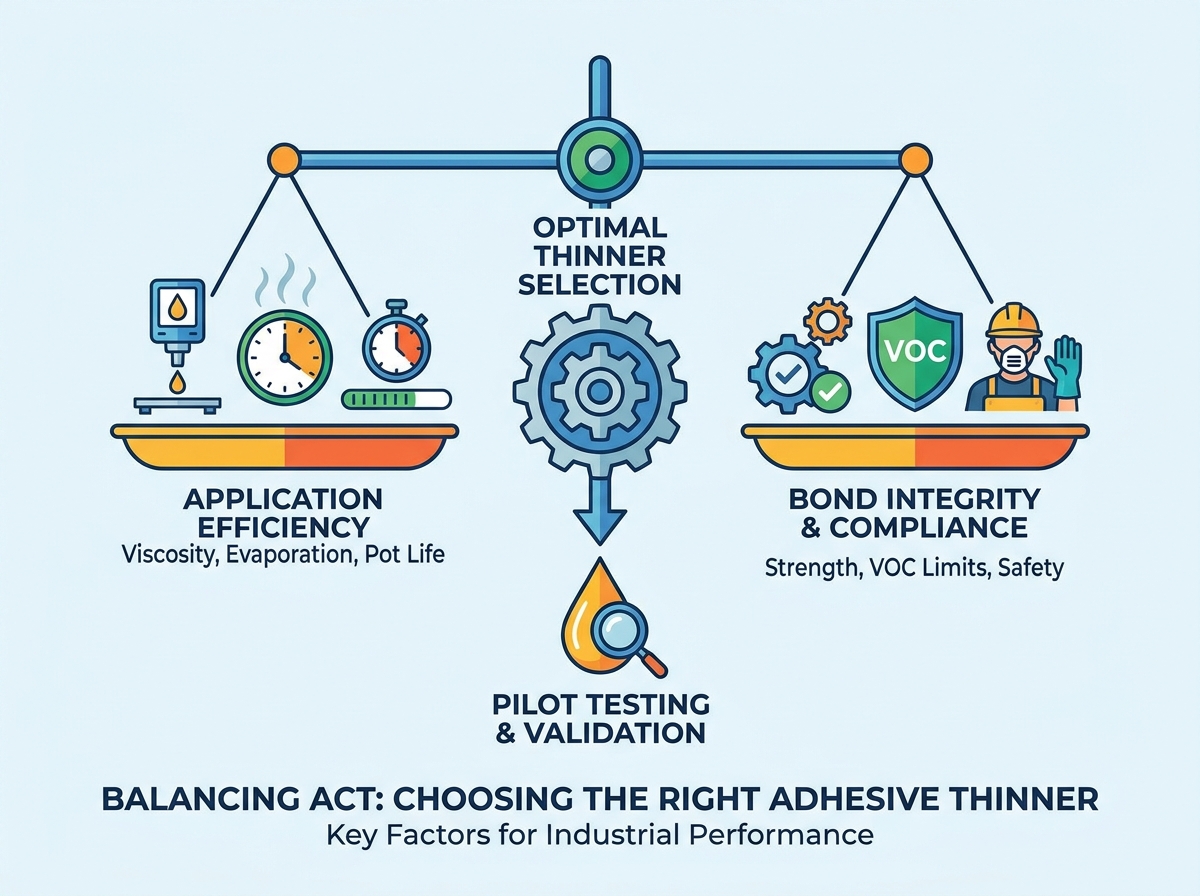
Industrial manufacturing relies heavily on precision. Even the strongest bonding agents fail if poor consistency restricts proper application. You need an optimal Adhesive thinner to adjust viscosity for flawless spray patterns. It also extends crucial pot life on the assembly line.
However, selecting an incompatible solvent carries high stakes. A mismatched thinner degrades bond strength rapidly. It unpredictably alters cure times and introduces severe compliance risks. Manufacturers cannot afford to guess when structural integrity and worker safety hang in the balance.
This article provides an evidence-based framework for evaluating your options. You will discover how to match solvents to chemical bases perfectly. We will teach you to balance evaporation rates and conduct reliable pilot tests. We will equip you with the exact strategies needed to maintain peak performance without compromising safety standards.
Key Takeaways
- Compatibility is non-negotiable: The chemical base of the adhesive dictates the permissible solvent or thinner category.
- Evaporation rates dictate production speed: Flash-off times must align with ambient factory conditions and assembly line speeds.
- Compliance limits options: Stringent VOC (Volatile Organic Compound) regulations require balancing performance with environmental and safety standards.
- Validation requires testing: Relying solely on theoretical compatibility is risky; controlled pilot testing validates peel and shear strength retention.
Defining Success Criteria for Your Adhesive Thinner
You cannot select the right chemical without defining what success looks like. Every application demands a tailored approach. We must establish clear metrics to evaluate how a thinning agent performs under real-world conditions.
Viscosity Control
You must determine the target Centipoise (cP) required for your application. Spray guns require low-viscosity mixtures to atomize properly. If the mixture remains too thick, you get uneven spray patterns. Roll and brush applications tolerate higher viscosity. They need enough body to prevent sagging. You should identify the exact cP range recommended by your equipment manufacturer. This ensures smooth, consistent coverage across all substrates.
Pot Life Extension
Pot life dictates your functional working window. You must calculate the necessary working time for complex assemblies. Workers need sufficient time to align parts before flash-off occurs. Fast-evaporating solvents shrink this window dramatically. Slower thinners keep the mixture workable longer. You must balance this working time against your daily production goals. Too much pot life can bottleneck a fast-moving line.
Minimal Bond Degradation
Adding any solvent dilutes the solid content. This inherently affects the final structural integrity. You must establish acceptable thresholds for variations in final shear and peel strength. Compare these metrics directly to un-thinned adhesives. A five percent drop in shear strength might be acceptable for cosmetic panels. It is entirely unacceptable for load-bearing joints. Always define your minimum acceptable strength before testing begins.
Cost-to-Yield Ratio
You need to evaluate how the addition of thinner impacts total volume. A good thinner increases your overall coverage rate. You get more usable adhesive from a single batch. You must weigh this increased yield against the cost of the agent. Some specialty exempt-solvents cost more upfront. However, they might provide better spreadability. This often justifies the initial chemical expense.
Best Practices for Defining Criteria:
- Always consult the technical data sheet (TDS) for baseline viscosity.
- Measure ambient factory temperatures when calculating desired pot life.
- Establish strict pass/fail benchmarks for peel strength early in the process.
![Industrial application of adhesive thinner on a manufacturing line]()
Evaluating Solution Categories by Adhesive Compatibility
Chemical compatibility dictates your entire selection process. You cannot mix solvent families randomly. The chemical base of your adhesive restricts your options. Mixing incompatible chemicals leads to disastrous failures on the factory floor.
Rubber and Neoprene-Based Adhesives
These elastomeric adhesives dominate flexible bonding applications. They require specific aliphatic or aromatic solvents to dissolve properly.
- Evaluation focus: Toluene, Hexane, or Naphtha blends.
- Decision lens: You must balance fast evaporation with the risk of solvent entrapment. Toluene flashes off very quickly. It works well for high-speed contact cements. However, mating parts too soon traps the gas. This causes blisters under the substrate. You must time your assembly precisely.
Polyurethane (PU) Adhesives
PU adhesives offer incredible durability and chemical resistance. They cure through moisture exposure. This unique curing mechanism complicates the thinning process.
- Evaluation focus: MEK (Methyl Ethyl Ketone) or Acetone.
- Decision lens: You must assess moisture sensitivity strictly. PU thinners must be completely anhydrous (water-free). Even trace amounts of moisture in the solvent will trigger premature curing. This ruins the entire batch inside the pot. Always use urethane-grade solvents for PU systems.
Epoxy Systems
Epoxies provide rigid, high-strength structural bonds. They rely on precise resin-to-hardener ratios. Thinning them introduces significant physical changes.
- Evaluation focus: Xylene or specialized epoxy thinners.
- Decision lens: You are managing a strict trade-off. Thinning reduces viscosity for better penetration. However, the evaporating solvent increases shrinkage during the curing process. Excessive shrinkage induces stress fractures inside the joint. You must keep thinning ratios as low as possible.
Water-Based Adhesives
Aqueous systems offer excellent safety and environmental profiles. They replace volatile organics with water-soluble polymers.
- Evaluation focus: Deionized water or proprietary aqueous modifiers.
- Decision lens: You must evaluate the impact on drying times carefully. Water evaporates much slower than traditional solvents. You also must consider rust prevention. Applying water-thinned adhesives directly to bare metallic substrates causes flash rusting. You might need to add anti-corrosive agents to the mixture.
Compatibility Summary Chart
| Adhesive Base | Recommended Thinners | Primary Risk Factor |
| Rubber / Neoprene | Toluene, Hexane, Naphtha | Solvent entrapment causing blisters |
| Polyurethane (PU) | MEK, Acetone (Urethane-grade) | Moisture contamination causing premature cure |
| Epoxy Systems | Xylene, Proprietary Blends | Increased shrinkage and joint stress |
| Water-Based | Deionized Water | Extended dry times and flash rusting |
Core Evaluation Dimensions: Performance vs. Compliance
Choosing an Adhesive thinner requires balancing physical performance with strict regulations. You cannot prioritize one over the other. A high-performing solvent is useless if it violates local safety laws.
Evaporation Rate & Flash-Off Time
Flash-off time controls your production rhythm. You must assess ambient plant temperature and humidity constantly. Hot, dry environments accelerate evaporation rapidly. Cold, humid facilities slow it down. You must match fast-evaporating thinners to high-speed automated lines. Machines mate parts quickly before the solvent escapes. Conversely, use slow-evaporating thinners for large surface area manual applications. Human operators need more open time to position large panels accurately.
Regulatory & Safety Compliance (EHS)
Environmental Health and Safety (EHS) dictates industrial chemical usage today. You must cross-reference the thinner makeup with local VOC limits. Agencies like the EPA, CARB, and SCAQMD enforce strict emission caps. Exceeding these limits brings heavy fines. You also must evaluate permissible exposure limits (PELs) for worker safety. Highly volatile solvents endanger factory personnel. You should strongly consider Low-VOC or exempt-solvent alternatives. Specific acetates often provide excellent solvency while remaining exempt from strict VOC calculations.
Residue and Substrate Interaction
Solvents do not just affect the adhesive. They interact physically with your substrates. You must verify the thinner will not craze, etch, or degrade the materials being bonded. This is highly critical for sensitive plastics. Polycarbonate and acrylic craze easily when exposed to harsh solvents like MEK. Crazing creates microscopic surface cracks. These cracks weaken the material and ruin its aesthetic finish. Always test your selected agent on scrap substrate before full integration.
Common Mistakes in Evaluation:
- Ignoring seasonal climate changes on the factory floor.
- Assuming a solvent is compliant just because it is available for purchase.
- Failing to test solvent impact on plastic substrates prior to production.
Implementation Risks and Quality Control Fallouts
Even perfectly matched solvents carry execution risks. Human error and environmental shifts easily derail the application process. You must anticipate these quality control fallouts.
Solvent Entrapment
Risk: Mating parts too quickly before the thinner evaporates entirely. This traps solvent gas between impermeable substrates. As the assembly heats up during curing, the gas expands. This causes bubbling, blistering, or catastrophic bond failure. You must train operators to respect mandatory flash-off wait times. Implementing forced air systems often safely accelerates this evaporation phase.
Over-Thinning (The "More is Better" Fallacy)
Risk: Diluting the solid content of the adhesive below functional thresholds. Operators sometimes add extra solvent to make spreading easier. This leads to starved joints. A starved joint lacks enough polymer solids to bridge the gap between substrates. The resulting bond is inherently weak and prone to sheer failure. You must lock away excess solvent to prevent unauthorized dilution.
Phase Separation / Incompatibility
Risk: Using a non-manufacturer-approved generic solvent. Hardware store chemicals often contain impurities or mismatched hydrocarbon chains. This causes the adhesive polymer to coagulate instantly. It separates from its suspension entirely. You will see the mixture turn into an unusable, stringy mess. Always source industrial-grade chemicals verified by the adhesive manufacturer.
Environmental Fluctuations
Risk: Seasonal temperature and humidity shifts alter the thinner's evaporation rate. A solvent ratio that works perfectly in January might fail in July. Summer heat causes premature flash-off. Winter cold prevents proper evaporation. You must require dynamic ratio adjustments based on daily climate readings. Implementing strict climate control in the mixing room eliminates this variable entirely.
Shortlisting Logic and Pilot Testing Framework
You need a structured methodology to navigate these risks. Do not rely on guesswork. Follow this logical framework to select and validate your thinning agent safely.
- Step 1: Consult Technical Data Sheets (TDS): Never start blindly. Restrict your initial choices strictly to thinners recommended or approved by the adhesive manufacturer. The TDS provides a safe starting point based on laboratory testing. Using unapproved chemicals immediately voids performance warranties.
- Step 2: Establish the Maximum Thinning Ratio: Document the absolute maximum percentage allowed before solids drop below specification. You typically measure this by volume or weight. The safe range is generally 5% to 15%. Exceeding this limit guarantees a weakened structural bond. Put this limit in your standard operating procedures.
- Step 3: Conduct Off-Line Viscosity Testing: Mix a small sample batch. Use a Zahn cup or digital viscometer to verify the thinned mixture. It must meet your application equipment requirements precisely. Document the exact ratio and the resulting cP reading. This becomes your baseline metric for daily production.
- Step 4: Perform Destructive Testing: Run a pilot batch and apply it to actual substrates. Let the assembly reach full cure. Perform standard lap-shear and peel tests. You must validate structural integrity against your predefined success criteria. If the bond fails, you must adjust the ratio or change the solvent.
- Step 5: Review Safety Data Sheets (SDS): Finalize procurement only after your EHS team clears the chemical. They must verify VOC compliance and worker safety protocols. They will dictate required PPE and ventilation upgrades for factory floor integration.
Conclusion
Choosing an adhesive thinner is a complex technical balancing act. You must align application efficiency, structural bond integrity, and strict environmental compliance. A successful selection ensures smooth production runs and prevents catastrophic joint failures.
We highly recommend consulting directly with adhesive formulation engineers. They provide invaluable guidance for custom applications or when transitioning to modern low-VOC alternatives. Their expertise prevents costly trial-and-error phases.
Your immediate next step is clear. Audit your current adhesive TDS documents today. Define your exact viscosity targets and acceptable strength thresholds before procuring any new testing samples. Rigorous preparation guarantees a stronger, safer assembly line.
FAQ
Q: Can I use standard hardware store paint thinner for industrial adhesives?
A: Generally, no. Industrial adhesives require high-purity, chemically matched thinners. Generic paint thinners often contain impurities or mismatched solvent blends. These contaminants can cause rapid coagulation, phase separation, or complete bond failure on the assembly line.
Q: How much adhesive thinner should I add?
A: Addition rates should strictly follow the adhesive manufacturer’s TDS. Typically, this is limited to 5-15% by volume. Exceeding this drastically reduces the adhesive's solid content, leading to starved joints and severely degraded final strength.
Q: Does using a thinner void the adhesive manufacturer’s warranty?
A: Using an unapproved, third-party solvent almost always voids performance guarantees. Manufacturers cannot vouch for unknown chemical interactions. Always use the specifically recommended thinner or obtain written approval for any alternatives from their engineering team.
Q: How does ambient temperature affect my choice of thinner?
A: Higher ambient temperatures accelerate evaporation significantly. A "fast" thinner used in a hot facility may flash off completely before mating occurs. This requires a switch to a "slow" or "retarder" thinner during the summer months to maintain proper pot life.