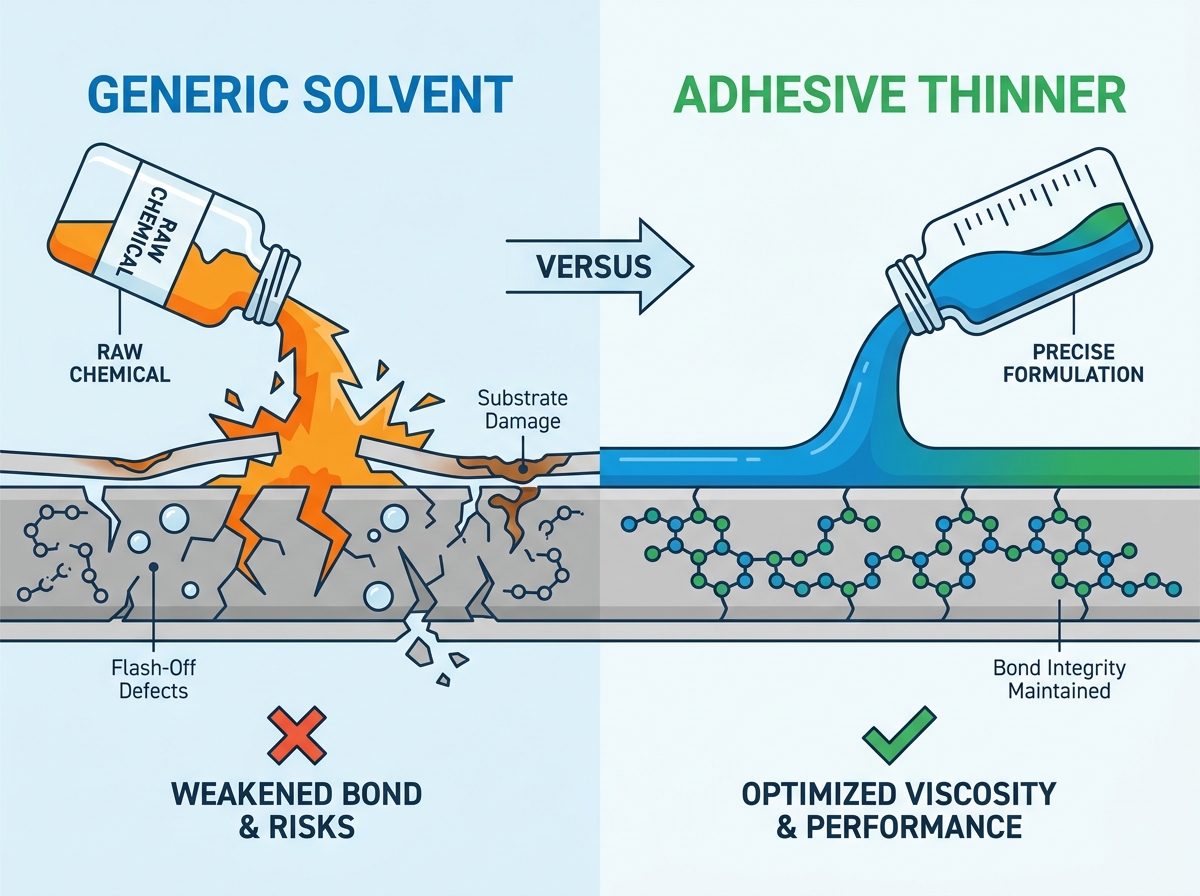
It happens on almost every industrial job site. You encounter a thick, difficult-to-apply adhesive and need a quick fix. To save time, you grab a generic solvent to dilute the mixture. This operational shortcut seems harmless at first glance. However, it often introduces massive risks to your assembly process.
While all adhesive thinners contain solvents, not all solvents are formulated to function safely as thinners. Making the wrong choice introduces severe problems. You risk compromised bond strength, ruined substrates, and strict compliance violations. An incompatible chemical blend can turn a straightforward bonding task into an expensive failure.
This guide breaks down the critical chemical and functional differences between these products. We will help technical buyers and project managers select the exact chemical profile needed for specific applications. You will learn how to maintain project integrity, ensure proper curing, and avoid the hidden costs of chemical mismatch.
Key Takeaways
- Formulation vs. Raw Material: An adhesive thinner is a precisely blended formula designed to reduce viscosity without degrading bond properties; a generic solvent is a raw chemical primarily used for dissolving or cleaning.
- Bond Integrity Risks: Using a harsh raw solvent to thin an adhesive can alter curing times, cause "flash-off" defects, and structurally weaken the final bond.
- Evaluation Criteria: Material compatibility, application method (e.g., spray vs. brush), and local VOC compliance dictate the correct choice.
- Cost of Failure: Saving money on generic solvents often results in expensive rework, delamination, and substrate damage.
The Core Difference: Solvents vs. Dedicated Adhesive Thinners
You must understand the chemical intent behind a product before applying it to your materials. Manufacturers engineer chemicals for highly specific tasks. Swapping them out based purely on availability often creates unseen structural weaknesses.
A solvent acts as an active chemical agent. Common examples include acetone, methyl ethyl ketone (MEK), or toluene. Chemists design these raw substances to break down or completely dissolve a solute. In business-to-business manufacturing or construction contexts, you primarily use solvents for surface preparation. They excel at cleaning heavy equipment or removing cured glue from work areas. They aggressively attack polymer chains to strip materials away.
Conversely, an Adhesive thinner utilizes a specific proprietary blend. Manufacturers engineer these liquids to alter the physical state of the glue. They lower the viscosity to improve overall workability. More importantly, they achieve this while keeping the solid-to-liquid ratio balanced. The chemical chains remain completely intact. You gain better flow characteristics without sacrificing the final hold.
The distinction lies heavily in evaporation control. Dedicated blends control the evaporation rate meticulously. They ensure the mixture cures exactly as the manufacturer intended. Raw chemicals evaporate unpredictably based on ambient room temperature. This rapid gas expansion often traps air inside the bond line, weakening the joint permanently.
| Chemical Characteristic | Generic Solvents | Dedicated Thinners |
| Primary Function | Dissolving, stripping, and cleaning | Lowering viscosity and improving flow |
| Evaporation Rate | Unpredictable, often extremely fast | Calibrated and controlled |
| Impact on Polymers | Breaks down chemical cross-linking | Preserves structural integrity |
| Best Use Case | Surface prep and tool maintenance | Pre-application adhesive modification |
![Application of industrial adhesive thinner in a workspace]()
When to Choose an Adhesive Thinner Over a Generic Solvent
Certain industrial applications demand absolute precision. You cannot rely on guesswork when structural integrity is on the line. Knowing exactly when to deploy a specialized chemical blend saves both time and material.
Viscosity control remains paramount for automated equipment. You must maintain precise flow rates when using High Volume Low Pressure (HVLP) spray systems. Automated dispensing machines easily clog if the liquid becomes too thick. A specialized thinning agent ensures smooth, continuous atomization. You avoid sputtering, uneven coverage, and costly equipment downtime.
Complex assemblies often require extended working times. We refer to this window as the "pot life" of the mixture. Specific thinning agents safely delay the curing process. You gain the extra minutes needed to align large panels or intricate parts. A raw chemical might flash off immediately, forcing you to rush and make alignment errors.
Warranty compliance serves as another major deciding factor. Manufacturers explicitly guarantee their technical performance based on specific chemical pairings. Pouring third-party raw chemicals into their product automatically voids these technical guarantees. Matching a product with its designated thinning agent maintains the warranty. You protect your company from assuming full liability for joint failures.
Finally, appropriate blends prevent frustrating "flash-off" defects. Skinning occurs when rapid surface drying traps wet glue underneath the top layer. This defect happens frequently when workers use generic, fast-evaporating chemicals. A proper blend keeps the entire layer open and wet, allowing uniform drying from the bottom up.
- Use specialized blends for HVLP spray systems requiring exact fluid dynamics.
- Select them to safely extend the pot life of large-scale panel alignments.
- Rely on them to maintain strict manufacturer technical warranties.
- Apply them to prevent rapid surface skinning and moisture entrapment.
The Risks of Using the Wrong Chemical for Your Project
Substituting chemicals purely for convenience invites disaster. The molecular reaction between incompatible liquids and substrates rarely ends well. You must understand the specific modes of failure to prevent them.
Substrate Crazing and Melting
Aggressive raw chemicals eat directly into sensitive substrates. Materials like polystyrene, clear acrylics, or specific PVC plastics react violently to harsh liquids. Crazing creates micro-cracks across the surface. Sometimes, the material completely melts away. You compromise the structural integrity of the part before the glue even begins to set. A tailored mixture provides the necessary dilution without aggressively attacking the underlying plastic or composite.
Cohesive Failure and Delamination
The mechanical reality of over-diluting proves unforgiving. Pouring a harsh raw chemical into your mixture breaks the internal polymer cross-linking. You destroy the microscopic web holding the material together. This disruption leads directly to cohesive failure. The bond easily shears or peels apart under minimal load. Delamination occurs because the mixture lost its inherent solid content. You are essentially gluing parts together using tinted water.
Unpredictable Curing Dynamics
Temperature and humidity interact poorly with uncalibrated chemicals. Fast-evaporating liquids drastically drop the surface temperature of the substrate. This sudden chill pulls moisture out of the surrounding air. We call this phenomenon "blushing." Moisture entrapment creates brittle, chalky glue lines. The joint loses its flexibility and shatters under vibration. Calibrated mixtures evaporate slowly enough to prevent this rapid temperature drop, ensuring a strong, moisture-free bond.
Evaluating Your Application: A Framework for Choosing
You need a repeatable process for selecting the right chemical modifier. Guesswork leads to inconsistent production quality. Follow this structured evaluation framework to ensure optimal material compatibility.
- Base Chemistry Alignment: Always match the chemical family of the thinning agent to the base of your glue. Aliphatic liquids pair differently than aromatic or ketone-based liquids. If you use a polyurethane base, you need a modifier engineered specifically for urethanes. The same rule applies to epoxies and contact cements.
- Application Method: Your application technique dictates the required evaporation rate. Manual brushing requires a slower rate to allow the bristles to level the liquid. Atomized spray applications demand a faster rate so the product tacks up shortly after hitting the substrate.
- Performance Requirements: Frame your decision around the final environmental stress the joint will face. Will the bond endure extreme heat resistance tests? Will it face constant moisture exposure? A compromised, mismatched mixture will fail these environmental stress tests instantly.
- Cost vs. ROI: Address the common misconception regarding upfront price. A bulk bucket of generic liquid looks cheaper on a purchase order. However, a dedicated Adhesive thinner prevents massive labor costs. You avoid the expensive hours associated with tearing down failed assemblies, scraping ruined substrates, and completely redoing the work.
Safety, Handling, and Environmental Compliance (VOCs)
Industrial chemicals demand strict respect and robust safety protocols. You must protect your workforce and your local environment. Proper handling goes far beyond simple ventilation.
You must navigate the Safety Data Sheet (SDS) and Technical Data Sheet (TDS) thoroughly. These documents highlight critical compatibility limits and flashpoints. They dictate the exact Personal Protective Equipment (PPE) required. You might need specific nitrile gloves or specialized respirator cartridges. Ignoring these documents puts your operators in direct danger of chemical burns or respiratory distress.
Environmental compliance requires constant vigilance. Generic raw chemicals often contain extremely high Volatile Organic Compound (VOC) levels. Using them recklessly may violate strict local regulations set by organizations like CARB, the EPA, or SCAQMD. Compliant proprietary mixtures are engineered explicitly to meet these regional limits. They allow you to operate legally without facing severe environmental fines or facility shutdowns.
Storage and disposal carry their own industrial realities. You must store highly flammable liquids inside approved, fire-rated cabinets. Grounding wires must connect dispensing drums to prevent static sparks. Furthermore, disposing of hazardous waste costs significantly more than standard trash. You must calculate these disposal realities into your project planning to avoid budget overruns.
Conclusion
Selecting the right chemical additive dictates the ultimate success of your assembly. Generic raw chemicals serve a distinct purpose for surface cleaning and material removal. However, a dedicated chemical mixture ensures precise application, predictable curing, and long-term performance preservation. You protect your materials and your profit margins by respecting this distinction.
Consult the manufacturer’s Technical Data Sheet before opening any containers. The TDS will accurately identify the approved formulation required for your specific product base. Do not rely on assumptions or past habits when specifying these critical materials.
Finally, always conduct a small-scale peel or shear test. Mix your chosen combination and apply it to scrap substrate pieces. Let it cure fully before stressing the joint. This simple verification step guarantees your chemical selection works flawlessly before you commit to a full-scale project rollout.
FAQ
Q: Can I use acetone as an adhesive thinner?
A: Generally no, unless explicitly specified by the manufacturer. Acetone flashes off far too quickly for most applications. This rapid evaporation causes sudden surface cooling, leading to moisture condensation known as blushing. Trapped moisture ruins polymer cross-linking and creates exceptionally weak, brittle bonds.
Q: What is the difference between paint thinner and adhesive thinner?
A: Paint thinners are usually mineral spirit-based formulas intended for oil-based paints. They simply lack the required chemical strength and precise evaporation control needed for heavy-duty industrial glues. Mixing them into industrial bonding agents usually results in a sludgy, unusable mess that refuses to cure properly.
Q: How much thinner should I add to my adhesive?
A: Always defer to the exact ratios listed on the manufacturer's Technical Data Sheet. A general industry rule of thumb is never to exceed a 5–10% dilution ratio by volume. Adding too much liquid destroys the solid content of the mixture, completely ruining its structural holding power.