Industrial coating projects require a careful balance. You need high operational efficiency but cannot sacrifice long-term asset protection. Every minute of application downtime costs money. Yet, premature coating failure leads to even more expensive rework. 1K industrial paint offers a highly effective solution to this widespread challenge. We define this single-component formulation as a ready-to-use product. It cures naturally through solvent evaporation, oxidation, or ambient moisture. You never need to mix in a separate hardener or catalyst. This simplicity drastically reduces human error on the shop floor.
Our goal here is to provide an objective, actionable framework. You will learn exactly how to evaluate, specify, and implement these coatings. We will show you how to leverage their speed and ease of use. You can achieve excellent industrial application results without compromising on durability, quality, or regulatory compliance.
Key Takeaways
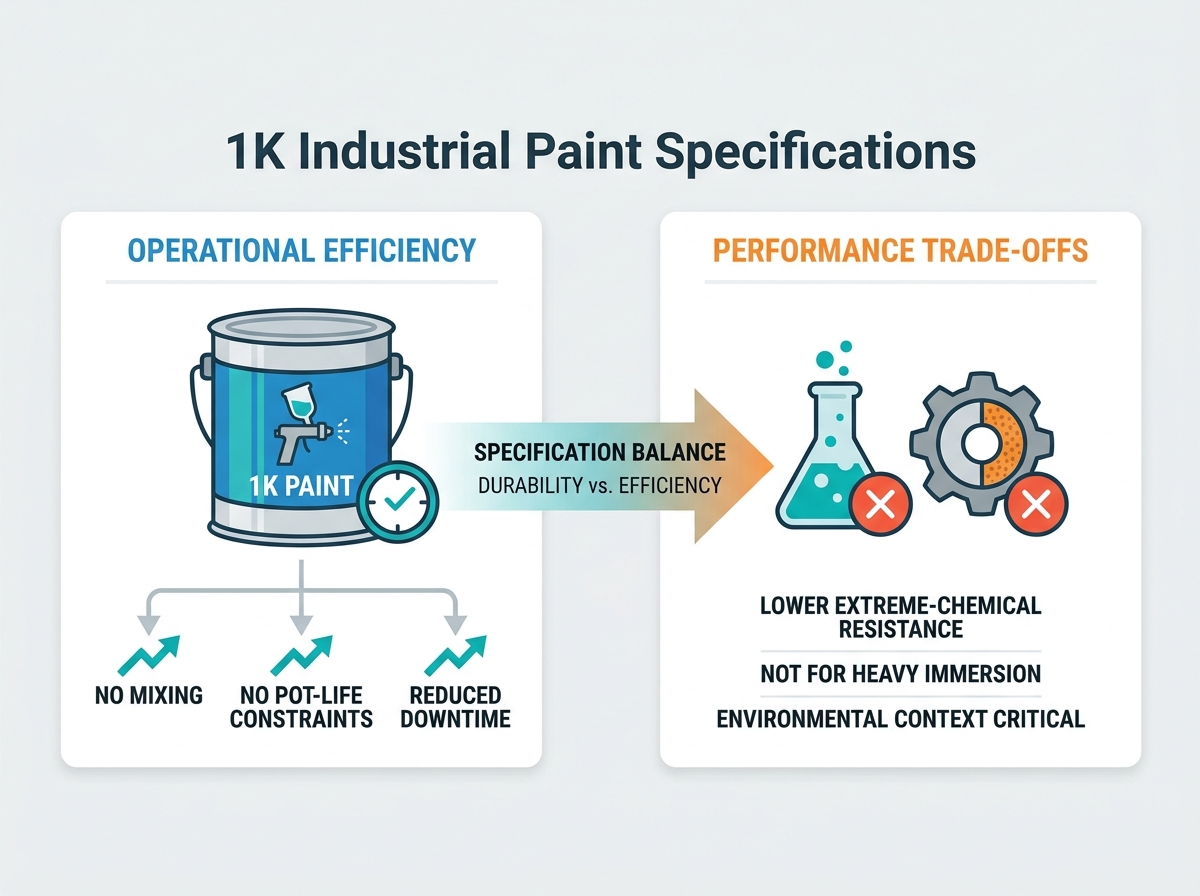
- Operational Efficiency: 1K systems eliminate pot-life constraints and mixing errors, drastically reducing application downtime and material waste.
- Specification Imperatives: A sound 1K specification must explicitly define resin type, Dry Film Thickness (DFT), VOC compliance, and compatible curing environments.
- Performance Trade-offs: While highly efficient, 1K paints generally offer lower extreme-chemical resistance compared to 2K (two-component) systems, making environmental context the ultimate deciding factor.
- Compliance & Safety: Modern high-performance 1K coatings require strict adherence to standard operating procedures, including localized VOC limits and specific PPE protocols.
The Business Case: When to Specify 1K Industrial Paint
Industrial facilities often face significant bottlenecks during painting operations. Complex mixing ratios demand precise measurements. Short pot life forces crews to rush applications. If an operator delays, multi-component paints can harden inside expensive spray equipment. These strict curing parameters constantly threaten operational timelines. Single-component formulations eliminate these specific anxieties. You open the container, agitate the product, and begin spraying immediately.
Where Single-Component Coatings Excel
Choosing the right coating technology depends on your success criteria. You should specify 1K industrial paint when operational speed holds priority. Consider these ideal implementation scenarios:
- High-Volume Manufacturing: OEM assembly lines require continuous spraying. Operators cannot stop to mix new batches every two hours. Single-component products keep the line moving.
- Remote Maintenance Projects: Field touch-ups in difficult-to-access locations benefit from simplified logistics. Crews carry fewer cans and eliminate on-site mixing equipment.
- Labor-Constrained Environments: Applications where ease of use outweighs the need for extreme chemical immersion resistance. Simplified application significantly lowers training requirements and labor costs.
The Skeptic’s Lens: Setting Transparent Boundaries
Trustworthy specifications require transparent boundaries. We must acknowledge when not to use these paints. They do not suit every environment. You should avoid single-component systems for heavy chemical immersion. Do not use them to line the inside of aggressive acid storage tanks. They also underperform in extreme abrasive environments, such as mining ore chutes. Two-component (2K) epoxies or polyurethanes provide the necessary cross-linked density for those brutal conditions. Acknowledging these limitations ensures you deploy single-component products only where they guarantee success.
Core Elements of a Quality 1K Paint Specification
A rigorous industrial coating specification serves as your project blueprint. Vagueness leads to premature failure. You must outline non-negotiable components to ensure reliable procurement and application. A strong baseline protects your assets and sets clear expectations for the painting contractor.
Resin Selection Framework
The binder resin dictates the performance characteristics. You must select the resin chemistry based on the specific environmental exposure. Below is a comparative chart to guide your selection process.
| Resin Type | Curing Mechanism | Primary Advantages | Ideal Industrial Environments |
| Alkyds | Oxidation | Cost-effective, good gloss retention, easy application. | Mild industrial environments, machinery exteriors, indoor steel. |
| Acrylics | Solvent/Water Evaporation | Fast-drying, excellent UV resistance, color stability. | Exterior structural steel, commercial architectural metal, OEM parts. |
| Moisture-Cure Urethanes (MCU) | Ambient Moisture Reaction | High durability, exceptional surface tolerance, fast cure. | High-humidity applications, bridges, marine environments. |
Critical Technical Parameters to Define
You cannot simply specify a color and a resin. Technical parameters dictate the physical application process. Detail the following metrics in your specification document:
- Volume Solids: This metric dictates coverage rates. It tells you how much paint remains on the surface after the solvent evaporates. Higher volume solids mean thicker coats per pass.
- Dry Film Thickness (DFT) & Wet Film Thickness (WFT): Establish precise mil ranges. If you apply the paint too heavily, sagging occurs. If applied too thinly, premature corrosion begins. Specify WFT targets so applicators can measure thickness during the active spray process.
- Adhesion Standards: Define acceptable bonding limits. We recommend referencing ASTM D4541 for pull-off strength. Specify the exact PSI required before the asset enters active service.
Best Practice: Always require contractors to use a WFT gauge continuously during application. This prevents disputes over inadequate DFT after the coating cures.
![1K industrial paint application]()
Evaluating Performance Outcomes vs. Implementation Realities
Performance on a specification sheet often differs from field reality. You must understand how environmental conditions alter the application process. Ignoring these dependencies introduces severe implementation risks.
Curing Mechanisms & Environmental Dependencies
Single-component systems cure through distinct mechanisms. Evaporative coatings dry as solvents flash off into the air. Oxidative coatings absorb oxygen to harden. Moisture-cure urethanes require water vapor from the ambient air to trigger their chemical reaction. Ambient temperature and relative humidity directly dictate these project timelines.
Implementation Risk: Cold environments drastically slow down solvent evaporation. If operators apply a second coat before the first coat flashes off, they risk solvent entrapment. The top layer skins over. The trapped solvent underneath tries to escape, causing severe blistering and delamination. You must adjust recoat windows based on actual ambient temperatures.
Surface Preparation Realities
Proper surface preparation dictates coating lifespan. You must specify appropriate SSPC (Society for Protective Coatings) or NACE standards. Many single-component formulas market themselves as "surface tolerant." This term causes widespread confusion. Surface tolerance does not mean you can paint over loose rust or mill scale.
Optimal lifespan still relies on proper mechanical or abrasive preparation. For mild environments, SSPC-SP 2 (Hand Tool Cleaning) or SSPC-SP 3 (Power Tool Cleaning) might suffice. However, for maximum durability, we highly recommend specifying SSPC-SP 6 (Commercial Blast Cleaning). It creates an angular anchor profile. The coating physically locks into this profile, maximizing long-term adhesion.
Compliance, Safety, and Best Practices for Operators
Modern industrial coatings face strict regulatory oversight. You must balance high-performance application with operator safety and environmental compliance.
Navigating VOC Regulations
Volatile Organic Compounds (VOCs) contribute to air pollution. Regional authorities enforce stringent emission limits. To meet these demands, the industry is shifting rapidly. Manufacturers now formulate high-solids and waterborne 1K industrial paint options. These modern formulations deliver excellent protection while keeping VOC levels below strict regional thresholds. You must audit local air quality regulations before specifying a solvent-heavy product.
Personal Protective Equipment (PPE) Standards
A dangerous myth persists on the shop floor. Many operators believe single-component paints are harmless because they lack isocyanate hardeners. Voice of Customer data shows a frequent disregard for respiratory protection in these scenarios. "Single-component" does not mean "hazard-free."
Operators face severe inhalation risks from evaporating solvents. You must specify and enforce strict PPE protocols:
- Respiratory Protection: Mandate half-face respirators equipped with NIOSH-approved organic vapor cartridges. Dust masks provide zero protection against chemical vapors.
- Dermal Protection: Require chemical-resistant nitrile gloves. Solvents can absorb directly through the skin.
- Body Coverage: Utilize disposable Tyvek suits to protect clothing and skin from overspray.
Application Best Practices
Standardizing application methods maximizes operational uptime. Detail the spray equipment settings in your specification.
For high-volume structural steel, airless spray systems provide the best efficiency. Specify exact fluid tip sizes. A 0.015 to 0.019-inch tip usually handles medium-viscosity industrial acrylics perfectly. For smaller machinery requiring a fine finish, specify HVLP (High Volume Low Pressure) equipment. Finally, mandate strict line-flushing procedures. Operators must flush lines with compatible solvents immediately after completing a shift. This prevents residual buildup and ensures equipment readiness for the next project phase.
Shortlisting Logic: Choosing the Right 1K Paint Manufacturer
Selecting the right supplier is as critical as selecting the right resin. A high-quality manufacturer acts as a technical partner, not just a material vendor. Use a structured evaluation dimension to shortlist potential suppliers.
Evaluation Dimensions for Suppliers
Do not rely solely on marketing brochures. Demand objective evidence of performance. Evaluate suppliers across these three pillars:
- Testing & Certifications: Demand independent laboratory data. Request reports for salt spray resistance testing under ASTM B117. Ask for accelerated weathering data under ASTM D4587. This proves the coating can withstand actual industrial stress.
- Technical Support: Assess their field capabilities. Does the manufacturer offer on-site technical support? Will they conduct facility audits? A strong supplier provides specification writing assistance tailored to your exact environment.
- Supply Chain Scalability: Project delays kill budgets. Ensure the supplier possesses robust manufacturing scalability. They must demonstrate the ability to meet your project volumes and timeline demands consistently, even during raw material shortages.
Next-Step Actions
Never commit to a full facility rollout based purely on paperwork. We strongly recommend requesting a trial batch first. Conduct a localized test patch on your actual assets. This allows you to verify adhesion strength, monitor real-world drying times, and inspect the final finish. Testing under your actual facility conditions mitigates risk before you issue the final procurement order.
Conclusion
Single-component industrial coatings provide a highly scalable solution for asset protection. They eliminate complex mixing ratios, eradicate pot-life anxieties, and keep production lines moving rapidly. When specified correctly against the right environmental variables, they deliver exceptional durability.
To maximize these benefits, take the following action steps:
- Review your current asset protection requirements against the resin framework provided above.
- Update your internal procurement documents to include precise DFT, WFT, and ASTM testing standards.
- Audit your facility's safety protocols to ensure compliance with VOC limits and proper PPE usage.
- Contact a technical coating specialist today to help draft a custom, site-specific specification.
FAQ
Q: What is the main difference between 1K and 2K industrial paints?
A: The primary difference lies in the curing mechanism. 1K paints are single-component and require no chemical hardener. They cure through air drying, oxidation, or ambient moisture. 2K paints are two-component systems. They require a specific catalyst or hardener to trigger a chemical cross-linking cure. This difference gives 1K systems unlimited pot life and easier application, while 2K systems offer higher extreme-chemical resistance.
Q: Can you apply 1K industrial paint directly over rust?
A: No. While some formulations are marketed as "surface-tolerant," this does not mean you can paint over loose, flaking rust. Surface-tolerant coatings adhere better to tightly adhering rust than standard paints. However, for industrial longevity, we highly recommend proper SSPC mechanical or abrasive preparation to create an anchor profile for the paint.
Q: How long does 1K industrial paint take to dry?
A: Drying times vary significantly based on resin chemistry, ambient temperature, and relative humidity. A coating may be "dry to touch" in 30 minutes due to rapid solvent evaporation. However, being "fully cured" for rigorous industrial use can take several days. Cold environments drastically extend both drying and fully cured timelines.
Q: Does 1K paint require a clear coat?
A: Generally, no. Most industrial applications are designed as standalone topcoats or direct-to-metal (DTM) finishes. They are formulated with built-in UV resistance and gloss retention suitable for industrial environments. Unlike automotive finishes, industrial structural steel and machinery rarely require the aesthetic depth of a secondary clear coat.