Recent media discussions have triggered a massive surge in awareness around the concept of Magic Paint. You often see this term popping up during high-profile historic building renovations. However, marketing hype heavily clouds its actual definition. In commercial, architectural, and industrial contexts, there is no real magic involved. The term simply refers to high-performance, specialized architectural coatings. These include high-build elastomerics, ceramic-insulating paints, and advanced waterproofers. Property managers and decision-makers face a tough challenge when choosing the right product. You need to separate legitimate chemical engineering from exaggerated claims. This article serves as your comprehensive buyer’s evaluation guide. We will help you understand exactly when you should apply these advanced coatings. More importantly, you will learn when you must avoid them entirely to protect your structural assets from irreversible damage.
Key Takeaways
- It’s Applied Chemistry, Not Magic: "Magic paint" typically refers to elastomeric or high-build functional coatings designed to waterproof, insulate, or bridge structural cracks.
- High Risk on Historic Masonry: Despite promises of a pristine finish, impermeable coatings can trap moisture in older brick or stone structures, causing catastrophic spalling—a key reason preservation experts often advise against their use.
- ROI Requires Strict Prep: The long-term benefits (10–20 year lifespans) are entirely dependent on rigorous surface preparation and substrate compatibility.
- Verification is Critical: Buyers must evaluate technical specifications (like permeability ratings and solar reflectance index) rather than relying on marketing claims regarding energy savings.
Demystifying "Magic Paint": Core Coating Categories
Traditional paints fail quickly in harsh commercial environments. They require repainting every five to seven years. They offer zero structural benefits. They also lack thermal protection properties. Property owners naturally seek better solutions. You need coatings reducing long-term financial burdens. You also want to minimize disruptive maintenance cycles. Vendors often pitch miraculous solutions to meet these demands. You must look past the flashy marketing terminology. You need to understand the underlying chemistry they actually sell.
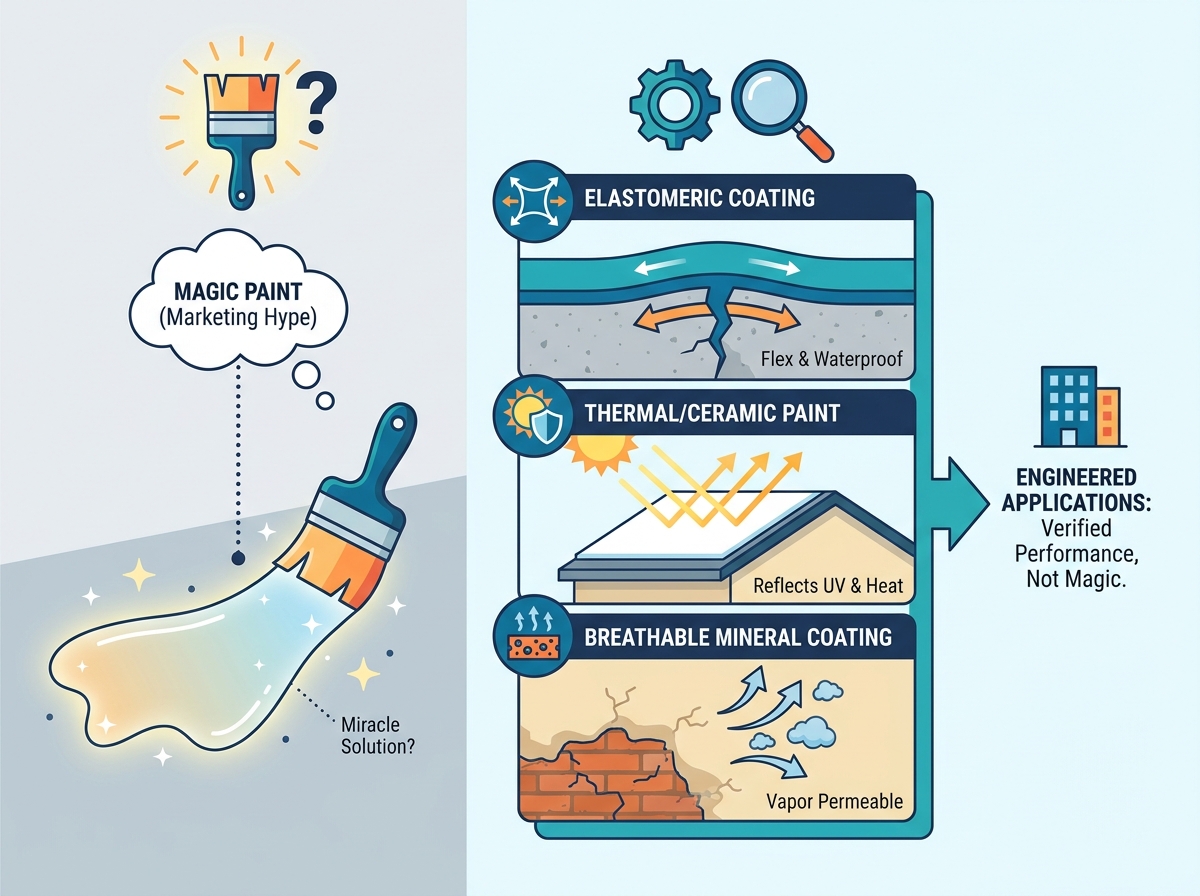
When suppliers discuss Magic Paint, they typically refer to three specific categories of advanced architectural coatings. Each category solves a distinct building envelope problem.
- Elastomeric Coatings: These are highly flexible, thick liquid coatings. They stretch significantly after curing. This flexibility allows them to bridge hairline cracks. They create a continuous membrane to prevent exterior water intrusion.
- Thermal/Ceramic Paints: Manufacturers blend microscopic ceramic spheres into these coatings. The microspheres reflect ultraviolet rays away from the structure. They reduce solar thermal transfer into the building interior. Vendors frequently market them as insulating paints.
- Breathable Mineral/Siloxane Coatings: These represent advanced water repellents. They block liquid water from entering the exterior surface. Simultaneously, they allow internal water vapor to escape. They are ideal for specific porous masonry applications.
Understanding these categories helps you make informed purchasing decisions. You cannot apply a single product universally. A coating designed for a modern concrete warehouse will fail on a 19th-century brick facade. We must align the chemical properties with the physical demands of your specific building.
![Article image]()
Evaluating the Commercial Applications and Benefits
High-performance coatings carry a premium price tag. You need clear success criteria to justify this initial expense. How do you measure their performance? You evaluate them based on structural protection, energy efficiency, and lifecycle durability. Let us examine the three most common commercial applications for these specialized systems.
Exterior Stucco and Concrete Restoration
Modern commercial structures experience constant subtle shifting. They expand during hot days. They contract during freezing nights. This movement creates hairline cracks in traditional stucco and concrete. Water enters these micro-fissures easily. It freezes, expands, and destroys the substrate.
Elastomeric coatings solve this specific problem. They create a continuous, waterproof membrane across the entire facade. The coating expands and contracts alongside the building movement. It prevents water ingress completely. You avoid severe freeze-thaw damage. The structural integrity of your concrete building remains intact for decades.
Cool Roof and Energy Management Initiatives
Flat commercial roofs absorb massive amounts of solar radiation. This absorbed heat transfers directly into the building envelope. Your HVAC systems must work harder to maintain comfortable interior temperatures. This drives up utility expenses rapidly.
Ceramic and thermal coatings offer a practical remedy. They boast exceptionally high Solar Reflectance Index (SRI) values. They literally bounce radiant heat away from the roof surface. You see a tangible reduction in HVAC loads during peak summer months. We highly recommend these coatings for flat commercial roofing in hot climates.
High-Traffic and Industrial Interiors
Schools, hospitals, and industrial corridors face relentless physical abuse. Cleaning crews constantly scrub the walls. Carts and equipment scrape against the surfaces. Standard interior latex paint degrades rapidly under these conditions.
Specialized high-build commercial coatings provide extreme scuff-resistance. They offer superior washability compared to standard paints. They withstand harsh chemical cleaners without losing their finish. This durability drastically reduces your repainting frequency. Your maintenance staff spends less time touching up damaged corridors.
Application and Benefit Comparison Chart
| Coating Category | Primary Application | Key Structural Benefit | Expected Outcome |
| Elastomeric System | Exterior Stucco & Concrete | Bridges hairline cracks via high elongation | Prevents water ingress and freeze-thaw damage |
| Ceramic/Thermal Paint | Flat Commercial Roofing | Reflects UV radiation (High SRI) | Reduces summer HVAC cooling loads |
| High-Build Epoxy/Acrylic | High-Traffic Interiors | Extreme scuff and chemical resistance | Reduces repainting frequency in corridors |
The Risks: When "Magic Paint" Fails (The Historic Building Dilemma)
Not every building benefits from thick, specialized coatings. Architectural experts frequently push back against using them on historic structures. We have all seen well-documented controversies regarding executive office buildings. Applying the wrong specialized paint to historic masonry often triggers catastrophic structural failures.
The Breathability Trap (Perm Ratings)
Older masonry structures follow different rules of physics. They manage moisture by breathing. Historic brick and stone absorb water during rainstorms. They release this water as vapor when the sun shines. They require a high permeability rating to function correctly.
Many thick elastomeric paints act as strict vapor barriers. They trap interior moisture inside the wall cavity. This trapped water eventually freezes during winter. It expands with immense force. The expanding ice literally pops the faces off historic bricks. The industry calls this destructive process spalling. Applying an impermeable coating to old brick rapidly accelerates structural decay.
Common Mistake: Property owners often prioritize a uniform, pristine aesthetic over building physics. They seal old masonry tight. They essentially suffocate the building, leading to massive remediation expenses.
Substrate Adhesion Failures
Heavy-bodied coatings weigh significantly more than standard acrylics. They require maximum adhesion to the underlying surface. You must use specific primers designed for the exact substrate material. Flawless surface preparation is absolutely non-negotiable.
Contractors sometimes apply these heavy coatings over failing legacy paint. The old paint cannot support the weight and tension of the new elastomeric layer. The entire system peels off in large sheets. Application over a compromised substrate guarantees a total system failure. You waste the entire material and labor investment.
Separating Fact from Exaggeration: A Skeptical Buyer’s Framework
You must approach specialized coating vendors with a healthy dose of skepticism. Marketing brochures often stretch the truth. You need a reliable framework to interrogate their claims. We want to help you demonstrate trustworthiness to your internal stakeholders by focusing on verifiable facts.
The "R-Value" Myth
Sales representatives frequently claim their ceramic paints provide incredible insulation. They imply the paint acts like thick fiberglass or foam board. This is chemically and physically inaccurate. Ceramic paints offer excellent radiant heat reflection. They bounce the sun's energy away from the surface.
However, they do not provide measurable thermal resistance. Traditional bulk insulation carries a recognized R-value. Thin paint films simply cannot trap still air the way foam does. They lack true conductive thermal resistance. You must adjust your return-on-investment expectations accordingly. Use them to reflect heat, not to replace traditional wall insulation.
The "Lifetime Warranty" Caveat
Vendors often boldly advertise lifetime warranties. Buyers assume this protects them against any future peeling or bubbling. You must read the fine print carefully. These warranties typically cover only specific product defects. They might cover extreme chalking or unnatural color fading.
They almost never cover adhesion failure caused by poor contractor preparation. If the applicator skipped a crucial cleaning step, the manufacturer will void the warranty. The manufacturer will blame the contractor. The contractor will blame the manufacturer. You will pay for the repairs. Always rely on rigorous application standards rather than warranty promises.
Compliance and Codes
Advanced coatings contain diverse chemical solvents and resins. You must ensure the selected product meets local regulations. Many municipalities enforce strict Volatile Organic Compound (VOC) emission standards. Some elastomeric formulas exceed these allowable limits.
Furthermore, local historic preservation boards strictly regulate exterior alterations. They often ban non-breathable coatings on registered buildings outright. Ensure you secure all necessary approvals before signing a procurement contract.
Best Practice: Always request the Safety Data Sheet (SDS) and the Technical Data Sheet (TDS) upfront. Compare the VOC levels against your local environmental guidelines before placing an order.
Shortlisting and Procurement Logic for Advanced Coatings
Choosing the right coating requires a methodical approach. You cannot select products based on brand recognition alone. You must follow a strict implementation logic before signing any contract. These steps protect your building and ensure the coating performs exactly as specified.
- Step 1: Substrate Analysis. You must understand the current condition of your building. Commission a professional moisture test on the target walls. Hire an inspector to perform an adhesion test using the ASTM D3359 standard. This reveals if the existing paint can support a heavy topcoat.
- Step 2: Technical Specification Review. Demand the Technical Data Sheets from the manufacturer. Ignore the marketing brochures. Look for three specific engineering metrics. Check the elongation percentage to understand flexibility. Check the tensile strength for durability. Most importantly, verify the permeability rating (perms) to ensure appropriate breathability.
- Step 3: Contractor Vetting. The best coating in the world fails if applied poorly. Only utilize manufacturer-certified applicators. High-build coatings require precise application at specific mil-thicknesses. Applying them too thin compromises waterproofing. Applying them too thick causes sagging and improper curing.
Next-Step Action: We strongly recommend initiating a small-scale mockup. Ask the contractor to perform a patch test on an inconspicuous section of the building. Monitor this test patch for several weeks. Verify adhesion and aesthetic finish before committing to a multi-building rollout.
Conclusion
The term "magic paint" is ultimately a simplified marketing label for highly engineered architectural coatings. These specialized products offer exceptional durability when specified correctly. They excel at waterproofing modern concrete structures. They perform brilliantly as heat-reflective layers on flat commercial roofing systems. They deliver immense value when aligned with the right physical environment.
However, we must issue a final warning. When applied blindly, these same coatings become a massive liability. Sealing historic, porous masonry with non-breathable elastomers traps moisture. It accelerates decay and destroys the structural integrity of older buildings. You must match the chemistry to the substrate.
We encourage all buyers to seek independent professional advice. Consult with structural engineers before finalizing your specifications. Hire certified NACE or SSPC inspectors to evaluate your building envelope. Thorough preparation ensures your high-performance coating system delivers decades of reliable protection.
FAQ
Q: What is the difference between magic paint (elastomeric) and standard exterior paint?
A: Standard exterior acrylic paint is thin and mostly decorative. Elastomeric paint goes on up to ten times thicker. It cures into a highly flexible, rubber-like membrane. This extreme flexibility allows it to stretch over hairline cracks. It provides superior waterproofing capabilities that traditional house paint simply cannot match.
Q: Is it safe to use high-performance thick paints on historic brick?
A: Usually no. Historic brick needs to breathe to release trapped moisture. Thick elastomeric paints act as tight vapor barriers. They trap water inside the brick. During winter, this trapped water freezes, expands, and breaks the masonry apart. You should specify highly breathable mineral paints for older brick instead.
Q: Does insulating paint actually lower energy bills?
A: Yes, but the nuance matters. Ceramic-infused paint reflects solar radiant heat away from the building envelope. This significantly reduces HVAC cooling loads in hot climates. However, it does not provide traditional thermal resistance. It does not replace the need for bulk fiberglass or foam insulation inside your walls.
Q: How long does a specialized elastomeric coating last?
A: A high-quality elastomeric coating typically lasts between 10 and 20 years. However, this lifespan depends entirely on the initial installation. The underlying substrate must be completely stable. The contractor must execute flawless surface preparation and apply the coating at the exact required thickness.