Specifying industrial coatings represents a critical asset protection decision. It is never just a simple aesthetic choice. Every year, premature coating failures cost heavy industries billions of dollars globally. These financial losses stem from severe corrosion damage and unexpected, costly operational downtime. A bare steel structure exposed to harsh environmental elements will rapidly degrade without proper defense. We rely on specialized industrial coating systems to prevent this destructive process. Within these complex systems, the Finished Paint serves as the final, outward-facing protective layer. Think of it as the ultimate armor. It is explicitly designed to withstand specific, highly aggressive operational environments. It faces intense UV radiation, corrosive chemical spills, and severe physical wear head-on. Selecting the right product requires a strategic and careful balance. You must weigh upfront material costs against very strict application constraints. You also need to navigate complex regulatory compliance rules. We must ensure long-term lifecycle performance above all else. This guide explores how you can carefully align paint chemistry with facility demands to securely protect your commercial assets.
Key Takeaways
- Finished paint serves as the primary defense against UV degradation, chemical spills, and mechanical abrasion in industrial settings.
- Even premium finished paint will fail without adherence to strict surface preparation standards and environmental controls during application.
- Regulatory compliance (VOC limits) and operational downtime parameters heavily influence the final procurement decision.
The Role of Finished Paint in Industrial Coating Systems
Industrial environments demand robust, multi-layered defensive strategies. We simply cannot rely on a single, thin layer of paint to protect valuable infrastructure. Modern industrial coating systems utilize a very precise, engineered architecture. These systems typically include holding primers, high-build intermediate coats, and the final topcoat.
Primers actively grip the bare substrate and chemically inhibit rust formation. Intermediate coats build essential thickness to enhance the physical barrier. The finished paint seals the entire system together. It acts as the final protective skin, firmly locking out moisture and destructive chemicals.
This final finish dictates overall asset longevity. It keeps production lines running smoothly by dramatically reducing maintenance frequency. In food processing and medical manufacturing facilities, the finish helps maintain strict hygiene compliance. Smooth, highly impermeable surfaces prevent microscopic bacterial growth. They also allow for aggressive, daily chemical cleaning without damaging the substrate.
Industrial finishes certainly provide vital color coding for facilities. For example, OSHA safety colors designate specific hazards, piping contents, and safe walkways. However, their primary function goes far beyond simple aesthetics. The gloss and color are secondary to heavy-duty barrier protection. A high-performance topcoat actively blocks specific industrial threats like acid rain, salt spray, or alkaline wash-downs.
![Industrial Finished Paint Application]()
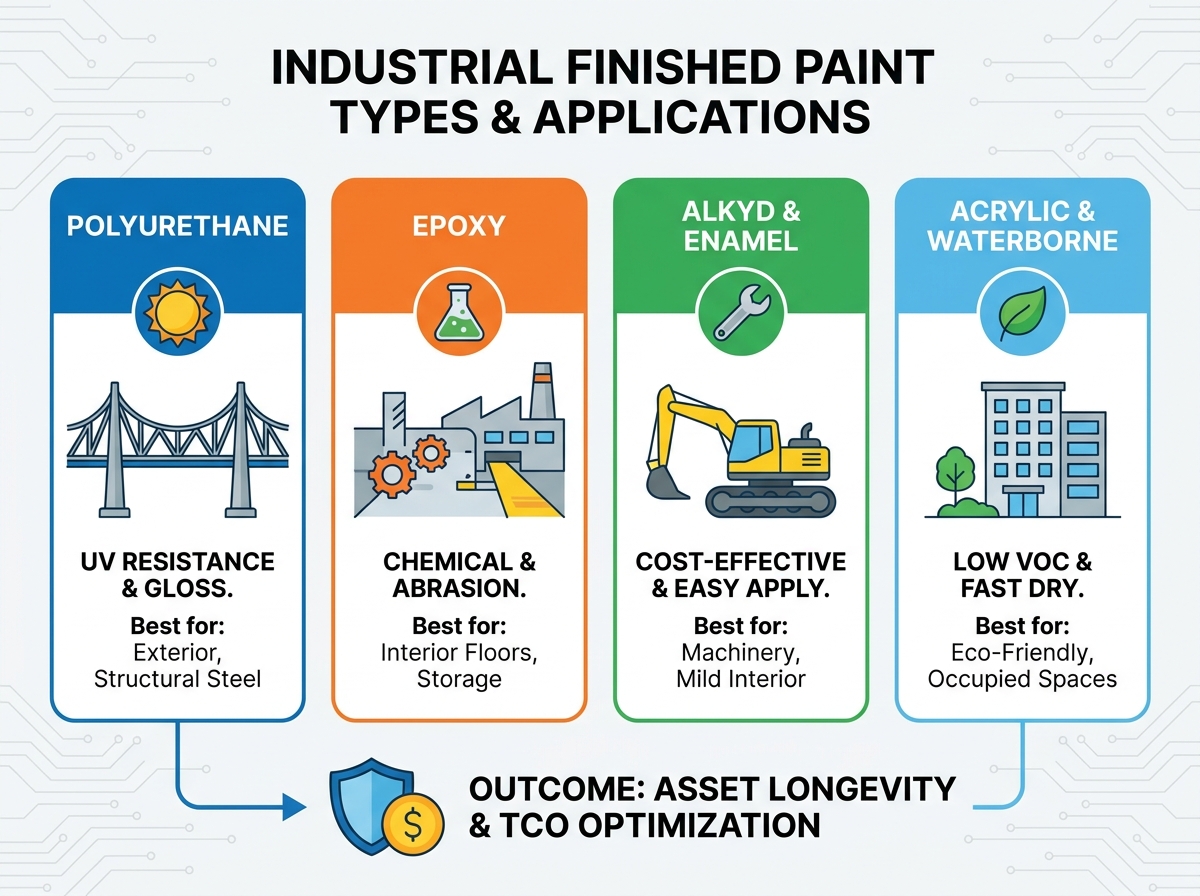
Core Types of Industrial Finished Paint (and When to Specify Them)
Choosing the correct coating chemistry dictates your long-term success. Every resin behaves differently under environmental stress. Let us review the primary formulations used in industry today.
Polyurethane Finishes
Polyurethane finishes entirely dominate exterior industrial applications. Applicators frequently use them on highway bridges, municipal water towers, and exterior storage tanks. You specify them for structural steel and highly visible commercial assets. They offer truly exceptional UV resistance.
They securely hold their gloss and original color for years under harsh sunlight. Furthermore, polyurethane remains highly flexible after curing. It easily expands and contracts alongside metal substrates during extreme temperature swings. However, these systems carry distinct application limitations. Applicators must maintain very strict moisture control during the process. Any ambient moisture in the air can react unfavorably with the paint. This reaction often causes severe blistering or micro-bubbling. Additionally, these systems require a significantly higher upfront material cost compared to basic enamels.
Epoxy Finishes
Epoxies serve as the reliable workhorses of interior industrial protection. You will find them heavily utilized on warehouse floors, chemical storage tanks, and submerged marine structures. We specify epoxies for submersion environments because they form an incredibly dense, impermeable barrier.
They deliver unmatched chemical and abrasion resistance for heavy industry. Once fully cured, epoxies achieve an extremely high physical hardness rating. They easily withstand dragging wooden pallets or heavily dropped tools. Despite these immense strengths, epoxies have one major structural weakness. They chalk and rapidly degrade under direct UV exposure. Sunlight causes the polymer chains to break down at the surface level. The finish turns chalky, powdery, and loses its aesthetic appeal entirely. Therefore, we generally restrict epoxies to interior applications.
Alkyd and Enamel Finishes
Alkyd and enamel finishes represent the traditional, oil-based industrial paints. Decades ago, these were the standard products across almost all commercial industries. Today, we carefully reserve them for stationary machinery, heavy equipment, and very mild interior environments.
You specify alkyds because they remain highly cost-effective for tight budgets. They are incredibly easy to apply using standard brush, roller, or spray equipment. Furthermore, alkyds remain fairly tolerant of less-than-perfect surface preparation. They wet out steel surfaces well and adhere over tightly adhering rust. However, they offer significantly lower chemical resistance overall. Their functional lifecycle is much shorter compared to modern, high-performance polymers. You will likely need to repaint alkyd systems twice as often.
Acrylic and Waterborne Finishes
Global environmental pressures have forced rapid, impressive advancements in waterborne technologies. Acrylic and waterborne finishes now play a crucial role in modern asset protection programs. We specify them heavily for facilities struggling with strict environmental regulations. They are also absolutely ideal for painting inside occupied commercial spaces like hospitals or schools.
They contain extremely low Volatile Organic Compounds. They dry incredibly quickly and emit almost no noxious odors during application. Historically, many industrial applicators viewed waterborne paints as vastly inferior. They were considered largely unsuitable for extreme, heavy-duty industrial exposures. However, modern acrylic formulations are rapidly closing this historical performance gap. Many new waterborne systems now strongly rival traditional solvent-based enamels in corrosion resistance.
Evaluation Framework: Aligning Coating Features to Facility Outcomes
You must rigorously match paint chemistry to your facility's physical reality. Relying on guesswork invites rapid coating failures. A structured evaluation framework effectively prevents these costly missteps.
- Chemical and Environmental Exposure: Start by thoroughly assessing the specific micro-environment. What exact pH levels will the paint endure daily? Are there harsh, highly concentrated solvents or intense atmospheric salinity present? Coastal facilities require coatings with excellent salt-fog resistance. Chemical processing plants require extreme acid or alkali resistance.
- Mechanical Wear and Traffic: Carefully evaluate the required physical abrasion resistance. A busy factory floor handling heavy, steel-wheeled forklift traffic needs a high-build epoxy. Conversely, static structural roof beams merely need basic atmospheric protection. You should specify coating hardness based directly on anticipated physical impact risks.
- Regulatory and Compliance Constraints: You must navigate EPA, OSHA, and local emission standards very carefully. Many metropolitan regions strictly restrict solvent-based paints. This drives a massive, industry-wide shift toward high-solids or advanced waterborne technologies. Always ensure your selected product fully meets local air quality mandates.
- Operational Downtime (Return-to-Service): Heavily factor in actual curing times. Shutting down a profitable production line costs significant money. Faster cure times often require advanced, plural-component heated spray systems. While the application process is much more complex, saving thousands of dollars in minimized downtime makes it highly worthwhile.
| Coating Category | Primary Strength | Ideal Operational Environment | Notable Weakness |
| Polyurethane | UV Resistance & High Flexibility | Exterior structures & bridges | Moisture sensitivity during application |
| Epoxy | Chemical & Severe Abrasion Resistance | Interior heavy floors & chemical tanks | Chalks quickly in direct sunlight |
| Alkyd/Enamel | Ease of Application & Lower Cost | Mild interior machinery components | Shorter overall functional lifespan |
| Acrylic/Waterborne | Low VOCs & Extremely Fast Drying | Occupied commercial indoor spaces | Lower heavy-duty chemical resistance |
Implementation Realities and Adoption Risks
Even the finest materials will fail if applied poorly. Facility implementation carries significant operational risks that you must mitigate.
Good paint simply cannot fix bad surface preparation. Approximately 70 to 80 percent of all premature coating failures stem directly from inadequate surface preparation. We rely entirely on strict industry standards to prevent this catastrophic waste. Institutions like SSPC and NACE provide clear, highly measurable guidelines. Heavy industrial applications typically require aggressive abrasive blasting. You must completely remove mill scale and loose rust to create a clean anchor profile. This microscopic surface roughness allows the new coating to grip the steel securely.
You also face significant chemical compatibility risks when upgrading older systems. Applying a new Finished Paint over an existing, completely incompatible coating invites disaster. For example, applying a "hot" solvent-based topcoat directly over an old, weak alkyd causes severe wrinkling. The strong modern solvents aggressively dissolve the underlying layer. You should always perform a standardized adhesion test patch before committing to full-scale application.
Finally, ambient environmental variables strictly dictate curing success. You risk rapid failure by applying finishes outside of manufacturer-specified climatic windows. Applicators must constantly monitor the dew point, relative humidity, and surface temperature. A standard industry rule demands the surface temperature remain at least five degrees above the dew point. Applying paint over invisible surface condensation heavily traps moisture and absolutely guarantees future delamination.
Assessing Coating Economics and Next Steps
Procuring industrial coatings requires looking far past the initial, upfront price tag. You need to analyze the true, long-term financial value of the protective system.
You should actively move your buyers away from standard "price per gallon" thinking. A cheap gallon of paint often contains up to fifty percent solvent. That cheap solvent simply evaporates uselessly into the air. Instead, we strongly advise evaluating the cost based on actual volume solids and theoretical coverage. You must calculate the actual cost to deposit one dry mil of paint over one square foot of steel. A paint formulation with much higher volume solids leaves far more protective material behind.
Next, consider the lifecycle costing of the entire maintenance project. Compare a cheaper, lower-quality coating system that actively requires repainting in just three years. Now, compare it against a premium, engineered system reliably lasting ten to fifteen years. The premium system easily wins the financial debate every single time. Practical application costs almost always dwarf raw material costs. You must carefully factor in the exorbitant costs of massive scaffolding, specialized labor crews, and forced facility downtime.
Finally, evaluate your strict criteria for shortlisting competent vendors. You should confidently select a coatings manufacturer or contractor based heavily on technical support. Look for favorable, clearly written warranty terms that protect your assets. You want highly experienced partners with a proven, verifiable track record in your specific industrial vertical.
- Audit your current facility conditions and firmly identify any specific chemical exposures.
- Define your maximum allowable facility downtime for the full application process.
- Consult technical coating data sheets for exact volume solids and environmental application requirements.
- Engage a certified, independent inspector to strictly verify your surface preparation plan.
Conclusion
Specifying a high-performance industrial topcoat remains a serious engineering decision. It is never a purely aesthetic choice meant just to look good. The topcoat acts as your primary, frontline defense against aggressive, destructive operational environments. We have clearly seen how proper resin selection securely shields steel, concrete, and heavy machinery from rapid degradation. Balancing performance needs against regulatory constraints ensures lasting protection.
Protect your massive infrastructure investment through expert validation and testing. We strongly advise stakeholders to conduct a thorough site audit immediately. You should consult directly with a NACE or AMPP certified coatings inspector. They can expertly validate your coating selection and entire surface prep plan. Always perform this crucial validation step before issuing a binding purchase order or formal RFP.
FAQ
Q: What is the difference between curing and drying in industrial finished paint?
A: Drying refers primarily to rapid solvent evaporation. It happens relatively quickly, simply leaving the paint film dry to the touch. Curing is the complex chemical cross-linking process occurring within the resin. It takes much longer but ultimately achieves the final hardness and durability required for heavy industrial protection.
Q: Can you apply a new finished paint directly over rust?
A: No. While specific "rust-converting" paints exist in the market, they face severe limitations in heavy industry. For durable, long-term industrial protection, you must use proper abrasive blasting. You need to completely remove existing rust and create a clean, rough anchor profile for the new coating.
Q: How do VOC regulations impact the choice of finished paint?
A: Regional environmental regulations strictly limit allowable Volatile Organic Compounds. This regulatory pressure forces many facilities to abandon traditional, solvent-heavy paints completely. Industries are rapidly shifting toward high-solids, 100% solids, or highly advanced waterborne coatings to remain legally compliant without sacrificing physical performance.
Q: What is the standard lifespan of an industrial topcoat?
A: The lifespan depends entirely on the operational environment, initial surface preparation quality, and specific paint chemistry. A basic interior enamel might only last 3 to 5 years. However, a premium, high-performance polyurethane applied perfectly over blasted steel can easily exceed 20 years of service.