Selecting the right paint system directly impacts material costs, shop turnaround times, and long-term finish durability. The choice between one-component and two-component systems dictates your production rhythm. Commercial body shop managers, industrial manufacturers, and professional-grade DIYers constantly evaluate coating options to maximize efficiency. Misapplying paint chemistry causes costly rework and unexpected bottlenecks. You need a reliable coating balancing rapid application with acceptable performance standards. Choosing poorly drains budgets through excessive material waste and sluggish curing times.
This article provides a technical and commercial evaluation of 1K color paint. We detail mechanical properties, operational benefits, and strict application boundaries compared to multi-stage systems. You will learn how ambient curing mechanics differ from chemical cross-linking. Read on to master how these coatings streamline your workflow and protect your bottom line.
Key Takeaways
- Definition: 1K (one-component) paint cures via solvent or water evaporation, requiring no separate hardener or activator.
- Operational Edge: Eliminates pot-life limitations, reduces material waste, and accelerates prep-to-spray workflows.
- Primary Use Cases: Ideal for automotive basecoats, interior paneling, industrial touch-ups, and cost-sensitive, high-volume production lines.
- The Trade-off: While 1K offers superior efficiency, it generally yields lower chemical and scratch resistance compared to chemically cross-linked 2K systems.
Understanding 1K Color Paint Specifications & Curing Mechanics
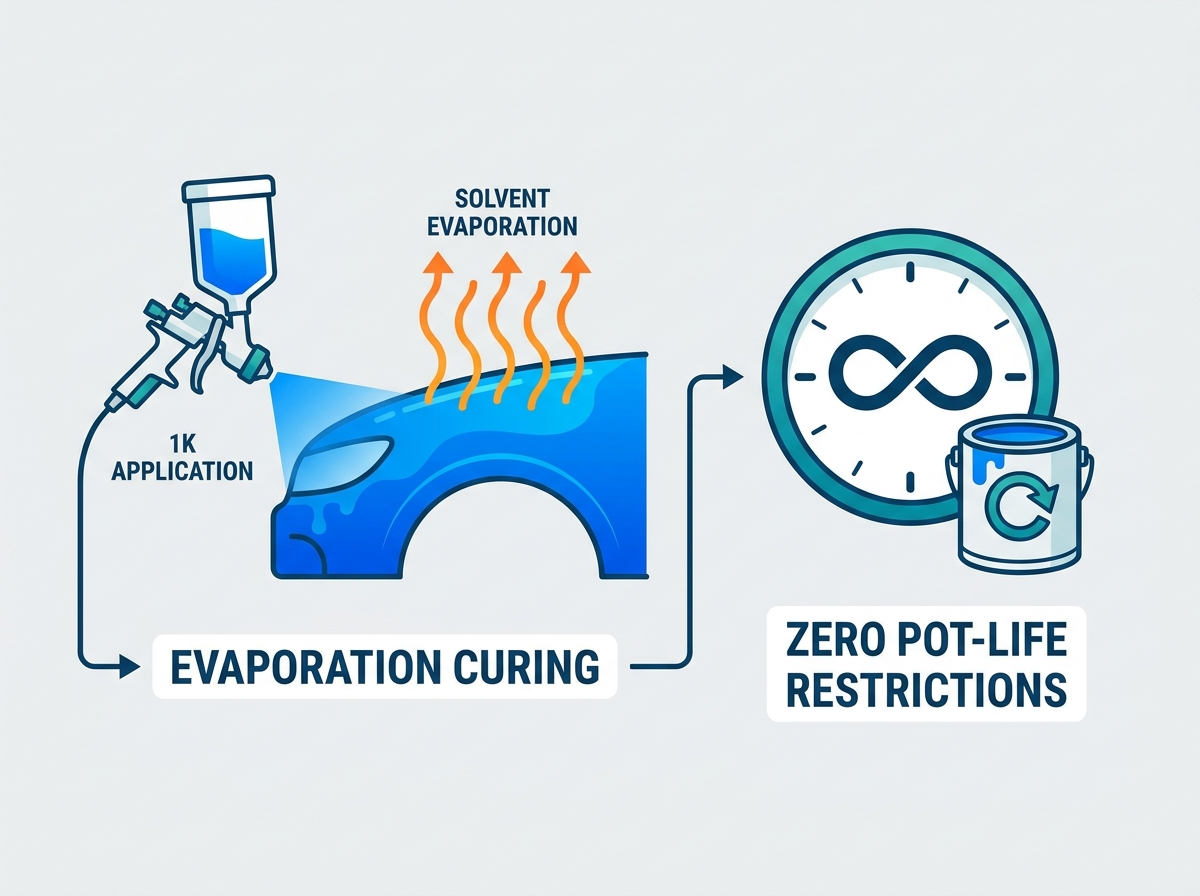
Professionals define 1-component (1K) systems by their simple chemistry. They lack a dedicated chemical hardener. They rely entirely on ambient air drying to solidify. As thinners, solvents, or water evaporate from the applied film, the remaining resins and pigments bind together. They form a solid coating on the substrate. This physical drying process differs vastly from exothermic chemical reactions. You simply spray the product, allow the carriers to flash off, and the surface dries.
To successfully integrate these products into your production line, you must review 1k color paint specifications carefully. Technical data sheets reveal several critical metrics. These metrics determine how the coating performs in real-world environments.
- Volume Solids: This metric dictates coverage rates and film build per coat. Higher volume solids mean less solvent evaporates. You get a thicker, more protective layer per pass. Lower solids require multiple coats to achieve full opacity.
- Flash-Off Times: This measures the expected drying windows between coats. It proves crucial for shop scheduling. Most standard 1K formulations require a 10 to 15-minute flash-off at room temperature. Fast flash times keep the spray booth moving.
- VOC Emissions: Environmental regulations heavily influence commercial shops. You must evaluate solvent-borne versus water-borne 1K variants. Water-borne systems emit fewer volatile organic compounds. They help shops maintain regulatory compliance in strict jurisdictions.
You must acknowledge the implementation reality of physical curing. Because 1K formulations do not chemically cross-link, they remain theoretically soluble. If you expose a cured 1K surface to heavy solvents later, the paint can reactivate or wrinkle. This fundamental limitation dictates application boundaries. You should avoid applying single-component paints on areas exposed to raw fuel, brake fluid, or harsh industrial chemicals. Recognizing this boundary ensures you specify the coating correctly for appropriate environments.
![1K Color Paint System Application]()
The Business Case: Core Benefits of Formulating with 1K
Efficiency drives profitability in any professional spray environment. Implementing one-component systems introduces several immediate operational advantages. The most significant benefit involves zero pot-life restrictions. When you mix a 2K system, the chemical clock starts ticking. You must use the activated paint before it hardens in the cup. Conversely, unused 1K paint remains stable. You can pour unthinned leftovers back into the storage tin. This simple practice drastically reduces chemical waste and lowers material overhead.
Workflow efficiency and turnaround times also improve. Painters experience fewer mixing errors because they skip complex hardener ratios. You achieve faster setup times. Furthermore, you eliminate hardener-related equipment purging. Cleaning a spray gun after a 2K session requires meticulous effort to prevent permanent internal blockages. Cleaning a gun after spraying 1K requires a simple solvent flush. These saved minutes accumulate into hours of reclaimed labor each week.
Cost predictability represents another major advantage. Lower upfront material costs help managers draft competitive project bids. You can calculate predictable coverage rates without factoring in wasted pot-life material. This stability proves essential for accurate project bidding in both industrial manufacturing and automotive repair scenarios. Your material usage aligns closely with your initial estimates.
Occupational safety improves alongside operational metrics. Standard 2K hardeners commonly contain highly toxic isocyanates. These chemicals pose severe respiratory risks. They mandate specialized forced-air personal protective equipment (PPE) and advanced spray booth ventilation. Single-component systems typically lack isocyanates. This absence reduces the respiratory hazard profile. While painters still need proper respirators and ventilation, the risk management requirements are less strenuous.
1K Clear Coat vs 2K Paint Systems: A Decision Matrix
Choosing the right clear coat often determines the longevity of the entire paint job. We must compare the curing process of both systems directly. A one-component system cures via evaporation. The surrounding air draws the solvent out. A two-component system cures via an exothermic chemical reaction. The resin and hardener link together molecularly. This reaction creates an impenetrable lattice structure.
When analyzing durability and hardness, we establish a firm trust marker. A 1K system cannot match a 2K system for absolute resistance. Two-component coatings deliver superior UV protection. They withstand fuel spills, battery acid, and harsh detergents. They also resist mechanical impacts like stone chips and aggressive polishing. Single-component films remain softer and more vulnerable to environmental degradation.
You must evaluate 1k clear coat vs 2k based on specific use cases. Analyze the project parameters carefully. Single-component clear coats excel in low-impact areas. Use them for quick spot repairs, interior door jambs, or budget refurbishments. They offer adequate gloss for protected surfaces. However, 2K remains the mandatory industry standard for high-exposure exterior topcoats. Automotive hoods, roofs, and industrial exteriors demand cross-linked protection.
Time-to-service heavily influences shop throughput. Single-component systems offer rapid ambient air dry times. They become touch-dry quickly, though full solvent release takes longer. Two-component systems rely on forced-bake booth cycles or chemically accelerated cure times. They harden predictably regardless of ambient humidity. A baked 2K panel can undergo polishing on the same day. A 1K panel often requires more delicate handling during the initial 24 hours.
| Performance Metric | 1-Component (Evaporation) | 2-Component (Cross-Linked) |
| Curing Method | Solvent/Water Evaporation | Exothermic Chemical Reaction |
| Mixing Complexity | Ready to spray (or simple thinning) | Requires precise hardener ratios |
| Pot Life | Unlimited (if sealed properly) | Strictly limited (usually 2-4 hours) |
| Chemical Resistance | Low to Moderate (Soluble) | High (Impervious to most solvents) |
| Mechanical Durability | Moderate (Prone to chipping) | Excellent (High impact resistance) |
| Typical Application | Basecoats, jambs, industrial touch-ups | Exterior topcoats, harsh environments |
Strategic Applications in Automotive Refinishing and Industrial Sectors
The automotive industry relies heavily on strategic layering. The standard "two-stage" paint system perfectly illustrates this synergy. Painters apply a single-component color as the basecoat. This layer delivers highly accurate color matching, metallic flake orientation, and fast drying times. Once the basecoat flashes off, painters lock it in using a two-component clear coat. This hybrid approach utilizes the rapid application speed of evaporation-cured color alongside the impenetrable protection of chemically cured clear.
Commercial body shops deploy these systems tactically across their operations. They maximize profit by matching the material to the panel's exposure risk. Technicians use single-component formulations for blending adjacent panels. They apply it to panel edge repairs, internal engine bays, and trunk interiors. Commercial fleet operators frequently use it on truck chassis and internal cargo spaces. In these specific areas, hyper-durability remains secondary to speed, ease of application, and cost containment.
The industrial and manufacturing sectors leverage similar advantages. Large-scale machinery spraying demands continuous application. Production lines cannot halt for pot-life expiration. Manufacturers use these fast-drying formulas for structural steel primers. Agricultural equipment, such as tractors and plows, often receives high-volume, rapid-dry single applications. Factory managers maintain production line speed by avoiding complex mixing stations. The fast solvent release allows workers to assemble painted components faster, reducing staging yard bottlenecks.
How to Determine if 1K is Right for Your Project
Making a data-backed purchasing decision requires auditing your specific operational needs. You must weigh material savings against performance requirements. Use these practical guidelines to navigate the selection process for your upcoming jobs.
- Select 1K If:
- The project remains highly budget-constrained, and material cost dictates profitability.
- The coating will serve exclusively as a basecoat under a protective, cross-linked clear.
- You manage a high-volume, continuous-spray production line where strict pot-life constraints would cause severe bottlenecks.
- Your application environment lacks the forced-air respiratory equipment legally required for spraying isocyanates safely.
- You are coating interior components protected from UV degradation and mechanical abrasion.
- Shortlist 2K Instead If:
- The finished component faces direct, prolonged exposure to harsh chemicals, automotive fuels, or battery acids.
- The environment involves heavy mechanical abrasion, such as gravel impact on a front bumper.
- You require a high-build, ultra-gloss final exterior finish capable of surviving aggressive machine compounding and polishing.
- The client demands original equipment manufacturer (OEM) grade longevity and is willing to pay premium labor rates.
Your next steps should involve an internal operational audit. Recommend your team review current shop bottlenecks. Determine if your primary issue is material waste, excessive drying time, or unacceptable durability failures. If waste and speed are your enemies, lean toward single-component systems. If customer comebacks due to peeling or fading haunt your shop, you must upgrade your topcoats to cross-linked formulas.
Conclusion
Single-component paint holds immense strategic value in modern coating environments. It provides a highly efficient, cost-effective solution when deployed correctly. Success depends entirely on understanding its physical drying limitations. You maximize its potential by using it as a high-speed basecoat or an industrial finish in low-exposure areas. It eliminates pot-life waste, reduces mixing errors, and keeps production lines moving rapidly.
Conversely, you court failure by asking evaporation-cured films to perform like chemically cross-linked armor. Acknowledging this boundary protects your reputation and your profit margins. Aligning the paint chemistry with the substrate's environmental exposure ensures long-lasting results. You build trust with clients by delivering appropriate durability for their specific budget.
Take immediate action to optimize your material usage. Prompt your procurement managers and shop owners to review technical data sheets (TDS) for your current inventory. Contact technical sales representatives to arrange a pilot test of commercial 1K formulations. Measure the reduction in mixing time and material waste during the trial. Data-driven adjustments to your paint inventory will ultimately streamline your workflow and expand your operational capacity.
FAQ
Q: Can I spray a 2K clear coat over a 1K color paint basecoat?
A: Yes. This represents the standard automotive two-stage process. You must allow the basecoat to flash off completely before applying the clear. Proper solvent evaporation prevents solvent pop and ensures excellent inter-coat adhesion. Always check the technical data sheet to confirm specific brand compatibility.
Q: Does 1K paint need a thinner or reducer?
A: Most formulations require thinning to achieve the correct spray viscosity. You adjust the reduction ratio based on your specific spray gun tip size and ambient booth temperature. Follow the manufacturer's mixing guidelines strictly to prevent runs or dry spray.
Q: How long does 1K color paint take to fully cure?
A: It becomes "touch dry" quickly, often within 15 to 30 minutes. However, full curing via complete solvent release can take several days or even weeks. Humidity, film thickness, and ambient temperature significantly influence the total time required to achieve maximum hardness.
Q: Is 1K paint fuel resistant?
A: No. Because it cures via evaporation without chemical cross-linking, it offers minimal resistance to harsh solvents. Spilled gasoline or harsh brake cleaners will soften, stain, or dissolve the finish. You must use a chemically activated two-component topcoat for genuine fuel resistance.