Using the wrong solvent in industrial and commercial finishing leads to a costly reality. Mismatched chemicals cause severe surface defects, significant project delays, and dangerous safety hazards. Paint batches fail to cure correctly, spray equipment clogs, and facilities lose valuable time correcting preventable errors.
To avoid these failures, finishing professionals rely heavily on specialized formulas. We define nitro thinner as a highly volatile, custom-engineered solvent blend. Manufacturers design it specifically to dissolve and stabilize nitrocellulose-based lacquers and paints. It delivers aggressive solvency power unavailable in standard mineral spirits.
This article provides industrial buyers, automotive refinishers, and commercial woodworkers with a definitive operational framework. We will explore how to evaluate, select, and safely implement this powerful solvent. You will learn the chemical mechanics behind it and discover practical strategies for optimizing your daily finishing workflow.
Key Takeaways
- Precision matters: Nitro thinner is not interchangeable with standard paint thinners; its specific ester, ketone, and alcohol blend is required to properly dissolve nitrocellulose resins.
- Evaporation control is critical: Selecting the right grade depends heavily on ambient temperature to prevent surface defects like blushing or orange peel.
- Compliance and safety dictate procurement: Strict adherence to VOC (Volatile Organic Compound) regulations and facility safety standards must drive the vendor shortlisting process.
- Cost vs. Quality: Utilizing low-grade or highly recycled thinners reduces upfront costs but significantly increases the risk of rework and finish degradation.
The Chemical Profile: Why Nitrocellulose Requires a Specialized Solvent
Standard aliphatic solvents completely fail to break down nitrocellulose resins. When operators attempt to thin lacquer using basic mineral spirits, they encounter immediate problems. The resin separates from the liquid carrier. This separation causes severe clumping in the mix. Poor adhesion follows once applied, ultimately resulting in ruined material batches and wasted labor hours.
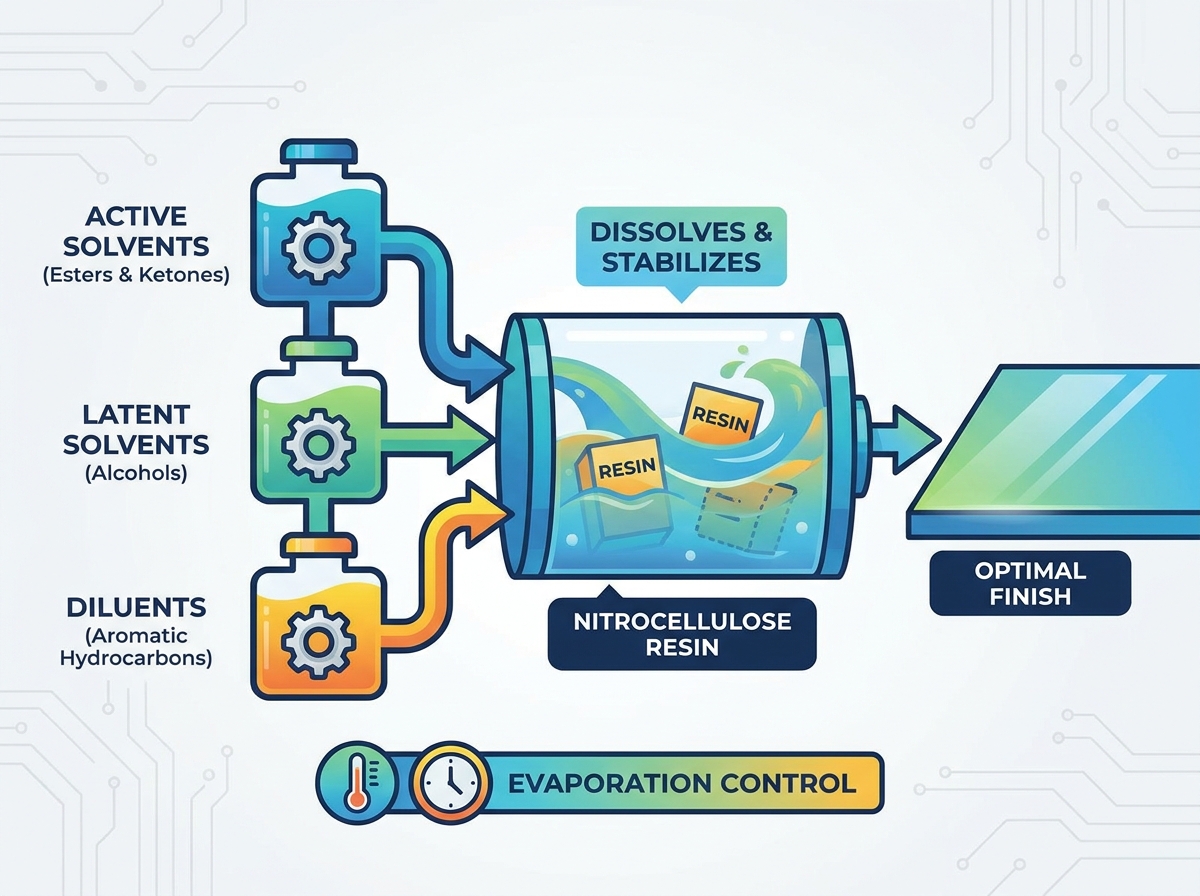
Nitrocellulose molecules demand an aggressive, multi-component chemical approach. A proper thinner formulation relies on three distinct chemical families working together. They create a stable, sprayable liquid capable of carrying solid resins evenly across a substrate.
Here is the functional component breakdown of a commercial blend:
- Active Solvents (Esters and Ketones): These chemicals drive the actual dissolving of the solid resin. They break down the tough molecular bonds. Common examples include ethyl acetate and acetone.
- Latent Solvents (Alcohols): While they cannot dissolve the resin alone, they enhance the cutting power of the active solvents. They stabilize the mixture and prevent the active solvents from flashing off too quickly.
- Diluents (Aromatic Hydrocarbons): Chemicals like toluene or xylene control the evaporation rate. They reduce overall material cost without compromising the viscosity of the fluid.
A balanced formulation determines your final success. It ensures a smooth, self-leveling finish. It also maintains the structural integrity of the base lacquer. If the manufacturer skimps on active solvents, the lacquer will not atomize properly.
Solvent Component Roles and Functions
| Component Type | Chemical Examples | Primary Function in the Blend |
| Active Solvents | Ethyl Acetate, Butyl Acetate, MEK | Dissolves the nitrocellulose resin directly. |
| Latent Solvents | Isopropyl Alcohol, Butanol | Boosts solvency power and stabilizes the mixture. |
| Diluents | Toluene, Xylene | Controls evaporation speed and reduces bulk formulation costs. |
Understanding this chemical profile helps you troubleshoot finish defects. When you know how the liquids interact, you can adjust your mixtures to compensate for challenging shop conditions.
![Nitro thinner application and processing]()
Primary Commercial and Industrial Applications
Professionals across multiple industries rely on this chemical for its fast-drying properties and high solvency. Each industry leverages specific traits of the blend to achieve distinct operational goals.
Automotive refinishing shops use it extensively for priming and prep work. Technicians thin high-build primers and fast-drying touch-up lacquers daily. Shop managers evaluate the liquid based on its ability to atomize cleanly through commercial HVLP spray guns. A clean atomization prevents spitting and ensures a uniform film build across vehicle panels. It speeds up the sanding process because the fast evaporation allows primers to cure rapidly.
Commercial woodworking and furniture manufacturing represent another massive application sector. It remains the absolute standard for achieving high-gloss, fast-curing wood finishes. Cabinet makers evaluate it on its ability to enhance natural grain clarity. High-quality blends perform this task without leaving a cloudy or milky residue behind. The fast cure times allow production lines to handle and stack furniture pieces much sooner than polyurethane alternatives.
Industrial cleaning and degreasing operations also consume large volumes of the chemical. It acts as an incredibly aggressive equipment cleaner. Operators use it for flushing spray lines and removing cured adhesives from metal surfaces. It effectively cuts through overspray accumulated on spray booth walls. Because it dissolves hardened resins easily, it keeps expensive fluid delivery systems operating at peak efficiency.
Evaluating fit requires aligning the application type with specific solvent volatility. Fast-evaporating blends work best for quick equipment cleaning or winter spraying. Conversely, controlled-evaporation blends excel in high-gloss finishing where the wet film needs time to lay flat.
Evaluating Nitro Thinner Performance and Benefits
When you source chemicals for your facility, you must map specific product features to tangible operational outcomes. Understanding how chemical properties influence the final finish helps you justify procurement decisions.
- High Solvency Power: A premium grade reduces the total volume of thinner required to reach spraying viscosity. This improves your solid-to-solvent ratio. A higher solids ratio allows you to achieve the necessary film build using fewer coats. You save significant labor time.
- Controlled Evaporation: Proper evaporation rates allow the wet paint film to level properly. When the liquid evaporates too quickly, the paint droplets do not flow together. This creates "orange peel," a textured surface dimpling resembling citrus fruit. A balanced blend provides enough open time for the surface tension to flatten out.
- Moisture Resistance: High-quality blends actively resist moisture entrapment. In high-humidity environments, rapid solvent evaporation cools the surrounding air. This cooling pulls airborne moisture into the wet paint film. The trapped water creates "blushing," leaving a milky, cloudy haze in the finish. Superior Nitro thinner uses specific retarder solvents to slow the flash time and eliminate blushing.
Scalability considerations matter deeply for commercial operators. Consistency across large batches prevents color-matching nightmares. If you purchase cheap, inconsistent thinner, the evaporation rate will fluctuate wildly from drum to drum. These fluctuations cause curing discrepancies in high-volume production lines. Your morning batches might gloss perfectly, while afternoon batches cure dull and textured. Insisting on tight manufacturing tolerances from your supplier guarantees reproducible results across thousands of parts.
Procurement Framework: Shortlisting and Selection Criteria
Purchasing finishing chemicals requires a strategic approach to mitigate production risks. You cannot simply select the cheapest drum available. You must verify purity, match the blend to your environment, and validate supplier credibility.
Purity and grade verification should drive your initial screening. You must assess the virgin versus recycled solvent ratio. Reclaimed thinners represent a viable, budget-friendly option for industrial equipment cleaning or gun washing. However, they carry incredibly high risks of contamination if you use them in topcoat finishing. Reclaimed blends often contain trace impurities, silicone, or varying moisture levels. These contaminants cause fish-eyes, poor adhesion, and unpredictable drying times in clear coats. Always mandate 100% virgin solvent for topcoat applications.
Climate and environmental matching dictate the exact formula you need. Your supplier should offer seasonal variations.
- Standard or Fast Thinner: Formulated for winter months or cold-climate applications. Cold temperatures naturally slow down evaporation. Fast thinners compensate for the cold, ensuring the paint cures within the expected timeframe.
- Retarder or Slow Thinner: Essential for summer months or high-heat environments. Hot temperatures force solvents to flash out prematurely. Retarders keep the paint film wet longer, preventing dry spray and allowing the finish to level smoothly.
Supplier authoritativeness represents your final checkpoint. You must shortlist vendors based on transparency. Demand immediate access to their Safety Data Sheets (SDS). Ask them for batch-testing documentation to prove chemical consistency. Evaluate their supply chain logistics. A supplier offering an excellent chemical blend becomes useless if they cannot deliver drums reliably during peak production seasons.
Implementation Risks, Safety, and Compliance Realities
Introducing highly volatile chemicals into your facility requires strict adherence to safety protocols. You must protect your workforce and your physical assets from severe hazards.
Health and handling hazards present the most immediate danger. These solvent blends exhibit high toxicity and extreme flammability. Vapors easily ignite from minor sparks, including static electricity. You must mandate the grounding of all metal containers during fluid transfer. Bonding wires prevent static discharge from igniting volatile fumes while operators pour liquid from a 55-gallon drum into a smaller mixing cup.
Personal Protective Equipment (PPE) and facility requirements demand rigid enforcement. Standard dust masks offer zero protection against solvent fumes. Facility managers must enforce the mandatory use of NIOSH-approved organic vapor respirators. Skin absorption poses another significant threat. Operators must wear nitrile or butyl rubber gloves, as standard latex disintegrates upon contact. Furthermore, your mixing rooms and spray booths require explosion-proof ventilation systems to continuously evacuate heavier-than-air fumes from floor level.
Regulatory compliance requires constant vigilance. You must navigate regional Volatile Organic Compound (VOC) limits set by organizations like the EPA, OSHA, or local environmental equivalents. Many regions enforce strict caps on the maximum allowable VOC output per gallon of sprayed material. You face massive business risks for non-compliance. Inspectors actively issue severe fines and can legally enforce immediate facility shutdowns if you violate emission limits. Always cross-reference your thinner's VOC profile with your local environmental regulations.
Storage best practices prevent chemical degradation and fire hazards. Local fire codes typically dictate stringent requirements. You must utilize specialized, fire-rated safety cabinets for daily storage. Climate-controlled environments prevent extreme temperature swings from compromising the solvent package. Implement strict inventory rotation using the First-In, First-Out (FIFO) method. While highly stable, storing opened drums for years can lead to moisture absorption or evaporation of the lightest chemical components. Proper inventory management ensures you always spray fresh, predictable material.
Conclusion
Choosing the right solvent requires carefully balancing your application needs, environmental conditions, and facility safety compliance. As we have explored, precision in chemical selection directly impacts the quality of your final finish. Substituting proper blends for cheap mineral spirits guarantees project failure.
Your decision logic should prioritize documentation and testing. Always request updated SDS documentation from potential vendors. Conduct small-batch testing on scrap materials before committing to large-scale procurement. This testing validates how the liquid performs within your specific shop climate and equipment setup.
Take action today by auditing your current finishing operations. Review your daily defect rates regarding blushing or orange peel. Check your local VOC restrictions to ensure compliance. Finally, contact a certified chemical distributor to request a tailored formulation quote that matches your exact production requirements.
FAQ
Q: Can I use standard paint thinner or mineral spirits instead of nitro thinner?
A: No. Mineral spirits and standard paint thinners lack the active ester and ketone solvents required to dissolve nitrocellulose. If you mix them, the resins will clump, resulting in ruined paint, poor adhesion, and severely clogged spray equipment.
Q: What causes "blushing" when using nitro thinner, and how can I fix it?
A: Blushing occurs when fast evaporation cools the painted surface rapidly, drawing ambient moisture from the humid air into the wet film. You fix this by switching to a slower-drying thinner or adding a specialized retarder to delay evaporation.
Q: What is the standard mixing ratio for nitro thinner and lacquer?
A: Mixing ratios vary widely by manufacturer and your specific application method. They typically range between 1:1 and 2:1 (thinner to lacquer). Always rely strictly on the technical data sheet provided with your specific lacquer for exact measurements.
Q: How long is the shelf life of commercial nitro thinner?
A: Commercial blends typically maintain a shelf life of 12 to 24 months. You must store them under proper, tightly sealed, and climate-controlled conditions. Leaving containers open allows highly volatile components to escape, altering the chemical balance.