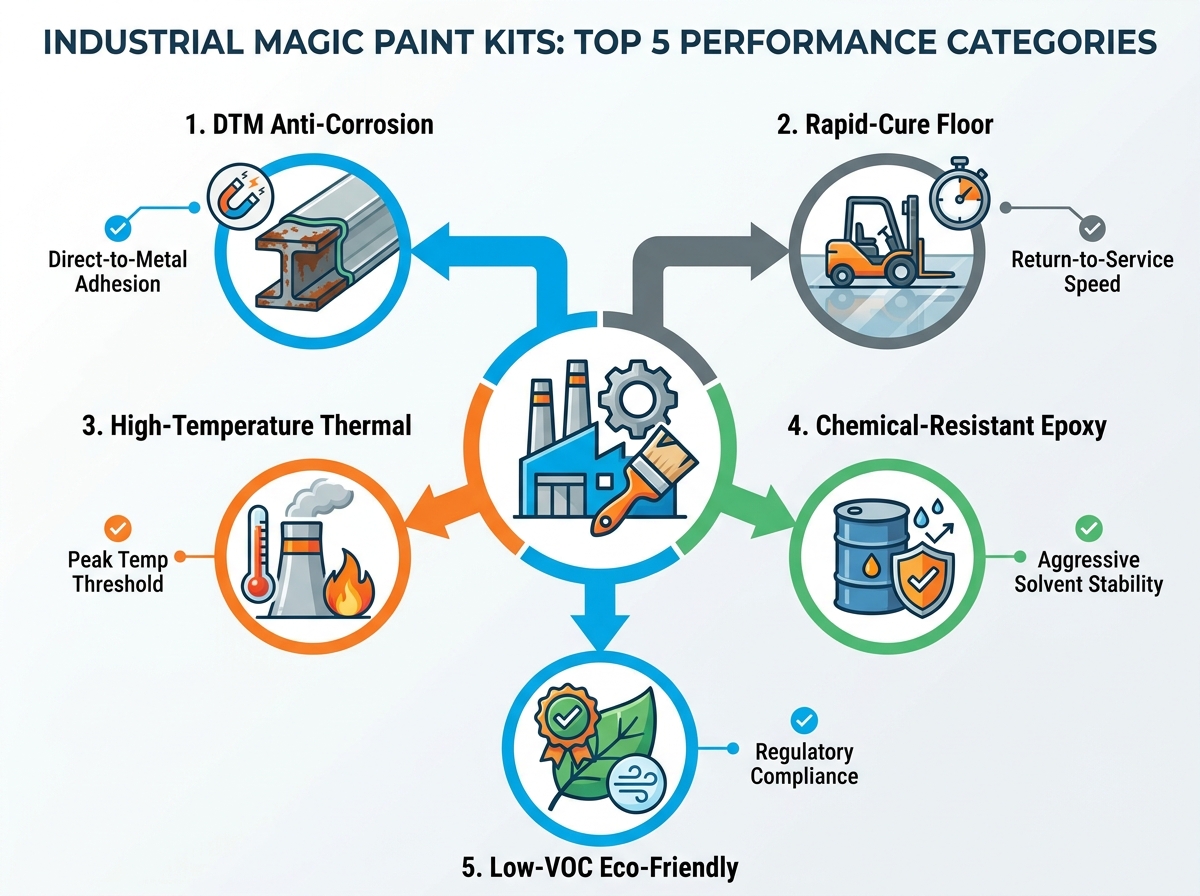
Facility downtime for maintenance painting costs thousands of dollars per hour. You simply cannot afford prolonged operational pauses. Procurement teams urgently need solutions offering faster cures, harder bonds, and fewer surface preparation steps. In the industrial sector, professionals often refer to these solutions as Magic Paint. This term describes advanced, rapid-cure, direct-to-metal, or self-leveling coating systems packaged as convenient all-in-one kits. They promise remarkable efficiency. Our objective is to strip away the marketing jargon completely. We will objectively evaluate the top five kits based on performance data, application realities, and compliance standards. This comprehensive guide will help facility managers make an informed procurement decision today.
Key Takeaways
- Not all "magic" coatings are created equal; selection must align strictly with the substrate (metal, concrete, polymer) and environmental exposure (chemical, thermal, physical wear).
- The true ROI of a premium magic paint kit is measured in reduced labor hours and minimized facility downtime, not just the cost per gallon.
- Even the most advanced all-in-one kits require strict adherence to surface preparation and environmental (temperature/humidity) application windows.
- Compliance matters: Selecting kits with Low-VOC and industry-specific certifications (e.g., FDA, OSHA color standards) mitigates regulatory risks.
Beyond the Marketing: What Defines an Industrial "Magic Paint" Kit?
Standard industrial coatings require frustrating multi-step processes. You typically apply a heavy primer first to seal the surface. Next, you add an intermediate base layer to build thickness. Finally, you apply a protective topcoat. This traditional approach demands extensive curing times between each distinct layer. Such long delays make older paints completely unviable for high-traffic facilities. Continuous-operation plants, like automotive assembly lines or chemical refineries, need much faster alternatives. They cannot halt production for three days just to paint a floor.
Industrial paint kits consolidate these cumbersome steps efficiently. They utilize advanced epoxies, polyurethanes, or modern polyaspartics. These engineered chemical formulations offer incredible direct-to-substrate adhesion. They also feature accelerated cross-linking. This specific chemical reaction creates a dense, three-dimensional matrix rapidly. This matrix provides incredibly fast drying speeds. You can often reopen a facility floor or put a machine back online in mere hours.
However, you must maintain a highly skeptical lens when reading brochures. There is no literal magic hidden in these plastic buckets. Manufacturers build highly engineered, reactive chemical systems. Poor surface prep will still lead to catastrophic delamination. The formula cannot save a poorly cleaned or greasy substrate. We advise maintenance teams to remember a core best practice. Always remove loose debris, oil, and grease first. A common mistake is assuming an all-in-one product forgives a dirty surface. It never does. The chemical bond requires direct contact with bare metal or clean concrete.
Core Evaluation Framework: How We Assessed the Kits
We used a strict feature-to-outcome mapping strategy to evaluate these systems. Our assessment measures return-to-service speed very accurately. We monitor exactly when coated floors can handle heavy foot traffic safely. We look for a strict two-hour minimum window. We also test for heavy forklift readiness within twelve hours. Faster cures mean significantly less operational disruption for your facility.
Next, we evaluate adhesion and tensile strength using rigorous criteria. We look for compliance with recognized industry standards like ASTM D4541 for pull-off adhesion. A tough coating must withstand heavy impacts daily without shattering. It needs strong abrasion and thermal shock resistance. It should not flake under heavy mechanical pressure or sudden temperature drops. We also verify chemical and UV resistance thoroughly. Long-term stability matters greatly against harsh industrial solvents. High resistance to aggressive degreasers, hydraulic fluids, and direct sunlight exposure is mandatory.
Compliance and safety form our second testing pillar. We review Volatile Organic Compound (VOC) levels in grams per liter. We check flammability ratings carefully to ensure fire safety compliance. Applicator safety requirements remain a top priority for every test we conduct.
Finally, we judge the overall scalability of application. Can in-house maintenance crews apply the product easily using standard tools? We highly prefer kits compatible with a simple brush or a heavy-duty roller. Some advanced systems demand specialized plural-component spray equipment. These complex spraying tools mix chemicals right at the nozzle. They require expensive outside contractors and extensive masking procedures.
| Evaluation Metric | Primary Focus Area | Ideal Industrial Standard |
| Cure Time | Downtime reduction | Under 12 hours for heavy machinery traffic |
| Tensile Strength | Impact and abrasion resistance | Zero flaking under rapid thermal shock |
| Chemical Stability | Solvent and UV exposure | Absolute resistance to industrial degreasers |
| Safety Standards | VOC levels and flammability | Low VOC emissions, safe for indoor crews |
![Industrial Paint Kit Application]()
The Top 5 Magic Paint Kits for Industrial Facilities (Evaluated)
We analyzed numerous products to find the absolute best options on the market. Here is our detailed breakdown of the top performers for commercial facilities.
1. The Best Direct-to-Metal (DTM) Anti-Corrosion Kit
You need this specific formulation for severely rusted structural steel. It works beautifully on exposed exterior pipes, storage tanks, and heavy lifting cranes. It excels in remote environments where abrasive sandblasting remains logistically or financially impossible. Facility managers love its practical simplicity.
This kit delivers thousands of salt-spray resistance hours. You get excellent primerless adhesion capability. It bonds tightly to firmly adhered rust, sealing out further oxygen.
However, you will face some notable limitations. It often features slower curing times compared to rapid floor coatings. You must perform mechanical wire-brushing at a minimum to remove loose flakes. You cannot paint over loose, flaking rust or heavy mill scale.
2. The Best Rapid-Cure Floor Coating Kit (Polyaspartic)
This kit suits high-traffic warehouse floors and logistics centers perfectly. Busy loading docks needing overnight return-to-service require this exact solution. It cures exponentially faster than traditional two-part epoxies.
It offers immense hot-tire pickup resistance. Heavy forklifts carrying loaded pallets will not tear it up. It boasts excellent self-leveling properties and high UV stability. The floor color will not fade or turn chalky near large bay doors.
You will face a very short pot life during application. The mixed material often lasts under twenty minutes in the bucket before hardening. It is highly sensitive to concrete moisture vapor transmission. You must test floor moisture levels rigorously before starting the project.
3. The Best High-Temperature / Thermal Kit
Apply this durable kit to industrial boilers and massive exhaust stacks. Heavy-duty motors and steam pipes also benefit greatly from this application. It handles extreme heat cycles without cracking or losing adhesion.
It handles peak temperature thresholds effortlessly. Some specialized formulations withstand up to 1200 degrees Fahrenheit safely. It meets strict heat-curing requirements demanded by heavy industry.
Color options remain largely limited due to heat-resistant pigments. You usually must choose basic black, silver, or safety red. The system requires a specific heat-cycling process to achieve final hardness. You must slowly raise the equipment temperature over several hours. This gradual process ensures the film fully cures properly without blistering.
4. The Best Chemical-Resistant Epoxy Kit
Use this rigid kit in aggressive forklift battery charging stations. Chemical processing plants and secondary containment areas desperately need this protection level. It forms an impenetrable chemical barrier against highly corrosive liquids.
It dominates resistance charts against concentrated sulfuric acid and hydrochloric acid. It withstands caustic soda and aggressive industrial solvents easily. Accidental spills will not degrade the protected surface.
It is prone to ambering or yellowing under prolonged UV exposure. You must apply it over a very rigid, stable substrate. The fully cured film possesses very low flexibility. Bending metals or expanding joints will cause this brittle coating to snap.
5. The Best Eco-Friendly / Low-VOC All-Purpose Kit
Food processing facilities and pharmaceutical labs prefer this clean option. Hospitals and occupied commercial spaces requiring strict odor control use it daily. It prevents foul chemical smells from traveling through shared ventilation ducts.
It guarantees zero or near-zero VOC emissions during application and curing. It frequently achieves FDA and USDA incidental food contact compliance. This strict certification keeps health inspectors and safety auditors completely satisfied.
You might sacrifice some physical impact resistance for this safety. It may require significantly longer drying times compared to high-solvent alternatives. You effectively trade rapid curing speed for maximum environmental and occupant safety.
Implementation Realities and Adoption Risks
You must understand the strict surface preparation mandate. We need to dispel a dangerous myth right now. You cannot apply any advanced Magic Paint over heavy grease or dirt. Loose mill scale will ruin the chemical bond instantly. You must follow minimum SSPC (Society for Protective Coatings) standards. For example, SSPC-SP 1 demands thorough solvent cleaning first to remove oils. Then, SSPC-SP 2 requires careful hand tool cleaning. SSPC-SP 3 demands more aggressive power tool cleaning. You cannot skip these crucial preliminary steps and expect success.
Environmental constraints dictate successful applications completely. Ambient temperature, substrate temperature, and relative humidity matter deeply. Dew point calculations are strictly non-negotiable for contractors. Applying epoxy when your substrate sits just three degrees above the dew point guarantees failure. Invisible moisture will condense directly on the cold surface. The coating will trap this moisture, blister, and peel within weeks. Always monitor microclimates inside your facility.
Safety protocols remain vital for all painting teams. Two-part chemical systems pose serious respiratory and dermal hazards. You must ensure proper area ventilation constantly. Applicators must wear appropriate personal protective equipment, including nitrile gloves and safety goggles. Brands may heavily market these products as user-friendly solutions. However, chemical cross-linking reactions release intense, sometimes invisible fumes. A common mistake involves ignoring organic vapor respirator requirements during the mixing phases. Always enforce strict safety policies for your maintenance crews to prevent acute chemical exposure.
Shortlisting Logic: Next Steps for Procurement
Procurement teams need a clear, actionable decision matrix. We recommend following a structured logic path based on facility priorities.
- If downtime is the highest cost factor, choose Kit 2 (Polyaspartic). These fast-curing solutions return floors to full service overnight.
- If infrastructure preservation is critical, choose Kit 1 (DTM). DTM anti-corrosion kits stop destructive rust spread immediately.
- If environmental compliance forms a strict barrier, choose Kit 5 (Low-VOC). Low-VOC formulas keep you entirely out of regulatory trouble.
You must establish a rigorous internal testing protocol. Never specify a new product blindly. Always order a small sample size first. Perform a careful patch test on the actual facility substrate. Follow this short protocol before committing to a massive bulk pallet order:
- Clean a two-by-two foot test section thoroughly.
- Apply the coating at the manufacturer's recommended mil thickness.
- Wait for the product to achieve a full chemical cure.
- Perform an X-cut tape adhesion test to verify bond strength.
Substrate porosity varies wildly across different older concrete pours and metal alloys.
Your immediate next action is very simple. Consult an expert technical representative directly. They will verify chemical compatibility between the new kit and your existing legacy coatings. This critical step prevents highly costly delamination disasters.
Conclusion
Industrial paint kits serve as powerful tools for reducing maintenance overhead. You must match them correctly to your specific environmental stressors. Their rapid curing speeds drastically minimize operational delays. Proper substrate preparation ensures these high-performance systems bond permanently. You gain long-lasting protection when you follow the rules carefully.
We strongly prompt you to take action today. Download a detailed technical data sheet comparison guide immediately. You can calculate your exact return on investment using a facility downtime calculator. Alternatively, request a commercial sample kit right now. Test the chemical resistance on your own factory floors to see real results.
FAQ
Q: Can I apply an industrial magic paint kit over an existing coating?
A: You must verify chemical compatibility first. Perform a quick solvent-wipe test on the old layer. If the old paint softens or lifts, you cannot apply strong solvent-based kits over it. Highly aggressive thinners in new kits easily cause severe wrinkling. Always abrade the existing surface to ensure proper mechanical adhesion.
Q: What is the actual shelf life of a two-part industrial paint kit?
A: Unmixed components typically last 12 to 24 months in unopened cans. Keep them stored in a climate-controlled room. Once mixed, the pot life drops drastically. Many fast-curing kits give you under 30 minutes of working time. You must apply the mixed batch before it hardens completely in the bucket.
Q: Do these kits meet OSHA safety color standards?
A: Yes, premium industrial kits offer specific safety compliance colors. You can easily source OSHA safety yellow for marked trip hazards. Fire red is widely available for essential extinguisher stations. Hazard orange marks dangerous moving machinery parts. Always verify the exact color code matches your specific regulatory requirement before purchasing.
Q: How do I calculate how many kits I need for my facility?
A: Start by reviewing the theoretical coverage rate on the technical data sheet. Then, subtract 20 percent for actual, real-world coverage. Substrate porosity absorbs much more liquid than expected. Rough surfaces like pitted concrete or heavy rust require extra volume. Always order one extra kit to account for natural application waste.