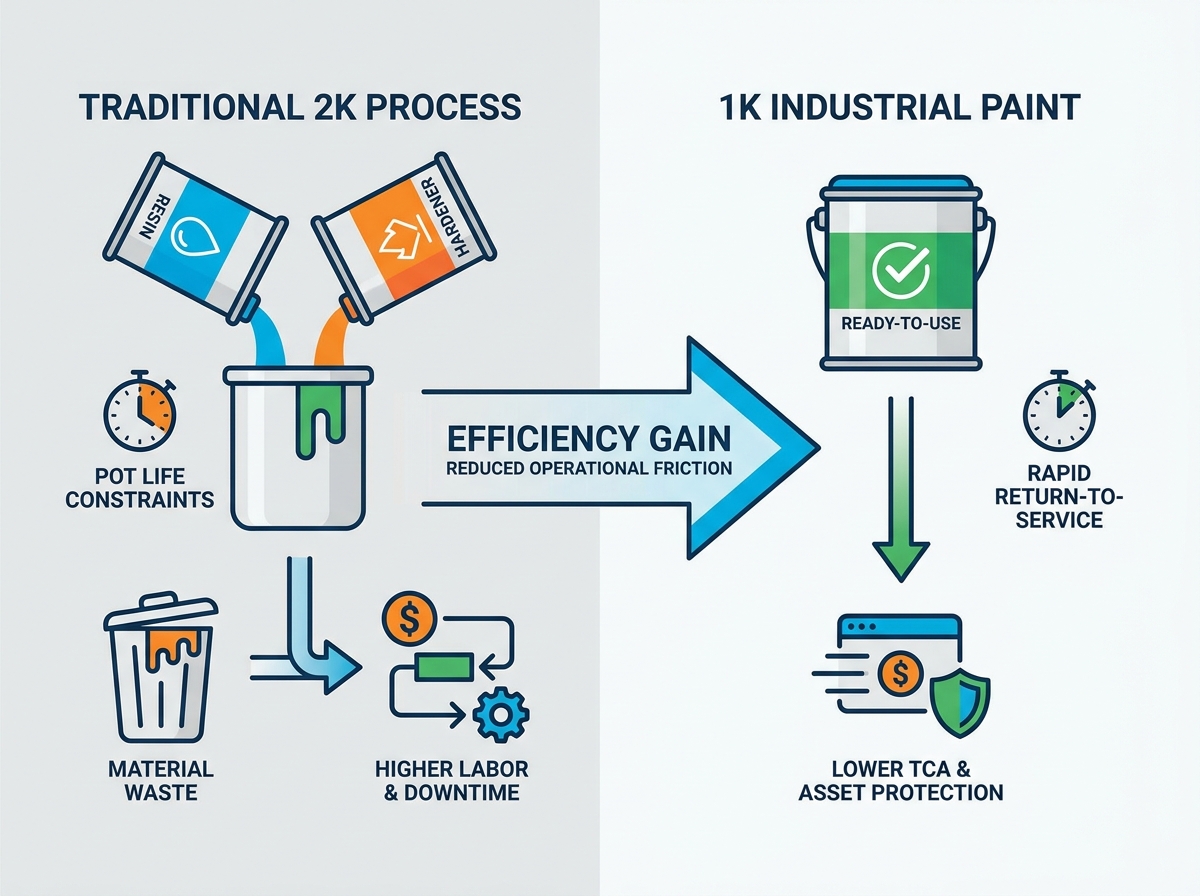
Manufacturing facilities constantly face a tough balancing act. They must protect physical assets while keeping production lines moving continuously. Every hour spent on maintenance equals lost output. Plant managers need highly efficient solutions to remain profitable. Balancing capital expenditure asset protection and minimal facility downtime remains a continuous tension. Complex multi-component coatings often compound this specific issue. They extend labor hours, complicate inventory, and increase costly application risks. Shifting toward single-component systems offers a strategic lever. It significantly reduces operational bottlenecks and optimizes maintenance budgets. This article breaks down why facilities specify 1K industrial paint to simplify routine maintenance protocols. You will learn the core commercial benefits of these versatile coatings. We also provide an objective look at where they fit into a broader, highly effective asset protection strategy.
Key Takeaways
- 1K industrial paint eliminates pot-life constraints, drastically reducing material waste and application errors.
- Single-component systems accelerate facility return-to-service, minimizing costly production downtime.
- Total Cost of Application (TCA) is heavily reduced through simplified labor requirements and inventory management.
- While highly effective for standard industrial environments, 1K systems should be evaluated against 2K systems for extreme chemical or abrasive exposure.
1. Elimination of Pot-Life Constraints and Material Waste
Two-component systems require highly precise mixing. Operators must blend resins and hardeners perfectly. This chemical reaction introduces very narrow application windows. Industry professionals call this specific window the "pot life." Once mixed, the chemical curing begins immediately. Painters must rush to apply the material. If they fail, the batch hardens directly inside the application equipment. This creates severe operational delays. It also destroys expensive spray guns and hoses.
Single-component formulations solve this problem instantly. You get a ready-to-use product straight from the container. Using 1K industrial paint requires zero on-site mixing. Crews simply open the lid, agitate the liquid, and begin spraying. They do not worry about a ticking clock. They work at a safe, deliberate pace.
This workflow drives a highly profitable business outcome. It completely eliminates "short-batching" waste. Short-batching happens when crews mix excessive material for a tiny repair. They inevitably throw away the remaining excess. Single-component products allow you to reseal unused paint quickly.
Follow this simple zero-waste application process:
- Open the container directly on the factory floor.
- Agitate the paint mechanically to ensure uniform pigment distribution.
- Apply the coating immediately using standard spray equipment or rollers.
- Reseal the remaining product securely for future maintenance cycles.
You save the unused material for the next maintenance shift. This process drives down your per-project material costs continuously. You also eliminate hefty hazardous disposal fees. Facilities no longer pay to throw away hardened, wasted products.
2. Accelerated Return-to-Service and Reduced Downtime
In manufacturing, halted production lines represent the true cost of painting. Material costs pale compared to lost manufacturing hours. You need coatings engineered for maximum speed. Every minute counts during facility maintenance. Halted machinery burns through daily revenue targets rapidly.
Single-component systems typically utilize fast solvent evaporation. Many formulations also rely on rapid moisture-curing mechanisms. Both chemical methods allow for exceptional touch-dry times. Crews often apply fewer coats overall. This reduces the total time spent waiting between layers. Workers finish the physical application much sooner.
Consider the daily implementation reality on a factory floor. Maintenance teams can execute critical spot repairs seamlessly. They can repaint full machinery sections during standard shift changes. They often complete extensive jobs during brief weekend shutdowns. The paint dries fast enough to prevent any operational disruption. Monday morning production resumes right on schedule. No one waits for slow chemical curing processes.
Here is a typical timeline comparing maintenance delays:
| Maintenance Phase | Multi-Component Process | Single-Component Process |
| Preparation & Mixing | 30 to 45 minutes | 5 minutes |
| Application Window | Strictly limited (2-4 hours) | Unlimited (can pause anytime) |
| Equipment Cleanup | Requires heavy solvent purging | Standard routine flushing |
| Return to Service | Often requires overnight curing | Usually ready within hours |
You regain control over your facility schedule completely. Managers stop delaying necessary maintenance due to schedule constraints.
![Industrial painter applying single-component coating to manufacturing equipment]()
3. Lower Total Cost of Application (TCA) via Labor Optimization
Look at standard cost breakdowns for industrial painting projects. Material costs represent only a tiny fraction of the total. Labor and surface preparation dominate your maintenance budget entirely. Optimizing labor directly reduces the Total Cost of Application (TCA).
Single-component paints offer unmatched labor scalability across your workforce. They require significantly less specialized training to apply correctly. You remove the severe risk of improper chemical mixing ratios. Bad mixing inevitably leads to catastrophic coating failures. These failures include permanently tacky finishes or premature peeling. Fixing these costly errors requires complete media blasting and extensive repainting.
Simplified application protocols drastically reduce expensive man-hours. We see this reduction across multiple phases of the job.
- Crews spend zero time measuring reactive chemical ratios.
- Painters do not rush application to beat a strict pot-life timer.
- Teams handle complex equipment cleanup much faster.
- Workers no longer waste time purging lines of catalyzed paint.
They simply clean the equipment normally and move on. You reduce the required labor hours drastically. Your Total Cost of Application plummets as a direct result. You achieve identical visual results using far fewer payroll hours.
4. CapEx Asset Protection for Standard Industrial Environments
Evaluate asset protection logically. You must match the coating specification directly to the actual environmental threat. Over-engineering your paint specification wastes capital continuously. Not every asset requires offshore-grade marine epoxy. Specifying excessive protection drains your maintenance budget unnecessarily.
Modern single-component acrylics, alkyds, and urethanes offer excellent performance realities. They provide robust defense against common, standard manufacturing threats. They handle ambient moisture effortlessly day after day. They resist mild abrasions from daily foot traffic or light impacts. They block aggressive UV degradation perfectly for exterior silos and storage tanks.
The business outcome speaks for itself. You extend the operational lifecycle of structural steel effectively. You protect concrete flooring and heavy machinery reliably.
Review these common industrial applications:
- Interior structural columns facing occasional forklift bumps.
- Exterior storage tanks requiring strong UV color retention.
- Machinery housing needing protection from minor oil splashes.
- Safety railings subjected to continuous daily hand traffic.
You achieve all this without paying for unnecessary chemical resistance. You get highly reliable protection perfectly tailored to normal industrial environments. This pragmatic approach preserves your capital expenditure assets intelligently.
5. Streamlined Inventory, Safety, and EHS Compliance
Multi-part systems create immense operational friction for procurement teams. You must track multiple SKUs constantly. You have to ensure perfectly matching inventory levels continually. You need an exact ratio of base product to activator. You also must store highly reactive hardeners safely. This complicates warehouse management and creates logistical headaches.
The single-component benefit simplifies this entire process immediately. You enjoy straightforward single-SKU procurement. Purchasing departments place much simpler orders. Inventory managers track fewer line items on their spreadsheets. You never end up holding orphaned base colors because you ran out of hardener.
Consider modern compliance-aware thinking. Many single-component systems use low-VOC or waterborne formulations today. This chemical shift simplifies Environmental, Health, and Safety (EHS) reporting dramatically.
- Facilities lower their total volatile organic compound emissions easily.
- Managers spend less time filing complex environmental compliance paperwork.
- Plant operators reduce expensive facility ventilation requirements during the application process.
- Workers face far fewer respiratory hazards during routine maintenance shifts.
You protect your workforce better. You face fewer regulatory hurdles from environmental agencies. Your safety audits become much simpler to pass.
Evaluation Framework: When to Choose 1K vs. 2K Paint Systems
Building trustworthiness requires total transparency. We must acknowledge the physical limits of single-component technology honestly. They do not work in every single industrial environment.
Single-component paints fall short in extreme, aggressive conditions. Transparently, they are not suitable for continuous chemical immersion. Do not use them inside tanks holding highly corrosive acids. Avoid them in extreme high-temperature environments. Skip them where severe mechanical abrasion occurs daily.
Use this straightforward shortlisting logic to guide your decisions.
Choose single-component systems if:
- Your main priority is incredibly fast, easy application.
- The equipment requires only routine, standard maintenance.
- You need standard corrosion protection against moisture and mild weather.
- Minimizing labor costs and material waste remains a top facility goal.
Choose multi-component systems if:
- The target asset faces harsh, highly caustic chemicals daily.
- The machinery endures heavy, repeated physical impact continuously.
- The environment strictly requires extreme chemical cross-linking durability.
- You coat offshore marine structures facing aggressive salt spray.
This simple framework prevents costly specification errors. You align the exact product chemistry directly to your true operational needs.
Conclusion
Specifying industrial coatings remains a critical business decision. Selecting a single-component solution roots this decision firmly in operational efficiency. Facilities drastically reduce their material waste. They achieve highly acceptable baseline performance for standard environments. You protect your vital capital expenditure assets intelligently. You also keep your Total Cost of Application tightly controlled.
Facility managers should take immediate, pragmatic next steps. Conduct a small-scale pilot test on low-risk equipment first. Apply the coating to a standard safety rail or an exterior storage tank. Monitor the touch-dry time and the simplified cleanup process yourself. Alternatively, consult a technical coatings representative today. Ask them to audit your current maintenance pain points completely. They can help identify areas ready for immediate labor optimization.
FAQ
Q: Does 1K industrial paint require a primer?
A: Most substrates benefit greatly from a dedicated primer. While direct-to-metal single-component options exist, primer recommendations depend entirely on your substrate condition. Rusted or heavily pitted steel requires a rust-inhibiting primer to ensure long-term adhesion. Clean, freshly blasted steel might accept a direct-to-metal product perfectly. Always assess the surface profile first before applying any topcoat.
Q: What is the typical shelf life of a 1K industrial coating?
A: Single-component industrial coatings typically offer a shelf life ranging from 12 to 24 months. You must store them properly to maintain this viability. Keep containers tightly sealed in a climate-controlled environment. Avoid extreme heat or freezing temperatures. Unlike multi-component products, you avoid worrying about a highly reactive hardener degrading prematurely during long storage periods.
Q: Can 1K paint be applied over existing 2K coatings?
A: Yes, you can apply them over existing multi-component coatings during maintenance cycles. However, you must perform mechanical compatibility testing first. You also need to abrade the existing surface thoroughly. Scuffing the old glossy finish ensures proper mechanical adhesion. If you skip this crucial surface preparation step, the new layer will likely peel off entirely.