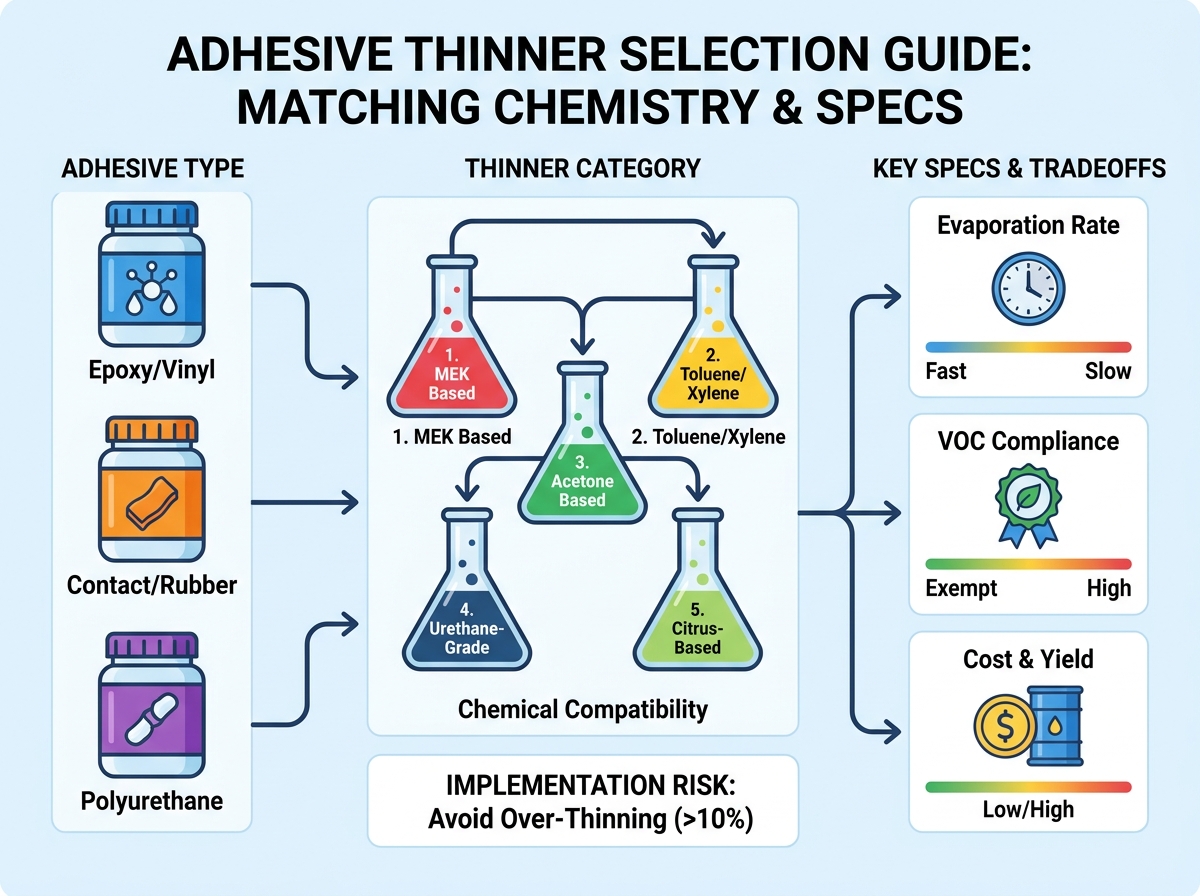
Using the wrong chemical to dilute bonding agents can instantly ruin an entire production run. Manufacturers face constant pressure daily. You must maintain optimal viscosity. At the same time, you cannot compromise the structural integrity of your assemblies. Finding the right balance requires a deep understanding of chemical properties. Incompatible solvents carry serious risks. Over-thinning compromises shear strength. It drastically alters cure times. This ultimately leads to expensive rework or catastrophic material failure in the field.
We designed this guide to help you make informed, data-driven decisions. We provide an objective, specification-driven comparison of the top five industrial chemical reducers. We evaluate them strictly on chemical compatibility, evaporation rate, VOC compliance, and cost-per-gallon yield. This ensures your procurement and technical teams match the exact chemical profile to your specific system and budget constraints. Let us explore how to optimize your production lines safely and efficiently today.
Key Takeaways
- Compatibility dictates choice: The base chemistry of the adhesive (e.g., polyurethane, epoxy, contact cement) strictly limits the viable thinner options.
- Cost vs. Yield: Lower upfront pricing often correlates with faster evaporation rates, meaning higher volume usage and hidden costs.
- Compliance matters: Local VOC regulations (e.g., EPA, CARB) increasingly restrict traditional heavy solvents, pushing buyers toward compliant but differently performing alternatives.
- Performance impact: Dilution beyond manufacturer specifications (typically 5-10%) significantly degrades ultimate bond strength.
Baseline Evaluation Criteria for Adhesive Thinners
Selecting an industrial Adhesive thinner requires more than checking the price tag. You must evaluate the chemical interactions occurring at a microscopic level. Teams should base their sourcing decisions on four foundational criteria.
First, chemical compatibility determines success or failure. You must match the solvent polarity to the adhesive base. Mismatched polarities cause immediate coagulation. The resins shock and separate into unusable lumps. You lose the entire batch instantly.
Second, evaporation rate matters immensely. Chemists often refer to this as the "flash-off" time. How fast the liquid evaporates dictates the open time of the adhesive. Very fast evaporation reduces your working window. Slow evaporation extends initial tack times. This can bottleneck high-speed assembly lines.
Third, toxicity and safety constraints dictate facility requirements. You must evaluate Lower Explosive Limits (LEL). You must know the flashpoints. Permissible exposure limits (PEL) directly impact worker safety. High-toxicity chemicals demand expensive ventilation upgrades.
Finally, volume pricing dynamics alter your purchasing strategy. A five-gallon pail carries different economics than a 55-gallon drum. You must account for hazardous freight surcharges. Volatile liquids cost significantly more to ship and store safely.
Top 5 Adhesive Thinners: Technical Specs and Cost Breakdown
Procurement teams need objective data to source chemicals effectively. We analyzed the five most common industrial solvent profiles. We compared their target applications, key specifications, estimated pricing, and implementation risks.
1. MEK (Methyl Ethyl Ketone) Based Thinners
MEK stands as an industry powerhouse. It dominates heavy manufacturing environments. You use it when dealing with stubborn, high-strength resins.
- Target Adhesives: High-performance vinyls, epoxies, and nitrile-based adhesives.
- Key Specifications: Extremely fast evaporation rate. It features high solubility. It is highly flammable due to a very low flashpoint.
- Pricing Estimate: Mid-to-high tier. The current market average hovers around $25 to $40 per gallon, depending on purity levels.
- Implementation Risk: This is a highly aggressive solvent. It can quickly melt or damage sensitive substrates. You must avoid using it on certain delicate plastics.
2. Toluene / Xylene Industrial Reducers
Toluene and Xylene serve as the backbone for traditional rubber manufacturing. They excel at breaking down thick, viscous polymers into sprayable liquids.
- Target Adhesives: Contact cements, rubber-based adhesives, and industrial silicones.
- Key Specifications: They offer a medium evaporation rate. They provide excellent viscosity reduction for thick formulas.
- Pricing Estimate: Low-to-mid tier. Expect to pay between $15 and $25 per gallon. This makes them highly cost-effective for high-volume industrial use.
- Implementation Risk: These chemicals emit very high VOCs. They face strict regulatory scrutiny globally. Your facility requires robust, explosion-proof ventilation systems to use them legally.
3. Acetone-Based Adhesive Thinners
Acetone is incredibly versatile. It remains popular because regulators classify it differently than heavier hydrocarbons.
- Target Adhesives: Polyester resins, cyanoacrylates (primarily for cleanup), and general-purpose solvent cements.
- Key Specifications: It is VOC-exempt in many stringent jurisdictions. It features extremely fast flash-off. It is highly water-miscible.
- Pricing Estimate: Mid-tier. Prices range from $20 to $30 per gallon. It remains highly accessible across global supply chains.
- Implementation Risk: Acetone evaporates so quickly it aggressively cools the surrounding air. In humid environments, this causes "blushing." Moisture condenses directly into the adhesive layer. This trapped water severely weakens the final bond.
4. Urethane-Grade Reducers
Urethanes require highly specialized handling. Standard commercial solvents will ruin a polyurethane batch instantly.
- Target Adhesives: Polyurethane adhesives and moisture-cure urethanes.
- Key Specifications: They are 100% moisture-free. They contain zero alcohol. They offer moderate to slow evaporation rates.
- Pricing Estimate: Premium tier. Given the rigorous distillation process, expect to pay $40 to $60 per gallon.
- Implementation Risk: Water acts as a catalyst for urethanes. Any moisture contamination in the thinner will cause the adhesive to prematurely cross-link. It will harden irreversibly inside the mixing pot.
5. Eco-Friendly / Citrus-Based Solvents (D-Limonene)
Consumer and regulatory pressures drive the adoption of green chemistry. D-Limonene offers a safer alternative for less aggressive bonding tasks.
- Target Adhesives: Mastic adhesives, pressure-sensitive adhesives (PSAs), and low-strength rubbers.
- Key Specifications: High flashpoint. Low toxicity profile. Slow evaporation rate. It features a distinct, pleasant citrus odor.
- Pricing Estimate: Premium tier. Eco-friendly extraction methods push costs to $50 to $80 per gallon.
- Implementation Risk: The very slow flash-off extends adhesive curing times significantly. It slows down production lines. It also leaves a slight oily residue. You must wipe substrates completely clean before mating parts.
The following technical summary outlines how these solvents compare across key procurement metrics.
| Solvent Type | Primary Chemistry Fit | Evaporation Speed | Relative Cost Tier | Primary Risk Factor |
| MEK | Epoxies, Vinyls | Very Fast | Mid-to-High | Substrate Damage |
| Toluene / Xylene | Rubber, Contact Cement | Medium | Low-to-Mid | High VOC / Toxicity |
| Acetone | Polyester, Cyanoacrylates | Fastest | Mid-Tier | Moisture Blushing |
| Urethane-Grade | Polyurethane | Slow-to-Medium | Premium | Moisture Contamination |
| Citrus / D-Limonene | Mastics, PSAs | Slowest | Premium | Oily Residue |
![Adhesive thinner]()
Health, Safety, and VOC Compliance Realities
Regulatory frameworks legally restrict chemical purchasing decisions. You cannot simply buy the most effective solvent. You must navigate a complex landscape of environmental laws. Agencies like OSHA set strict personal exposure limits. Regional boards, such as the SCAQMD in California, impose severe Volatile Organic Compound (VOC) limits. Non-compliance results in massive fines or forced facility shutdowns.
Heavy industrial thinners carry hidden operational expenses. You must upgrade your facility to handle them legally. You must install explosion-proof ventilation systems. Your workers require specialized Personal Protective Equipment (PPE). This includes fitted respirators and heavy-duty nitrile gloves. Furthermore, disposing of hazardous waste creates a permanent, recurring drain on your budget.
Eco-friendly alternatives present a "non-toxic" compromise. Solvents like D-Limonene dramatically improve worker safety. They eliminate explosive hazards. However, they force workflow adjustments. Their longer flash-off times delay assembly steps. You must weigh the upfront safety benefits against slower daily production rates.
Pricing vs. Actual Yield Analysis
Procurement teams frequently misunderstand solvent economics. A cheaper price per gallon rarely translates to actual savings. You must analyze the relationship between pricing and actual physical yield.
Consider the "evaporation tax." Buying a cheaper, fast-evaporating Adhesive thinner like acetone seems cost-effective initially. However, acetone flashes off into the atmosphere rapidly. Workers often use 20% to 30% more product simply to maintain a workable viscosity in the pot. You pay for solvent that vanishes before it does any work.
Freight and storage logistics further complicate pricing. Highly volatile solvents require Hazmat shipping. Transportation companies charge heavy premiums for these loads. Once the chemicals arrive, you must store them correctly. Fire-rated storage cabinets represent a significant capital expense. You cannot legally stack flammable drums in a standard warehouse corner.
Bulk purchasing logic demands careful math. Transitioning from 5-gallon pails to 55-gallon drums lowers the per-ounce price. However, you must perform a strict break-even analysis. If your production line uses solvent slowly, a 55-gallon drum might expire or evaporate before you empty it. Buy only the volume your facility can reliably consume within six months.
Implementation Risks: Avoiding Over-Thinning
Technical teams face constant pressure to stretch materials further. Operators often add extra solvent to make adhesives easier to spray or brush. This practice introduces massive implementation risks. You must establish strict boundaries to protect product quality.
The golden standard in manufacturing is the 10% rule. Industry guidelines state you should never thin an adhesive beyond 5% to 10% of its total volume. Exceeding this threshold drastically reduces structural integrity. Manufacturers design adhesives with specific solid-to-liquid ratios. Altering this ratio destroys the chemical backbone.
Excessive solvent causes severe shear strength degradation. We can explain this through simple physics. Solvents must eventually evaporate to allow the adhesive to cure. If you flood the mixture with solvent, a massive volume of liquid must escape the glue line. As it evaporates, it creates microscopic voids in the dried film. These voids act like Swiss cheese. They introduce stress points where the bond will inevitably tear under pressure.
You must implement a rigorous testing methodology. Never roll out a new chemical ratio across full-scale production immediately. Perform a peel and shear test on sample substrates first. Cure the samples under actual factory conditions. Pull them apart using mechanical force gauges. Only approve the dilution ratio when the data proves the bond remains intact.
Conclusion
Selecting the correct chemical reducer is critical for long-term manufacturing success. Your shortlisting logic must align directly with your baseline chemistry. Match aggressive MEK or Toluene formulations for heavy industrial rubber and vinyl applications. Choose Acetone for fast-drying or VOC-exempt requirements. Insist on Urethane-grade reducers for all moisture-sensitive jobs. Finally, deploy Citrus-based solvents for safe, low-toxicity environments where time is flexible.
Your next steps require due diligence. Do not order bulk pallets based on marketing claims. Advise your engineering team to request Technical Data Sheets (TDS) immediately. Obtain the latest Safety Data Sheets (SDS) from the manufacturer. Cross-reference these documents to verify chemical compatibility. Once you confirm the specifications, conduct small-batch testing to ensure flawless adhesion on your unique substrates.
FAQ
Q: Can I use standard paint thinner instead of a dedicated adhesive thinner?
A: Generally, no. Standard paint thinners and mineral spirits often contain impurities. They leave an oily residue on surfaces after evaporation. This residue prevents adhesives from properly wetting out and bonding to substrates. You will experience frequent delamination and weak shear strength.
Q: How do I know if an adhesive thinner is compatible with my product?
A: Check the adhesive manufacturer's Technical Data Sheet (TDS). The TDS specifically lists the recommended solvent base. Alternatively, match the thinner's primary chemistry directly to the adhesive's main solvent. For example, use a urethane-grade reducer exclusively for polyurethane adhesives.
Q: Does thinning an adhesive increase its coverage area?
A: While adding solvent improves spreadability, it essentially spreads the binding solids much thinner. This drastically compromises the final structural strength. You should only use reducers to restore lost viscosity in an open pot, never to stretch material to save money.