Industrial coatings and finishes require precise viscosity control. It ensures maximum durability and high aesthetic quality across applications. The choice of solvent directly impacts the final surface result. Using an incorrect or low-quality thinner causes severe operational problems. It leads directly to costly production defects like blushing, orange peel, or poor adhesion. Subpar solvents also risk non-compliance regarding modern environmental regulations. Procurement managers face intense pressure to eliminate these risks. Facility operators need reliable chemical solutions for daily tasks. We designed this guide to address these precise challenges. It provides procurement managers and facility operators a strict framework. The guide relies heavily on evidence-based chemical evaluation. You will learn how to accurately evaluate, select, and implement industrial-grade thinners. This knowledge empowers technical teams to optimize painting operations safely.
Key Takeaways
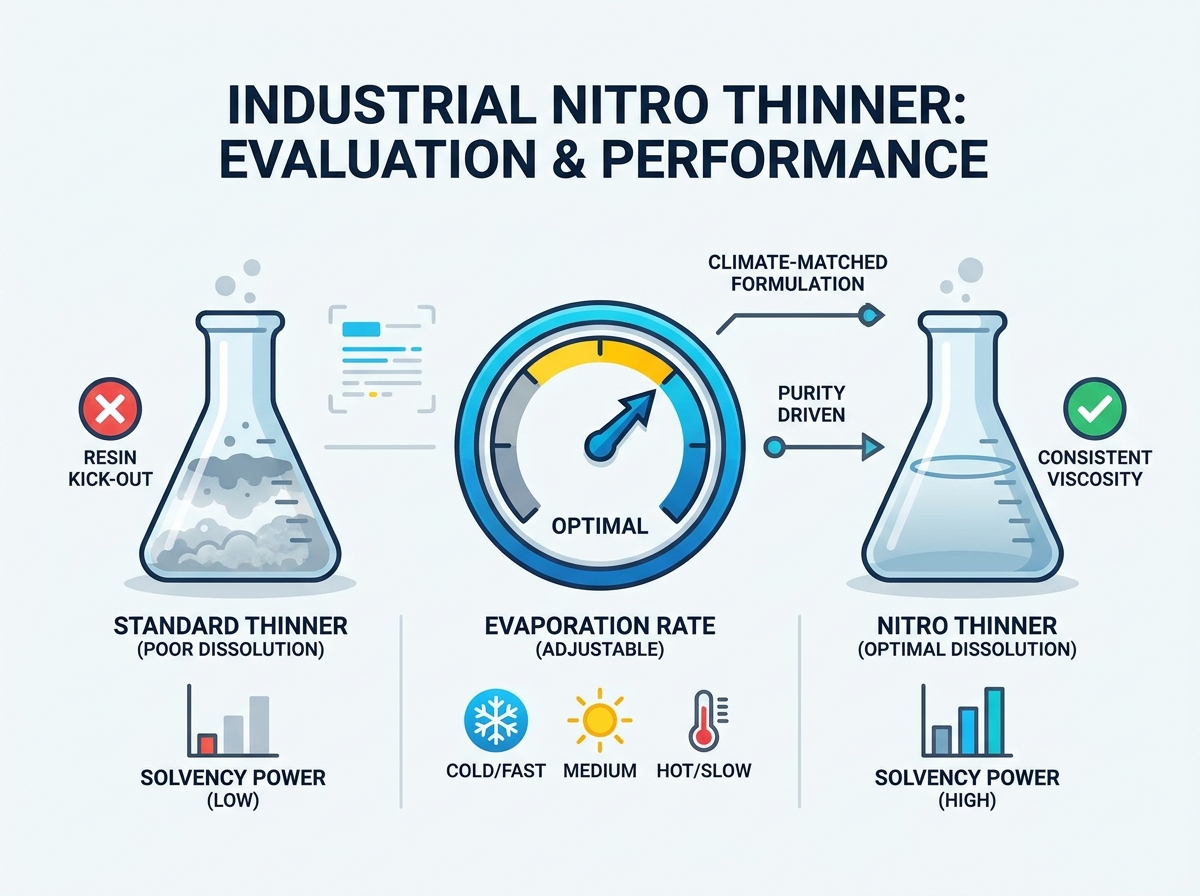
- Not all solvents are equal: Nitro thinners are specifically formulated with a blend of esters, ketones, and alcohols to dissolve nitrocellulose resins, unlike standard mineral spirits.
- Climate dictates formulation: Evaporation rates must be matched to ambient facility temperatures and humidity to prevent moisture trapping (blushing).
- Purity drives performance: High-grade industrial thinners reduce the risk of resin kick-out and ensure consistent spray viscosity.
- Compliance is mandatory: Modern procurement must balance solvency power with strict regional Volatile Organic Compound (VOC) regulations and facility safety standards.
Understanding Industrial-Grade Nitro Thinner vs. Standard Paint Thinners
Industrial formulations rely on a highly specific chemical balance. They combine active, latent, and diluent solvents into one product. Ketones and esters serve as the core active components. These aggressive chemicals actively dissolve the tough resin molecules. Alcohols function primarily as latent solvents in the blend. They enhance the overall efficiency of the active ingredients. Aromatic hydrocarbons like toluene or xylene act as diluents. They lower the liquid viscosity and help manage manufacturing costs.
Nitrocellulose lacquers demand this precise chemical blend universally. Nitro thinner chemically attacks the complex binder structure. It breaks the binders apart without destroying the polymer chain. The lacquer remains structurally intact upon final curing. This mechanism ensures the final coat stays hard and durable. Standard paint thinners completely lack this specialized chemical mechanism.
Substituting cheap generic mineral spirits guarantees immediate failure. Mineral spirits lack the chemical power to dissolve nitrocellulose. You will face severe operational issues on the floor. The cost of these substitutions always outweighs the savings.
- Immediate separation of paint and solvent in the cup.
- Irreversible clumping destroying the entire paint mixture.
- Clogged spray guns requiring complete and tedious tear-downs.
- Ruined product batches wasting incredibly expensive topcoat materials.
- Severe delays across the entire finishing production schedule.
Key Evaluation Criteria for Procurement Teams
Procurement teams must evaluate liquid solvents rigorously. Not every industrial batch performs identically on the floor. You must establish strict technical baselines for your vendors. Evaporation rates define application success in the spray booth. They dictate how the wet paint behaves on the substrate. Formulations must vary by season and specific facility conditions.
Thinner Evaporation Rate Comparison Chart
| Evaporation Rate | Ideal Environment | Primary Benefit | Common Risk if Misused |
| Fast-Evaporating | Winter / Cold facilities (Below 15°C) | Accelerates flash-off time | Severe blushing in high humidity |
| Standard / Medium | General facility use (15°C to 25°C) | Balanced flow and leveling | Sluggish drying in cold weather |
| Slow / Retarders | High heat / High humidity (Above 25°C) | Allows moisture escape preventing cloudiness | Excessive runs on vertical surfaces |
Solvency power matters immensely during the procurement phase. It determines the raw cutting ability of the product. High-solvency formulas reduce fluid viscosity much more efficiently. You use significantly less volume per paint batch. This efficiency creates massive material savings at scale.
Moisture content destroys professional industrial finishes instantly. Excess water causes a cloudy, milky appearance called blushing. Procurement must demand a Certificate of Analysis (COA). The COA verifies extremely low water content levels. High purity prevents these costly aesthetic defects completely.
Material compatibility is another crucial evaluation factor. Strong solvents interact heavily with expensive spray equipment. Powerful ketones quickly degrade cheap rubber seals. You must evaluate interactions concerning O-rings and fluid hoses. Assess how the solvent interacts with existing base primers. Require solvent-resistant Viton or Teflon seals for all equipment. This proactive step prevents sudden equipment leaks entirely.
![Industrial application of nitro thinner]()
Matching Formulations to Industrial Applications
Different industries require highly tailored solvent formulations. The specific chemical balance must perfectly align with the end-use.
- Woodworking & Furniture Manufacturing: Manufacturers prioritize rapid drying times above all else. High-quality solvents prevent excessive and damaging grain raising. They ensure ultimate clear-coat clarity for premium furniture. Clear finishes demand the lowest possible moisture content available. Otherwise, the expensive wood finish turns visibly hazy. Fast evaporation helps massive assembly lines move quickly.
- Automotive Refinishing: Auto shops require superior leveling properties for smooth finishes. High-gloss automotive clear coats leave zero room for error. Strict evaporation control prevents dreaded orange peel textures. You must verify chemical compatibility regarding specific auto lacquers. An incompatible solvent completely ruins an expensive custom paint job. Paint shops often blend standard and slow thinners dynamically.
- Heavy Machinery & Equipment Maintenance: Maintenance teams absolutely need robust chemical cleaning power. They flush high-pressure spray lines constantly between jobs. High-grade Nitro thinner removes hardened resins extremely efficiently. It achieves this aggressive cleaning without degrading heavy metal components. The strong solvency power easily clears blocked fluid nozzles. Operators must rinse the lines properly to protect seals.
Mixing Ratios & Implementation Realities
Application success hinges strictly on proper mixing ratios. Exact required amounts vary wildly across different product lines. Establishing technical baselines provides a solid starting point. Standard industrial spray applications usually require 10-20% reduction by volume. This basic rule-of-thumb works well for general industrial coatings. However, operators must always consult the Technical Data Sheet (TDS). The paint manufacturer’s TDS dictates the absolute chemical limits. Exceeding TDS recommendations generally voids material warranties immediately.
Environmental variables force daily adjustments on the floor. Operators adapt thinning ratios based on daily shop temperatures. High humidity requires slower evaporation to prevent moisture entrapment. Hotter days might require slightly more reduction to maintain flow. Skilled operators monitor the spray booth conditions continuously. They actively tweak the mixture before spraying every new batch.
Common implementation risks constantly plague inexperienced painting teams. Deviating from optimal ratios creates immediate and visible defects. Correcting these errors requires extensive sanding and recoating.
- Over-thinning: This reduces the paint’s solid content dramatically. It leads directly to runs and sags on vertical surfaces. It diminishes the total dry film thickness (DFT). Low DFT severely compromises long-term rust protection and durability.
- Under-thinning: The mixed fluid remains far too thick. The spray gun struggles to atomize the heavy paint. This results in heavy, ugly orange peel textures. It also causes wildly uneven curing across the substrate. The final cured finish looks highly unprofessional.
Facility Safety, Storage, and VOC Compliance
Industrial chemical solvents introduce significant workplace safety hazards. Facility managers must strictly enforce handling and storage protocols. Flammability demands absolute respect from all personnel. These volatile liquids possess extremely low flash points. Bulk metal drums require proper copper grounding wires constantly. Grounding strictly prevents static discharge during liquid transfer operations. Facilities must utilize approved fire-rated storage cabinets everywhere. You must keep bulk storage areas away from direct sunlight. Eliminate all potential ignition sources near the chemical mixing rooms.
Worker safety remains the top priority in any facility. Operators need correct Personal Protective Equipment (PPE) daily. Serious inhalation risks require high-quality organic vapor respirators. Standard paper dust masks provide zero protection against solvent fumes. You must install necessary facility ventilation and extraction systems. Downdraft spray booths and robust air extraction protect employee health. Skin contact causes severe defatting and painful dermatitis. Chemical-resistant nitrile gloves are strictly mandatory for all handlers.
Environmental and regulatory shifts severely complicate chemical procurement. Governing bodies constantly tighten acceptable VOC emission limits. Many regions ban traditional high-VOC chemical formulations outright. Facilities are aggressively evaluating "low-VOC" or eco-friendly alternatives. These modern solvents attempt to mimic traditional chemical performance. However, they sometimes alter drying times and leveling behaviors. Test new eco-friendly variants thoroughly before full production integration.
Shortlisting Suppliers: A Buyer’s Checklist
Sourcing volatile chemicals requires highly rigorous vendor vetting. You cannot rely on brand names or low prices alone. Verify batch-to-batch consistency very early in the relationship. Ask chemical suppliers for comprehensive historical COAs. Reviewing past documentation proves their quality control actually works. Inconsistent chemical purity destroys predictable production schedules. Demand total transparency regarding their blending processes and sourcing.
Evaluate their technical support capabilities before signing contracts. Does the supplier offer dedicated application engineering support? Can they provide custom chemical blending for your unique facility climate? A good partner actively helps solve complex finishing problems. They do not just drop off drums and leave. Technical support saves massive amounts of time during seasonal transitions.
Analyze supply chain reliability and bulk logistics deeply. Evaluate their standard delivery lead times critically. Check their minimum order quantities (MOQs) for various items. Assess the available packaging options for your storage capacity. Pails suit small custom job shops perfectly. Mid-sized production facilities prefer standard 55-gallon drums. High-volume industrial manufacturers require large IBC totes for efficiency. Ensure their delivery trucks can access your unloading docks safely.
Determine your precise next-step action immediately. Request a liquid sample before committing to bulk procurement. Perform small-batch testing strictly in your actual spray booth. Spray physical test panels and evaluate the cured finish. Only sign bulk supply contracts after the test panels pass inspection.
Conclusion
Selecting the right chemical solvent remains a highly strategic decision. It successfully balances upfront material choices against the risk of costly rework. Using precise technical criteria eliminates dangerous guesswork from your procurement cycle. Reliable solvents ensure your production lines run without interruptions.
- Prioritize Chemistry: Base all purchasing decisions on verified chemical compatibility with your specific resins.
- Control the Environment: Always align liquid evaporation rates with your shop's daily temperature and humidity levels.
- Demand Documentation: Require comprehensive supplier QA documentation, especially highly consistent COAs.
- Ensure Compliance: Keep your production facility safe by adhering to strict fire safety and VOC regulations.
Consult an experienced industrial chemical specialist today. Request a technical data sheet (TDS) for your current topcoats. Order a test sample of high-grade Nitro thinner for your specific industrial application. Testing guarantees optimal performance before large-scale deployment.
FAQ
Q: What is the difference between nitro thinner and standard lacquer thinner?
A: Nitro thinner uses a highly specific blend of esters, ketones, and alcohols. It targets nitrocellulose resins directly to dissolve them without destroying polymer chains. Standard lacquer thinners often contain higher levels of cheaper, generic diluents. Generic thinners may completely fail to break down heavy industrial nitro-binders effectively.
Q: Can nitro thinner be used for cleaning spray guns and industrial equipment?
A: Yes, it excels at thoroughly cleaning industrial equipment. Its aggressive solvency power flushes paint lines and removes hardened resins easily. However, you must avoid prolonged chemical exposure. Strong active solvents will quickly degrade standard rubber seals and O-rings unless they are made of chemical-resistant materials like Viton or Teflon.
Q: How much nitro thinner should I use for industrial topcoats?
A: A standard rule-of-thumb is a 10% to 20% reduction by volume for general spray applications. However, you must always defer to the specific coating's Technical Data Sheet (TDS). Exact ratios depend heavily on ambient facility conditions, spray gun tip size, and the manufacturer's strict chemical guidelines.
Q: How do humidity and temperature affect nitro thinner performance?
A: High humidity causes water to become trapped in the paint film as the solvent evaporates. This creates a milky defect known as "blushing." Hot temperatures cause extremely rapid evaporation, preventing the paint from leveling. You should use slow-evaporating retarders in these harsh conditions to ensure a flawless cure.
Q: Does nitro thinner expire or degrade in storage?
A: Yes, it degrades significantly if stored improperly. Highly volatile active solvents evaporate rapidly in unsealed containers, ruining the chemical balance. Over time, poorly sealed drums also absorb atmospheric moisture. This moisture contamination ruins the solvency power and directly causes blushing defects during future spray applications.