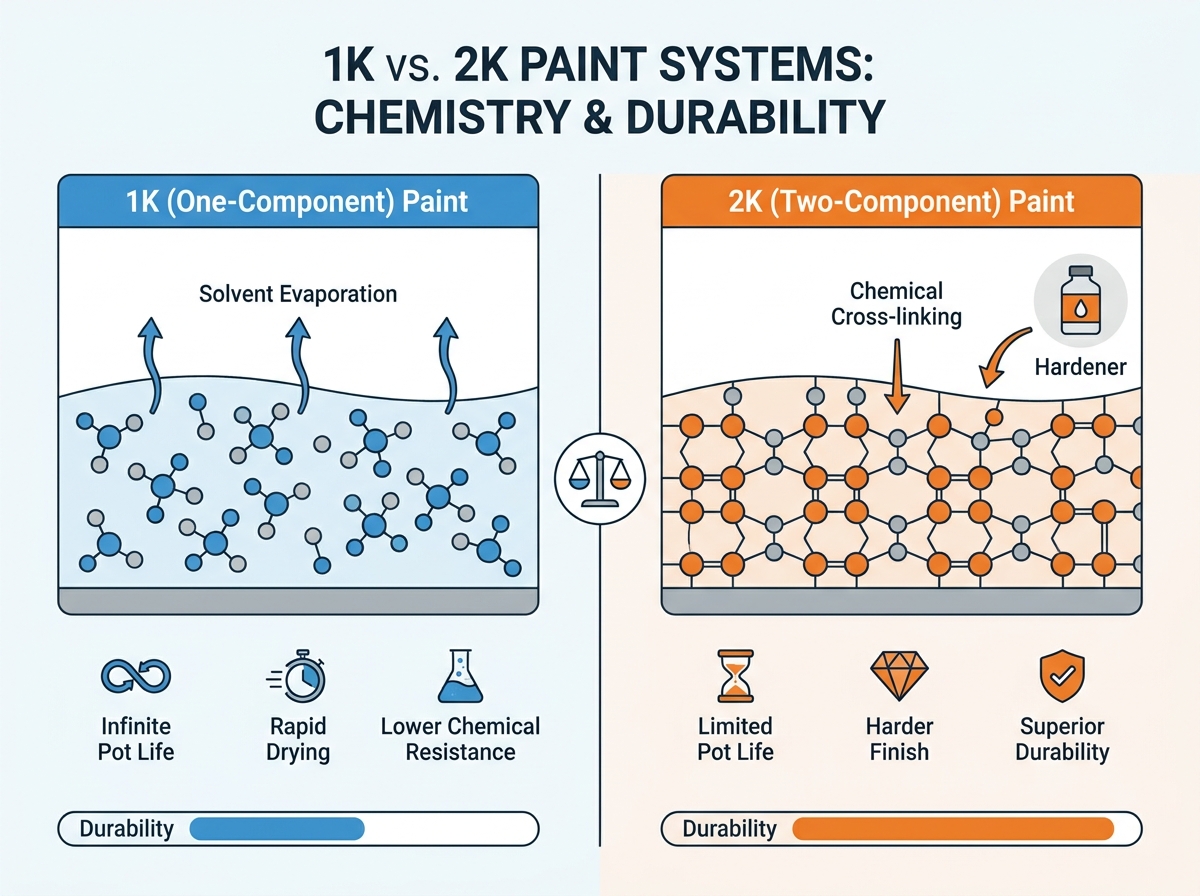
Balancing rapid turnaround times against long-term finish durability remains the ultimate challenge. Professionals face this daily in automotive refinishing. Cabinet restoration specialists encounter similar hurdles. Industrial touch-up operators also struggle here. Getting this balance wrong leads to costly reworks. It also causes severely delayed deliveries.
Single-component systems deliver massive efficiency advantages. They eliminate complex hardeners completely. However, specifying the wrong formulation quickly causes premature wear. It can also lead to severe chemical degradation. You need precise matching between substrate demands and paint chemistry.
We will break down exactly how you should evaluate these fast-drying finishes. You will discover practical frameworks for selecting formulations. We base these on environmental constraints and project scale. Read on to master the core metrics. You will ensure flawless application and lasting results for your next surface coating project.
Key Takeaways
- Efficiency vs. Durability: 1K color paint dries through solvent evaporation, offering infinite pot life and rapid application, but yields lower chemical resistance compared to catalyzed 2K systems.
- Specification Matching: Successful procurement requires matching 1k color paint specifications (solid content, flash times, and VOC levels) directly to the environmental controls of your facility.
- System Compatibility: Assessing compatibility between basecoats, primers, and the final clear coat is critical to preventing solvent pop, wrinkling, or adhesion failure.
- Scalability: Purchasing decisions should be calculated based on transfer efficiency and total square footage, choosing between high-yield gallon kits for large production and aerosol systems for localized touch-ups.
Understanding 1K Chemistry: When to Specify Single-Component Systems
Single-component formulations rely entirely on solvent evaporation. Industry professionals call this physical drying. The liquid vehicle simply evaporates into the surrounding air. This process leaves solid pigment and binder resins behind on the surface. Conversely, multi-component systems trigger an irreversible chemical cross-linking process. You must mix them just before application. Single-component products require no such mixing.
Where should you deploy single-component products? They excel on interior cosmetic components. Think of cabinet refinishing projects. These surfaces face moderate UV exposure. They rarely encounter harsh cleaning chemicals. You also see them heavily utilized as automotive basecoats. In automotive applications, technicians apply a robust protective clear over the top. Rapid-turnaround industrial touch-ups also benefit immensely. Operators love the zero pot-life limitations. They simply open the tin and begin spraying immediately.
However, we must transparently acknowledge the inherent limitations. These formulations fail quickly on high-friction surfaces. Avoid using them in areas receiving constant heavy solvent exposure. Spilled fuel will rapidly degrade an un-catalyzed finish. Shop floors or heavy machinery often require more robust chemical resistance. You must evaluate the operational environment before committing to physical drying systems.
1K Clear Coat vs 2K: Evaluating the Durability Trade-Offs
Evaluating the 1k clear coat vs 2k durability trade-off requires understanding molecular structures. Introducing an isocyanate hardener creates a rigid molecular grid. We call this chemical cross-linking. Air-dried systems remain linear and somewhat flexible at the molecular level. This structural difference dictates performance across all durability metrics.
You must map your project requirements against these structural differences. Automotive exteriors face brutal environmental conditions. They require maximum protection. Prototyping projects prioritize speed over longevity. Let us consult the decision matrix below.
| Evaluation Metric | Single-Component Characteristics | Multi-Component Characteristics |
| Hardness & Scratch Resistance | Sufficient for door jambs, interior trim, and rapid prototyping. | Mandatory for automotive exteriors and high-wear surfaces. |
| Chemical & UV Resistance | Adequate for standard environmental exposure. Vulnerable to heavy solvents. | Prevents fuel and heavy solvent damage. Superior UV blocking. |
| Safety & PPE Compliance | Generally requires standard respirators and basic ventilation. | Contains toxic isocyanates. Requires supplied-air respirators (OSHA/EPA strict). |
| Usability | Immediate readiness. Leftover material remains reusable. | Requires precise mixing ratios. Material wastes away after pot life expires. |
Safety considerations often drive the final purchasing decision. Isocyanates demand supplied-air respirators. They trigger strict OSHA and EPA compliance rules. Single components usually only need standard organic vapor cartridges. Usability strongly favors single-component mixes. You pour leftovers right back into the storage tin. Multi-component mixes harden directly in the mixing cup. This creates expensive hazardous waste.
![1K paint application techniques and specifications]()
Critical 1k Color Paint Specifications to Evaluate
Reviewing 1k color paint specifications prevents costly application errors. You must evaluate four core metrics before purchasing any product. Ignoring these data points leads to uneven coverage and compliance violations.
First, consider volume solids and hiding power. Higher solid percentages dictate better coverage rates. They drastically reduce the total coats required for full opacity. You spend less time spraying. You also purchase less total material. Lower solid formulas require multiple passes to hide the underlying primer.
Second, analyze flash-off and cure times carefully. These metrics dictate your production speed. Standard wait periods typically span 10 to 15 minutes between coats. This assumes standard 70°F (21°C) ambient temperatures. Cooler environments demand significantly longer flash intervals. You must adjust your pace accordingly.
Third, navigate VOC compliance rules in your region. Volatile Organic Compounds face heavy regulation. Regional environmental agencies dictate your available options. California CARB standards enforce extremely strict limits. You might need waterborne options instead of traditional solvent-borne formulas. Always check local regulations before ordering bulk supplies.
Finally, match viscosity to your fluid tip requirements. Technical data sheets recommend specific spray gun settings. Technicians commonly use 1.2mm to 1.4mm nozzles for standard basecoats. Thicker high-build formulas might require a 1.6mm tip. Using the wrong nozzle size causes severe orange peel.
Implementation Risks and Application Best Practices
Trapping solvents causes massive headaches during application. Industry veterans call this "solvent pop." It happens when you apply a heavy coat prematurely. The surface skin dries quickly. Solvents underneath try escaping later during the curing phase. This delayed escape causes microscopic blistering. You mitigate this by strictly following recommended flash times.
Substrate preparation strictly dictates your final adhesion quality. You cannot skip steps here. Mechanical adhesion relies entirely on creating the right surface profile. Chemical adhesion relies on absolute cleanliness. You must master both elements.
Best Practices for Surface Preparation
- Mandatory Degreasing: Always run dedicated degreasing protocols first. Use a high-quality wax and grease remover. Wipe it on wet, then wipe it off dry immediately.
- Sanding Progression: Progress your sanding grits carefully. Move systematically from P400 up to P600. This builds optimal mechanical adhesion for basecoats.
- Primer Compatibility: Verify primer compatibility beforehand. Aggressive dual-component topcoat solvents often wrinkle uncured single-component primers.
Common Mistakes in Environmental Control
Ignoring environmental controls ranks highest among application errors. High humidity clouds the finish. We refer to this moisture entrapment as blushing. Extreme temperature variations disrupt dry times unpredictably. They also destroy final gloss levels. Monitor your booth conditions constantly. Keep ambient temperatures stable throughout the entire application and drying process.
Procurement Logic: Sizing Your Project and Shortlisting Suppliers
Sizing your project correctly prevents frustrating material shortages. You calculate project yield by estimating total surface area first. Then, you must factor in your spray equipment's transfer efficiency. High Volume Low Pressure (HVLP) guns typically achieve 65% efficiency. Conventional guns waste much more material directly into the air. Adjust your volume calculations based on your specific equipment.
Choosing the correct 1K color paint format matters greatly for operational efficiency. You should match the packaging to your specific volume needs.
- Aerosols (Pre-thinned): Perfect for localized repairs. DIY cabinet refinishing benefits greatly here. You avoid setting up complex compressor systems. Always look for professional-grade adjustable fan nozzles. They mimic true spray gun patterns.
- Quarts and Pints: Ideal for single-panel automotive repairs. They also serve small industrial batches perfectly. You get enough volume for thorough coverage without massive leftovers.
- Gallon Kits: The most cost-effective route for fleet maintenance. Full-vehicle resprays demand this volume. Always assess included reducers. Verify technical support availability before buying bulk amounts.
Watch for crucial supplier trust signals during procurement. Always demand technical data sheets upfront. Request safety data sheets before placing orders. Ask for batch-consistency guarantees before finalizing large bulk purchases. Reputable suppliers provide these documents freely. Avoid vendors hiding their technical specifications.
Conclusion
Single-component formulations offer unmatched application speed. They provide incredible operational flexibility. You eliminate complex mixing ratios entirely. You also eliminate expensive pot-life waste. However, the underlying chemistry must align perfectly with your project's durability demands.
Your next steps require precise planning. Download the technical data sheets for your shortlisted products immediately. Calculate your total square footage accurately. Factor in your spray gun efficiency. Finally, verify your local VOC compliance regulations before placing any orders. Following this framework guarantees a professional, lasting finish.
FAQ
Q: Can I spray a 2K clear coat over a fully cured 1K color paint?
A: Yes. This remains standard practice in automotive two-stage systems. You must ensure the basecoat flashes off completely first. This prevents solvent entrapment underneath the rigid topcoat. A fully dried basecoat accepts the catalyzed clear coat perfectly.
Q: How long does 1K paint typically last in the can?
A: Unopened cans last up to two or three years easily. Opened cans survive for several months. You must seal the lid properly. Store them in temperature-controlled environments. Unlike catalyzed systems, they never cure inside the storage cup.
Q: Is 1K paint suitable for high-traffic cabinet doors?
A: It can perform very well. You must execute rigorous surface preparation first. We highly recommend using durable polyurethane or hybrid formulations. These specific blends resist daily friction and acidic skin oils much better than standard acrylic formulas.