Selecting the right industrial solvent goes far beyond basic chemical preferences. It acts as a critical operational decision affecting product quality, compliance, and overall workflow. Facility managers and painters face daily challenges when specifying these aggressive liquids. Using an incorrect solvent often triggers immediate manufacturing bottlenecks. Mismatched chemicals ruin complex finishes by causing blushing or clouding. They damage delicate spray equipment and create unnecessary regulatory exposure. Teams waste precious hours sanding down and repainting rejected parts. We will compare nitro thinner and acetone across their core chemical properties and physical application outcomes. You will uncover vital compliance realities and key procurement factors guiding your final purchasing choice. Understanding these distinct fluid profiles ensures you deploy the exact solvent needed for flawless operations.
Key Takeaways
- Acetone is a highly volatile, single-molecule solvent ideal for aggressive cleaning, degreasing, and fiberglass/resin manufacturing, but it evaporates too quickly for quality paint finishes.
- Nitro thinner is a complex chemical blend engineered specifically for thinning nitrocellulose lacquers, controlling evaporation rates to ensure smooth, high-quality surface finishes.
- Compliance impact: Both are highly flammable VOCs, but nitro thinner’s variable composition (containing toluene, xylene, or alcohols) requires stricter scrutiny of Safety Data Sheets (SDS) for workplace exposure limits.
- Decision logic: Choose acetone for surface prep and equipment cleanup; choose nitro thinner for application and leveling of solvent-based paints and lacquers.
Understanding the Chemical Baseline: Single Solvent vs. Engineered Blend
You cannot effectively substitute one solvent for another without understanding their underlying chemical structures. Industrial applications demand specific molecular behaviors. Fluid dynamics dictate how these liquids interact with solid substrates and synthetic resins. Let us break down the fundamental chemistry separating these two industrial staples.
Acetone (Dimethyl Ketone)
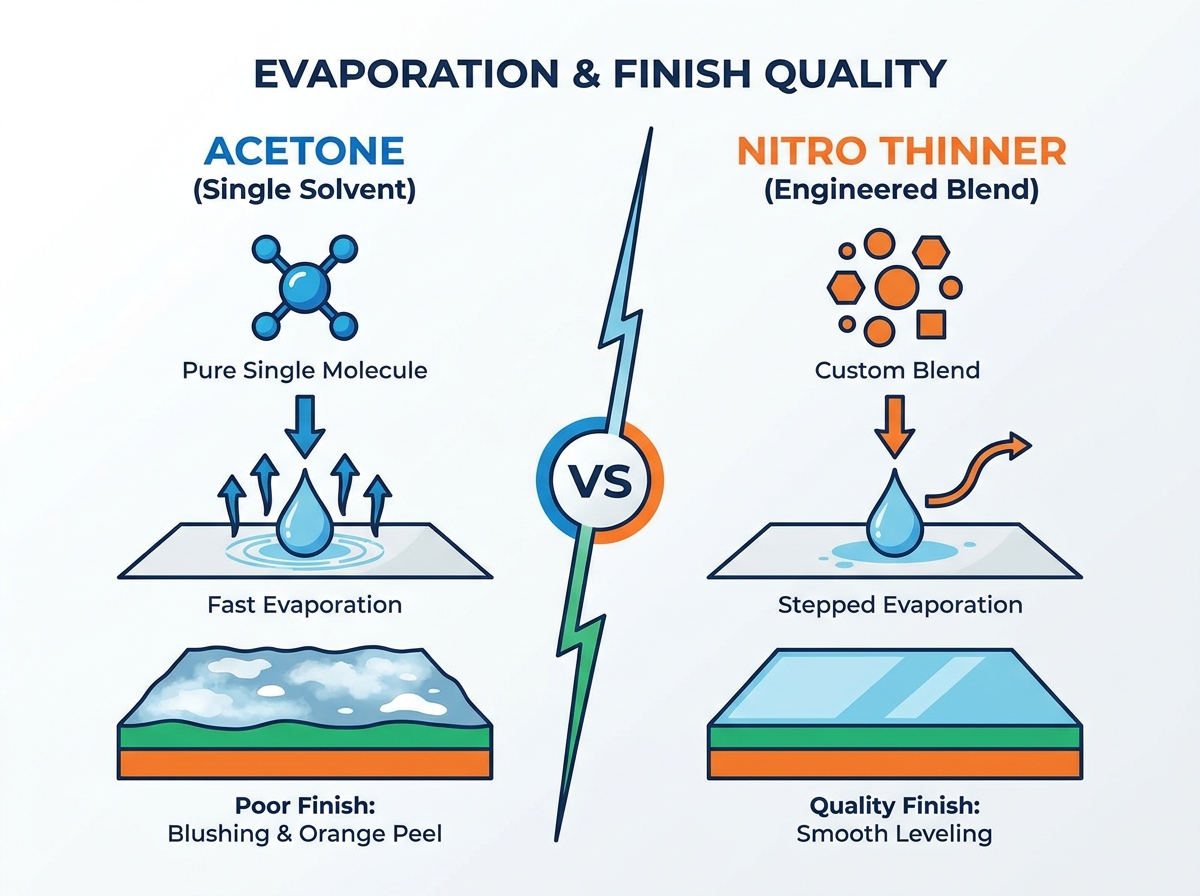
Acetone operates as a pure, single-component solvent. It contains only one type of molecule. This uniform structure gives it highly predictable characteristics across all applications. It features an extremely high evaporation rate. The liquid transitions into vapor almost immediately upon air exposure.
Furthermore, acetone is entirely water-miscible. It mixes freely into aqueous solutions without separating. Its aggressive solvent action breaks down uncured resins instantly. It dissolves adhesives, epoxies, and stray paint drips before they can fully crosslink and harden. Manufacturers rely on it heavily for aggressive, fast-acting material breakdown.
Nitro Thinner (Cellulosic Thinner)
Unlike pure acetone, cellulosic thinners utilize a highly engineered chemical matrix. Manufacturers formulate them as complex liquid blends. These formulas typically combine three distinct chemical categories to achieve optimal performance:
- Active Solvents: Ketones and esters act as the primary dissolving agents. They break down the solid nitrocellulose binders effectively.
- Latent Solvents: Alcohols enhance the dissolving power of the active ingredients. They cannot dissolve the solids alone but improve the overall mixture.
- Diluents: Hydrocarbons like toluene or xylene bulk up the liquid volume. They adjust the final viscosity to suit various application methods.
This custom formulation is designed specifically to dissolve nitrocellulose without causing chemical separation. The most significant advantage lies in its adaptability. Formulators adjust the blend ratios based on seasonal temperature and humidity. You can source standard, fast, or slow retarder variations. This flexibility makes nitro thinner indispensable for precision surface finishing.
![Spray painting and solvent evaporation process in an industrial booth]()
Evaporation Rates and Finish Quality: The Critical Differentiator
The speed at which a liquid turns into vapor dictates its usefulness in coating applications. Evaporation directly impacts leveling, gloss retention, and moisture management. Understanding this mechanism prevents catastrophic finish failures.
The Flaw of Acetone in Finishing
Acetone acts too aggressively for spray applications. It flash-evaporates the moment it leaves the spray gun nozzle. This rapid phase change absorbs ambient heat rapidly. Consequently, the surface temperature of the wet coating drops dramatically.
In humid environments, this rapid cooling creates a severe defect. Atmospheric moisture condenses directly onto the freezing wet paint film. This trapped moisture causes "blushing." Blushing manifests as a cloudy, milky white film trapped under the clear coat. Furthermore, the rapid evaporation leaves no "wet edge." The paint dries before it can flow out evenly. This results in heavy orange peel and uneven leveling across flat surfaces.
The Advantage of Engineered Blends in Coatings
High-quality finishing requires precise time controls. Cellulosic blends feature a highly specific "stepped" evaporation curve. The mixture releases its chemical components at different intervals.
First, the fast-evaporating components flash off. This action locks the paint securely to the target surface. It prevents runs and sags on vertical panels. Next, the slower components remain in the film longer. They keep the paint layer open and fluid. This extended open time allows the coating to level out into a glass-smooth finish. This engineered timing directly correlates to reduced rework. Automotive and woodworking facilities see massive drops in daily scrap rates when utilizing correct blends.
Evaporation and Performance Profile Comparison
| Characteristic | Acetone | Cellulosic Blend |
| Evaporation Curve | Instantaneous / Linear | Stepped / Controlled |
| Blushing Risk | Very High (in humidity) | Low (adjustable via retarders) |
| Surface Leveling | Poor (causes orange peel) | Excellent (maintains wet edge) |
| Primary Function | Cleaning / Degreasing | Viscosity Control / Application |
Core Applications: Aligning the Solvent to the Operational Goal
Identifying your primary operational goal simplifies the solvent selection process. Each chemical excels in a distinct manufacturing environment. You must align the solvent's volatility profile to your immediate production task.
When to Shortlist Acetone
Acetone serves as the ultimate heavy-duty workhorse for preparation and maintenance. Facilities prioritize it for aggressive material removal and surface preparation. You should mandate its use in these specific scenarios:
- Fiberglass Reinforced Plastics (FRP): Technicians require it for immediate tool and brush cleanup. It strips uncured resin from metal rollers before the matrix hardens.
- Metal Fabrication: It provides heavy-duty degreasing prior to sensitive welding or powder coating. It removes stamping oils rapidly without leaving a film.
- Adhesive Manufacturing: Operators use it for diluting two-part epoxies. It also cleans mixing vats efficiently between production batches.
When to Shortlist Nitro Thinner
Finishing departments require nuance and control. Aggressive flash rates destroy delicate lacquers. You must specify engineered blends whenever finish quality defines product value. Shortlist this solvent for the following applications:
- Woodworking and Cabinetry: Craftsmen use it for thinning nitrocellulose lacquers. It ensures sanding sealers penetrate the wood grain evenly without raising fibers.
- Automotive Refinishing: Painters rely on it for adjusting fluid viscosity. It helps spray guns atomize the clear coat precisely to ensure factory-grade, high-gloss finishes.
- Leather Production: Technicians use it for specialized surface treatments. It allows dyes and protective topcoats to achieve controlled penetration without drying out or damaging the flexible substrate.
Best Practice: Always segregate your solvent stations. Keep fast-flashing cleaners near the prep bays. Keep your engineered coating solvents inside the sealed paint-mixing rooms. This prevents accidental cross-contamination.
Safety, Storage, and VOC Compliance Risks
Industrial chemicals carry significant regulatory burdens. Mishandling volatile liquids triggers severe OSHA fines and compromises worker health. You must implement robust safety protocols based on exact chemical properties.
Regulatory Classification (VOCs)
Volatile Organic Compounds (VOCs) create ground-level ozone when exposed to sunlight. Regulatory bodies monitor facility emissions strictly. Acetone enjoys a unique regulatory status. The EPA in the United States classifies it as uniquely exempt from VOC regulations. It does not contribute significantly to atmospheric smog. This exemption makes it highly attractive for large facilities trying to stay under strict annual emissions quotas.
Conversely, cellulosic thinners contain high-VOC components. Ingredients like toluene and xylene are classified as volatile aromatics. Every gallon sprayed counts heavily against a facility's permitted emission caps. You must track daily usage rigorously to remain compliant.
Workplace Exposure (OSHA/NIOSH)
Worker safety demands proactive respiratory management. Acetone has relatively high permissible exposure limits (PEL). Operators can work around it safely with standard industrial ventilation. However, it is intensely defatting. It strips natural oils from human skin instantly, causing painful dermatitis. Technicians must wear chemical-resistant nitrile or butyl gloves.
Engineered blends require much more stringent safety infrastructure. Component chemicals like toluene exhibit systemic toxicity. Prolonged inhalation causes central nervous system depression. Facilities must install certified downdraft spray booths. Painters must wear supplied-air respirators or highly rated organic vapor masks during application.
Storage and Flammability Protocols
Both liquids pose extreme fire hazards. You must treat them with equal caution regarding ignition sources.
- Store both chemicals under Class 3 Flammable Liquid protocols.
- Utilize NFPA-rated fireproof storage cabinets.
- Install grounded transfer pumps to prevent static electricity arcs during dispensing.
- Mandate explosion-proof lighting and switchgear in all mixing rooms.
Common Mistake: Never leave solvent-soaked rags wadded up in open trash cans. As they dry, they release concentrated flammable vapors. Always dispose of them in sealed, water-filled, fire-rated safety cans.
Procurement Shortlisting and Vendor Evaluation
Optimizing your chemical supply chain streamlines daily production. Smart procurement goes beyond simply comparing per-gallon prices. You must evaluate fluid performance metrics and supplier reliability to ensure uninterrupted operations.
Volume and Yield Efficiency
Procurement teams often favor acetone due to its low baseline price. However, you must account for its rapid evaporation rate during consumption forecasting. Open-air cleaning operations consume massive volumes quickly. A soaked rag dries out in minutes, forcing workers to apply more liquid repeatedly.
Engineered thinners command a higher upfront price point. They require complex manufacturing processes. Despite this, they dramatically improve your overall application yield. Optimized viscosity control means less wasted paint in the spray booth. A slower evaporation curve reduces the number of rejected parts requiring rework. Investing in proper viscosity control directly increases your daily throughput efficiency.
Vendor Evaluation Criteria
You must scrutinize your chemical distributor thoroughly. A cheap supplier often provides inconsistent blends. Use these criteria when evaluating a new vendor:
- Batch Consistency Reports: Require a Certificate of Analysis (CoA) for every delivery. This ensures the chemical blend ratio does not fluctuate between winter and summer batches.
- Bulk Delivery Options: Assess their logistical flexibility. Determine if they can supply 55-gallon drums for smaller operations or 330-gallon totes for high-volume automated lines.
- Waste Management: Prioritize vendors offering closed-loop recycling capabilities. A good supplier will retrieve your spent, dirty solvent for off-site distillation and safe disposal.
Next Steps for Buyers
Do not finalize bulk orders blindly. You must validate the chemical against your specific operational environment. Request the latest SDS documents for review by your safety officer. Ask the supplier for sample gallons. Run a small-batch humidity test in your actual spray booth to observe leveling performance. Finally, audit your current facility VOC emission allowances. Ensure you have the regulatory headroom to support an engineered coating process.
Conclusion
Choosing the correct solvent dictates the success of your industrial finishing and maintenance routines. The evaluation framework remains straightforward once you understand the underlying chemistry. Acetone stands out as the superior, VOC-exempt workhorse for aggressive cleaning, degreasing, and equipment prep. Conversely, engineered cellulosic blends represent the non-negotiable solution for precision coating applications and flawless finish quality.
Take immediate action to refine your chemical inventory. Consult directly with a certified chemical distributor to discuss your specific viscosity needs. Request updated Safety Data Sheets to ensure full environmental compliance. Evaluate your existing spray equipment and ventilation infrastructure to confirm they can handle your selected fluid safely.
FAQ
Q: Can I use acetone instead of nitro thinner for spray painting?
A: No. Acetone evaporates too quickly for paint applications. This rapid flashing leads to poor leveling, severe orange peel textures, and moisture trapping. The trapped moisture creates a cloudy defect known as blushing in the final finish.
Q: Is nitro thinner the same as paint thinner or mineral spirits?
A: No. Mineral spirits are mild aliphatic hydrocarbons designed for traditional oil-based paints. Cellulosic blends are significantly more aggressive. Formulators design them specifically to dissolve synthetic cellulose-based lacquers without separation.
Q: Which solvent is safer for indoor industrial environments?
A: Both require heavy ventilation and strict fire precautions. However, acetone is generally less toxic systemically and is exempt from VOC emissions quotas. Cellulosic blends contain harsher aromatics like toluene, requiring strict respiratory protection to prevent nervous system exposure.
Q: Does acetone leave a residue on metal parts?
A: Pure acetone evaporates completely and leaves zero chemical residue behind. This clean flashing characteristic makes it ideal for pre-weld or pre-paint metal degreasing operations.