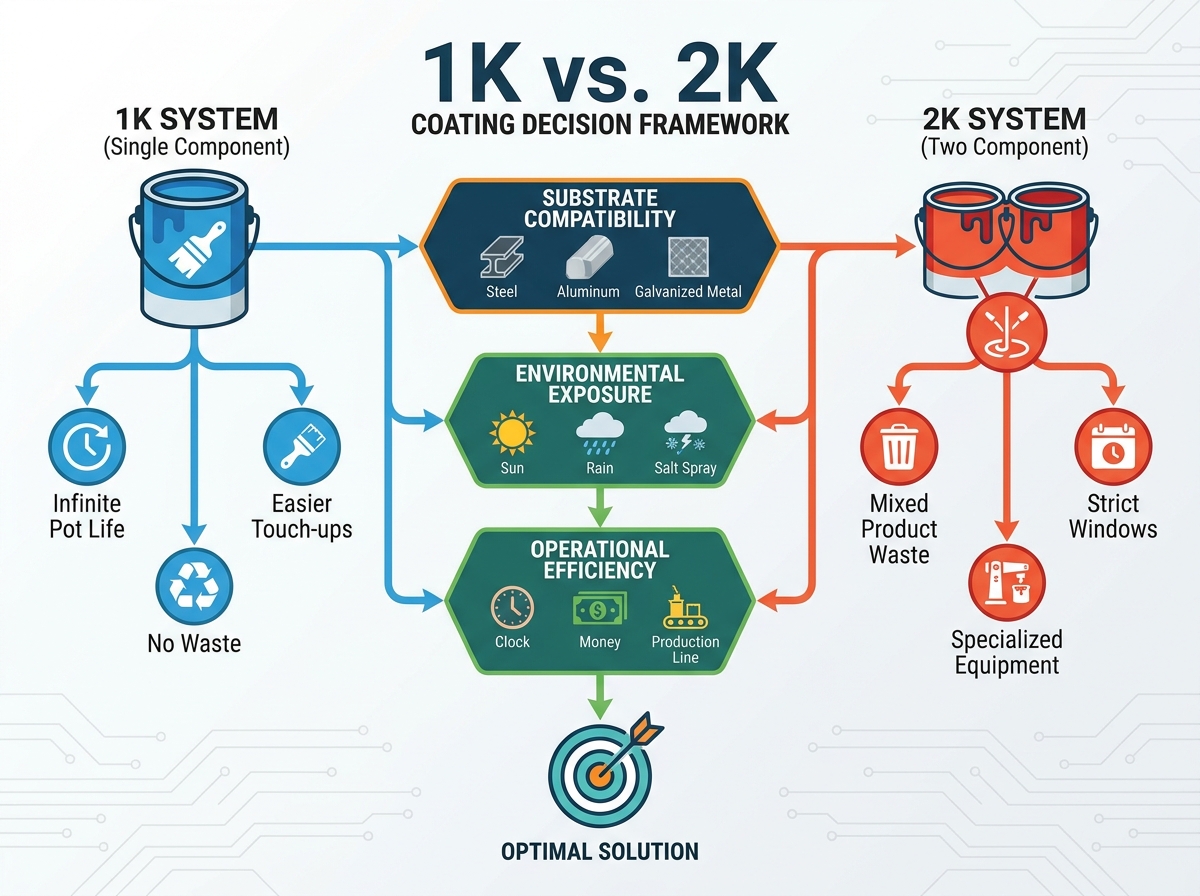
Premature coating failure on industrial metal assets doesn't just look bad. It causes severe operational downtime. It accelerates structural degradation and heavily drives up maintenance costs. Many facility managers default to 2K (two-component) systems for extreme environments. However, modern 1K formulations offer compelling operational advantages for specific use cases. The real challenge lies in objectively matching 1K chemistries to your exact environmental exposures. You must also align them to your substrate realities.
This guide provides a vendor-neutral, decision-stage framework. We will help you evaluate, shortlist, and specify the correct coating. You will learn how to choose the right solution for your metal fabrication or facility maintenance needs. By relying on concrete performance data, you can achieve durable results while optimizing your application workflows.
Key Takeaways
- Substrate Dictates Chemistry: Alkyd, acrylic, and urethane 1K paints interact differently with steel, aluminum, and galvanized surfaces; ignoring these differences risks catastrophic adhesion failure (e.g., saponification).
- Value Extends Beyond the Gallon: The true value of 1K systems lies in reduced labor costs, zero pot-life waste, and streamlined application, offsetting marginally lower absolute durability compared to 2K epoxies.
- Data over Marketing: Procurement decisions should be driven by Technical Data Sheets (TDS) and Safety Data Sheets (SDS), focusing specifically on salt spray hours, VOC compliance, and standardized adhesion test results.
- Surface Prep is Non-Negotiable: Even premium high-performance 1K coatings will fail without adherence to strict industry surface preparation standards (e.g., SSPC/NACE).
1. 1K vs. 2K Coatings: Defining Your Operational Boundaries
You must establish when a single-component system is actually the right business solution. Do this before evaluating specific product lines. 2K systems require mixing a resin and a hardener. Conversely, 1K paints cure via solvent or water evaporation. They also cure through oxidation. You do not need a chemical hardener.
The Convenience vs. Durability Trade-off
Single-component systems offer infinite pot life. You can open the can, spray, and close it back up. They make touch-ups incredibly easy. However, they typically trail two-component epoxies and polyurethanes in extreme chemical resistance. You must analyze your specific operational reality. If your metal assets face constant immersion in harsh chemicals, 2K remains necessary. If they face general weathering, a high-quality 1K industrial paint performs exceptionally well.
Labor and Waste Reduction
You must factor in the hidden costs of complex coating systems. Two-component mixtures create significant waste. Once mixed, the chemical reaction starts immediately. If your team does not spray the entire batch within a strict application window, it hardens. You lose the product. Furthermore, 2K systems require specialized mixing equipment. They demand intensive solvent flushing to clean spray lines. Single-component formulations deliver "spray and save" operational efficiency. They eliminate mixed product waste. They drastically reduce equipment cleaning time.
Ideal 1K Use Cases
Single-component chemistries excel in specific industrial sectors. You should specify them for:
- OEM machinery manufacturing.
- Light-to-moderate industrial environments.
- Agricultural and construction equipment.
- Structural steel located in non-corrosive atmospheres.
- Facility maintenance projects requiring rapid deployment.
2. Material Compatibility: Aligning Chemistry with Metal Substrates
You must prevent adhesion failures by matching the right paint category to specific metals. Different metal surfaces possess unique chemical and physical properties.
Carbon Steel & Iron
Carbon steel demands robust, built-in rust inhibitors. Moisture easily attacks iron molecules. You should look for formulations containing active anti-corrosive pigments. Zinc phosphate is a prime example. You must evaluate Direct-to-Metal (DTM) 1K acrylics against traditional primer-plus-topcoat systems. DTM acrylics save a massive amount of labor. They combine the primer and topcoat into one layer. However, heavily pitted steel often still requires a dedicated rust-inhibiting primer for maximum protection.
Galvanized Steel (The Saponification Risk)
Galvanized steel poses a major threat to inexperienced specifiers. Standard 1K alkyd paints routinely fail on galvanized surfaces. Zinc reacts chemically directly against alkyd resins. This reaction forms a soapy film under the coating. Industry professionals call this saponification. The paint eventually peels off in large sheets. You must use 1K acrylics or specialized wash primers for galvanized substrates. Acrylic resins do not react negatively against zinc.
Aluminum & Non-Ferrous Metals
Aluminum presents a notoriously slick surface. Paint struggles to grip it mechanically. Non-ferrous metals require aggressive adhesion strategies. You must address this surface slickness before applying a topcoat. We strongly recommend etching primers. Specialized adhesion promoters also work well. These undercoats chemically bite into the aluminum. They create a micro-textured profile. Your final layer can then anchor itself securely to the metal.
![1K industrial paint application on industrial metal surfaces]()
3. Core Evaluation Dimensions for Decision-Makers
You must translate paint features into operational outcomes. Objective performance metrics matter far more than marketing claims. Decision-makers need standardized data to justify procurement choices.
Corrosion Resistance & Weatherability
Corrosion resistance determines the lifespan of your metal assets. You should always look for ASTM B117 salt spray test hours on the Technical Data Sheet. This standardized test accelerates the rusting process. It provides a reliable benchmark for comparison. Exterior assets also demand high UV resistance. Chalking ruins the appearance of industrial equipment. 1K aliphatic urethanes and modern acrylics resist UV degradation brilliantly. Conversely, traditional alkyds often chalk and fade quickly under direct sunlight.
Mechanical Durability (Impact & Scratch Resistance)
Fabrication communities frequently discuss scratch resistance concerns regarding single-component systems. Moving parts face constant abrasion. You must evaluate pencil hardness ratings. You should also request Taber abrasion data from your supplier. Taber tests measure exactly how much coating wears away under friction. High-performance formulations bridge the gap impressively.
Curing Profiles & Facility Downtime
Curing speed directly impacts your facility downtime. You must understand the difference between dry-to-touch times and full cure times. A part might feel dry after two hours. However, it might need seven days to reach full mechanical hardness. Temperature and humidity sensitivities heavily impact production line speeds. Cold environments slow down solvent evaporation. High humidity retards waterborne evaporation. You must calculate these return-to-service intervals into your project planning.
| Chemistry Type | UV Resistance | Corrosion Protection | Ideal Substrate | Cure Mechanism |
| 1K Alkyd | Low (Prone to chalking) | Moderate to High | Carbon Steel | Oxidation |
| 1K Acrylic (Waterborne) | Excellent | Moderate | Galvanized, Aluminum | Coalescence / Evaporation |
| 1K Polyurethane | High | High | Mixed Metals, Machinery | Moisture Cure / Evaporation |
4. Navigating Environmental Compliance and Safety Standards
Mitigating regulatory risk ensures long-term scalability. Environmental standards continually evolve. You cannot afford to specify a coating system facing imminent bans.
VOC Limits and Regional Regulations
Volatile Organic Compounds (VOCs) release harmful smog-forming emissions into the atmosphere. Regulators worldwide are heavily restricting them. You must assess the ongoing shift from high-VOC solvent-borne paints to high-performance waterborne technologies. Ensure your chosen formulations meet local environmental standards. Check for EPA, CARB, or REACH compliance. Modern waterborne systems meet these strict limits. Furthermore, they achieve this without sacrificing corrosion protection. They provide a future-proof solution for your finishing lines.
Occupational Health
Worker safety remains paramount. You must thoroughly evaluate Safety Data Sheets (SDS). The SDS outlines specific worker safety requirements. It details necessary ventilation needs. It also highlights any hazardous air pollutants (HAPs) present in the mixture. Reducing HAPs lowers your environmental reporting burden. It also protects your application crew from chronic respiratory issues.
5. Implementation Realities: Surface Prep and Application Risks
Field experience reveals exactly where paint projects actually fail. The best chemistry in the world cannot overcome poor implementation.
Minimum Surface Preparation Standards
Simply wiping a metal beam down is never enough. Surface contamination guarantees adhesion failure. You must define necessary SSPC-SP (Society for Protective Coatings) standards required for your chosen 1K industrial paint. Direct-to-Metal adhesion requires a properly profiled substrate.
- SSPC-SP 2 (Hand Tool Cleaning): Removes loose mill scale, loose rust, and peeling paint using hand chipping or wire brushing.
- SSPC-SP 3 (Power Tool Cleaning): Uses power grinders or wire brushes. It cleans more thoroughly than SP 2 but still leaves tightly adherent rust.
- SSPC-SP 6 (Commercial Blast Cleaning): Abrasive blasting removes all visible oil, grease, dust, dirt, mill scale, and rust. It provides an optimal anchor profile for premium coatings.
Application Method Constraints
Formulation viscosity dictates your application equipment. You must assess compatibility between the paint and your existing facility equipment. High-Viscosity liquids might clog HVLP (High Volume Low Pressure) guns. They often require powerful airless spray rigs. Conversely, thin waterborne acrylics might run and sag if sprayed through overly large airless tips. Electrostatic application requires specific conductivity levels. Ensure your supplier formulates the paint specifically for your preferred application method.
Film Build Limits
Operators frequently assume a thicker coat provides better protection. This is a dangerous misconception. Exceeding the manufacturer’s recommended Wet Film Thickness (WFT) introduces severe risks. Thick layers dry quickly on the surface. They trap wet solvents underneath. This solvent entrapment prevents the underlying layer from curing. Eventually, the surface cracks deeply as the trapped solvents force their way out. We call this mud-cracking. You must train operators to strictly measure WFT during application.
6. A Framework for Shortlisting 1K Industrial Paint Suppliers
B2B procurement requires actionable next steps. You need a reliable framework to validate potential vendors.
Requesting and Reading the TDS
Ignore glossy marketing brochures. They offer very little actionable engineering data. You must mandate side-by-side TDS comparisons. Focus strictly on volume solids. A higher volume solid percentage means less product evaporates into the air. It yields better theoretical coverage per gallon. Compare standardized performance testing metrics like salt spray endurance and cross-hatch adhesion scores.
Evaluating Vendor Technical Support
A good supplier provides more than just liquid in a bucket. Evaluate their technical support infrastructure. Does the supplier offer site visits? Can they assist your team through environment-specific specification writing? Will they provide failure-analysis support if something goes wrong on the production line? Robust technical backing separates premium partners from mere commodity sellers.
Proof of Concept (PoC)
Never commit to facility-wide procurement blindly. The importance of requesting batch samples cannot be overstated. You must run a localized adhesion test. Conduct a cure-time test in your actual facility environment. Temperature and humidity variations in your shop will affect drying times differently than the sterile lab conditions listed on the TDS. A controlled Proof of Concept prevents expensive facility-wide failures.
Conclusion
Choosing the right coating requires a calculated balance. You must weigh substrate compatibility against environmental exposure. You must also factor in your application efficiency. Single-component systems drastically reduce labor burdens and eliminate mixed-product waste. They deliver impressive durability for most moderate industrial environments.
We recommend avoiding over-specifying 2K systems. High-performance single-component DTMs can readily meet your durability requirements while lowering your overall operational lifecycle costs. Do not pay for extreme chemical resistance if your assets only face normal outdoor weathering.
Consult closely with your engineering or maintenance team today. Define your specific SSPC surface preparation capabilities accurately. Then, request technical data sheets from shortlisted vendors. Run a controlled field test to validate adhesion and curing times before finalizing your procurement decision.
FAQ
Q: Can I apply 1K industrial paint directly over rust?
A: You must delineate between tight rust and flaking rust. Tight rust requires specialized rust-converting primers designed to neutralize oxidation. However, flaking or loose rust guarantees failure. You must remove loose rust mechanically using SSPC-SP 2 or SP 3 standards before applying any coating.
Q: How long does 1K industrial paint take to fully cure on metal?
A: Differentiate between "dry to touch" and "full mechanical cure." A painted metal surface often feels dry to the touch within a few hours. However, full mechanical cure can take days or even weeks. This timeline depends heavily on solvent evaporation rates, ambient temperature, and facility humidity.
Q: Is waterborne 1K paint as durable as solvent-borne for metal?
A: Modern waterborne acrylics offer excellent UV and corrosion resistance. They meet strict environmental regulations effectively. However, solvent-borne alkyds may still provide better initial surface wetting on marginally prepared steel. Each chemistry balances environmental compliance against surface preparation tolerances.
Q: Do I always need a primer with 1K industrial paint?
A: No. Direct-to-Metal (DTM) paints combine the primer and topcoat into one formulation, saving significant labor. However, extreme corrosive environments still benefit greatly from a dedicated zinc-rich or anticorrosive primer placed underneath the topcoat for maximum asset protection.