Industrial facilities face a constant procurement challenge every day. Facility managers must balance application efficiency against long-term coating durability. Single-component coatings offer a compelling baseline for these operations. For instance, single-stage paints provide unlimited pot life. They also ensure rapid deployment on busy production lines. This immediate efficiency reduces labor bottlenecks significantly. However, these coating formulas require careful specification from engineering teams. Otherwise, you risk premature coating failure in harsh operating environments. This article delivers a strict, evidence-based framework for buyers. It helps engineers, facility managers, and procurement teams evaluate industrial coating systems. You will learn to source single-component paints safely and efficiently. We guide you to avoid over-speccing expensive materials. You will also avoid under-speccing, which directly causes rapid shop-floor degradation. Read on to master your industrial paint selection process today.
Key Takeaways
- 1K color paint is optimal for moderate-wear industrial applications, offering zero pot-life waste and faster flash-off times compared to multi-component systems.
- Selecting the correct product requires cross-referencing exact 1k color paint specifications (adhesion, VOCs, dry time) with your specific substrate and environmental constraints.
- While 1K systems reduce application friction, they cannot match the extreme chemical and mechanical resistance of 2K catalyzed systems; honest assessment of operating environments is critical.
- Reliable procurement depends on verifying batch-to-batch color consistency (e.g., standard RAL/ANSI) and reviewing comprehensive Technical Data Sheets (TDS).
Assessing Your Operational Environment: When is 1K Color Paint Sufficient?
Over-speccing paint systems drives up material costs unnecessarily. It also creates severe application bottlenecks on the factory floor. Highly catalyzed paints take longer to mix and apply. Under-speccing carries even worse financial penalties. It leads to premature film failure and costly field rework. You must frame this business problem accurately. Your team must match the coating strictly to the operating environment. Paint selection should solve bottlenecks, not create them.
Appropriate Industrial Use Cases
Appropriate use cases exist throughout modern manufacturing facilities. Consider interior machinery and static equipment housing. These metal surfaces rarely face extreme physical abrasion. They only require basic corrosion protection and aesthetic uniformity. Agricultural and construction equipment assembly also benefits greatly. Manufacturers leverage single-component systems for rapid, high-volume line coating. Tractors and attachments need fast-drying solutions to keep assembly moving. You also see these paints used in routine facility maintenance. They work perfectly for localized repairs and quick touch-ups. In these specific scenarios, baking or forced curing remains impossible.
Understanding Environmental Limitations
You must build stakeholder trust by acknowledging chemical limitations. Honest evaluation prevents catastrophic coating failures. We must explicitly state where these standard coatings fail. High-friction zones strip the paint film quickly. Forklift pathways and loading docks destroy single-component layers. Areas facing continuous solvent or chemical immersion simply dissolve them. Hydraulic fluid leaks will easily ruin an un-catalyzed finish. Extreme marine environments cause rapid subsurface corrosion. You should never specify standard single-stage formulas for offshore platforms. Know these precise boundaries before issuing purchase orders.
Essential 1k Color Paint Specifications to Evaluate
Drying mechanisms dictate your daily production speeds. Evaporation drives standard lacquers and industrial acrylics. Solvents simply leave the film into the atmosphere. Conversely, moisture-cured urethanes rely on ambient humidity to harden. You must map these chemical mechanisms against your production line speeds. Monitor flash-off, dust-free, and full-cure timelines carefully. A fast flash-off prevents shop dust contamination. However, full-cure timelines determine when you can safely package the product. Always cross-reference your environmental controls before spraying.
Standardization and Color Matching
Standardization ensures brand consistency across global supply chains. Navigating industrial color standards remains vital for procurement. You will frequently reference RAL or ANSI safety colors. Facility managers rely heavily on these standard codes for safety markings. Single-stage formulas require high UV stability. Gloss retention matters significantly for outdoor equipment housing. Fading colors signal a breakdown in the protective barrier film. Always verify exact 1k color paint specifications before finalizing your order. Accurate adhesion ratings and verified dry times dictate long-term success.
Compliance and Safety Regulations
Compliance and safety remain non-negotiable in modern manufacturing. Regional industrial environmental regulations dictate your finishing operations. You must evaluate VOC (Volatile Organic Compound) limits closely. Local environmental agencies issue heavy fines for exceeding VOC limits. Waterborne single-component systems often help facilities meet strict regulations. Flammability ratings demand strict chemical storage protocols. Always review the MSDS (Material Safety Data Sheet) hazard ratings thoroughly. They determine your required shop-floor ventilation and fire suppression systems.
![Industrial application of single component color paint on metal equipment]()
The Durability Baseline: 1K vs. 2K Coating Systems
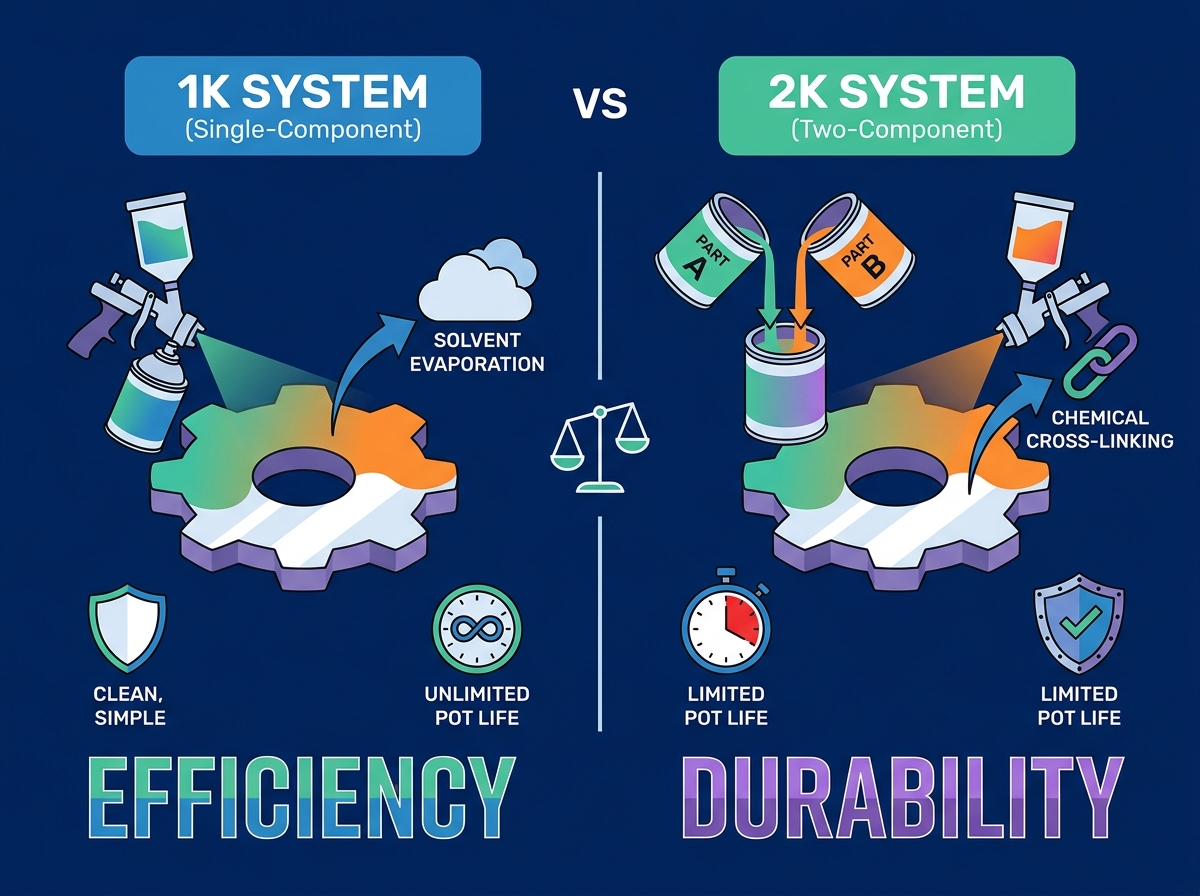
Curing processes define these two fundamental coating categories. Single-component systems rely entirely on simple solvent evaporation. The film solidifies as liquids evaporate into the air. No chemical alteration occurs within the resin itself. Two-component (2K) systems use aggressive chemical cross-linking. A dedicated hardener triggers a permanent chemical reaction. This reaction binds the polymer chains together tightly. The resulting film becomes incredibly dense and impermeable.
Evaluating Operational Efficiency
Operational efficiency strongly favors single-component paints. They offer unlimited pot life in sealed containers. Painters experience minimal equipment purging between shift changes. You can leave the material in the spray gun briefly. This reduces expensive cleaning solvent usage. Two-component paints enforce strict, unforgiving application windows. They also generate significant hazardous material waste. Once mixed, you must use it immediately or discard it. Hardened paint ruins expensive spray equipment quickly.
System Integration and Clear Coats
System integration often sparks intense debate among finishing engineers. Facility managers frequently discuss the 1k clear coat vs 2k dilemma. A single-component color base coat accelerates production drastically. It flashes off rapidly, allowing quick handling. However, applying a 2K clear coat over it is often required. This hybrid combination achieves the chemical resistance needed for higher-stress applications. The catalyzed clear coat seals the softer base coat beneath it. It protects the color layer from UV degradation and minor scratches.
Cost-to-Outcome Ratio
Analyze the overall cost-to-outcome ratio carefully. Initial material savings look highly attractive on paper. But you must weigh them against lifecycle maintenance expenses. More frequent recoating drastically increases future labor expenses. Do not just look at the raw price per gallon. Calculate the hidden cost of machine downtime during recoating procedures.
| Feature | 1K Coating Systems | 2K Coating Systems |
| Curing Mechanism | Solvent Evaporation / Moisture | Chemical Cross-Linking |
| Pot Life | Unlimited (when sealed) | Strictly Limited (1 to 8 hours) |
| Material Waste | Minimal (can be reused) | High (mixed material hardens) |
| Chemical Resistance | Low to Moderate | Very High |
| Application Speed | Very Fast (Quick Flash-Off) | Moderate (Requires Mixing Time) |
Implementation Risks: Substrates and Surface Preparation
Implementation realities dictate your ultimate shop-floor success. Single-component paints remain highly sensitive to surface contamination. They rely heavily on mechanical adhesion to grip the substrate. They lack the aggressive chemical bite found in catalyzed epoxy primers. Any residual stamping oil ruins the molecular bond instantly. Proper degreasing becomes the most critical step in your workflow.
Substrate Compatibility Requirements
Substrate compatibility requires strict, documented preparation protocols. Bare metal demands specific mechanical preparation before spraying. Steel and aluminum need precise abrasive blasting profiles. The paint needs microscopic peaks and valleys to grip properly. Often, you must apply dedicated etching primers first. Previously painted surfaces introduce entirely new chemical risks. You must test for solvent lifting on old finishes. Wrinkling happens often when applying fresh single-stage coats over old layers. The new active solvents attack and soften the old film.
Common Shop-Floor Failures
- Insufficient flash times: Rushing coats leads directly to solvent pop. Trapped outgassing creates tiny, visible bubbles in the finish.
- Environmental thresholds: Extreme humidity severely impacts moisture-cured formulas. Low shop temperatures stall solvent evaporation completely.
- Improper film thickness: Over-application traps wet solvents near the substrate. The surface skins over, leaving the bottom layer perpetually soft.
- Contaminated air lines: Moisture or oil in the compressor lines causes immediate fish-eyes and adhesion loss.
Best Practice: Always calibrate your spray equipment to the manufacturer's recommended fluid pressure. Test your air lines daily for moisture contamination using a white rag test.
How to Shortlist and Validate Industrial Paint Suppliers
Moving from technical specs to procurement reality takes deep diligence. Shortlisting logic demands strict vendor evaluation parameters. You need reliable technical partners, not just cheap bulk suppliers. Poor supplier support causes prolonged assembly line shutdowns.
Criteria for Vendor Selection
Criteria for vendor selection must include data transparency. Do they provide comprehensive TDS and SDS documents readily? You need exact data on dry film thickness (DFT) limits. Theoretical coverage numbers help procurement calculate accurate budgets. Cross-hatch adhesion test results prove long-term viability. Ask for accelerated weathering data if your equipment lives outdoors.
Batch consistency guarantees aesthetic uniformity across production runs. Demand written assurances for delta-E tolerances. This metric matters for both custom and standard industrial colors. Noticeable color shifts between batches ruin brand perception. Supply chain reliability prevents catastrophic line stoppages. Evaluate average lead times for bulk drum orders. Also, check the availability of aerosolized variants. Field maintenance teams desperately need matching aerosols for post-installation touch-ups.
Next-Step Validation Actions
- Request wet samples of the exact formula from the supplier.
- Prepare your actual production substrate using standard shop practices.
- Apply the sample under standard shop temperature and humidity conditions.
- Perform localized cross-hatch adhesion testing after full cure.
- Expose the painted part to typical operational fluids (e.g., hydraulic oil).
Never commit to large volume purchases blindly. Prove the product on your actual substrate first. Validating assumptions prevents expensive rework cycles.
Conclusion
Evaluating industrial coatings requires a disciplined decision framework. You must match the paint to the production bottleneck. You must also match it strictly to the environment's actual stress levels. Do not specify expensive catalyzed systems for imagined, worst-case scenarios unless necessary. 1K color paint is a highly efficient, cost-effective solution. It works perfectly when specified strictly within its chemical limitations. By understanding dry times, adhesion limits, and VOC regulations, your team wins. Take immediate action to improve your procurement process today.
- Download the technical data sheets for your current baseline coatings.
- Request a wet sample formulation from your shortlisted vendor.
- Perform an internal audit of your shop-floor temperature and humidity controls.
- Consult a technical coating specialist to verify substrate compatibility before ordering.
FAQ
Q: What is the actual shelf life of industrial 1K color paint?
A: Unopened single-component paints typically last one to three years. Shelf life depends heavily on the specific chemical formula. Store them in climate-controlled environments away from direct sunlight. However, moisture-cured variants have strict limits once unsealed. Ambient humidity triggers the curing process inside the open can immediately.
Q: Can I apply a 2K clear coat over a 1K color paint?
A: Yes, you usually can. Facility managers often utilize this hybrid approach. The base coat must be fully flashed off first. Ensure both chemical formulas are strictly compatible. Testing prevents the strong 2K solvents from wrinkling or lifting the softer base coat underneath.
Q: Why did my industrial paint remain soft after 48 hours?
A: Soft paint usually indicates severe application errors. Applying coats too thick traps evaporating solvents beneath the cured surface skin. Exceeding recommended dry film thickness (DFT) is a common mistake. Curing in exceptionally low temperatures or improper humidity also halts the hardening process entirely.