Upgrading to advanced industrial coatings is a high-stakes capital decision. Premature coating failure leads to facility downtime. It also causes compliance fines and compromises critical infrastructure. You might hear these solutions called Magic Paint. They offer smart, self-healing, or extreme-durability properties. These solutions are transformative.
You must distinguish consumer-grade marketing claims from industrial-grade functional coatings. Facilities face severe daily threats. Chemical corrosion, abrasive wear, and thermal degradation destroy unprotected assets. Choosing the wrong formulation wastes valuable resources. It leaves essential equipment vulnerable.
This guide outlines a rigid, evidence-based framework. You can use it to evaluate and implement the right coating. We cover realistic performance metrics. We detail non-negotiable surface preparation steps. We also explain strict environmental compliance standards. You will learn how to match specialized formulations to specific commercial environments.
Key Takeaways
- Problem-First Procurement: The right formulation is dictated by the primary failure mode you are trying to prevent (e.g., chemical corrosion, thermal degradation, or abrasive wear).
- Surface Prep is Non-Negotiable: Even the most advanced functional coatings will fail without precise substrate profiling and environmental controls during application.
- Compliance Matters: VOC regulations and localized environmental laws must filter your options before performance specs are evaluated.
Defining the Baseline: What Specific Failure Are You Trying to Prevent?
We must frame the business problem clearly. You need strict success criteria before buying any industrial coating. Facilities operate in unique micro-environments. You cannot use a one-size-fits-all approach. Evaluate your baseline conditions thoroughly. This ensures optimal long-term protection.
- Identify the Core Threat: Categorize your facility’s micro-environment carefully. Salt spray degrades carbon steel rapidly in coastal areas. Extreme UV exposure breaks down epoxy binders on outdoor tanks. Continuous immersion causes osmotic blistering in water treatment plants. High-traffic abrasion physically removes protective layers on factory floors. You must rank these threats by severity.
- Substrate Variables: Document the materials requiring coating. Carbon steel, porous concrete, and galvanized metals react differently to chemical binders. Check their current physical condition. Are they heavily pitted? Do they have old lead-based coatings intact? A perfectly clean carbon steel plate accepts paint differently than aged, spalling concrete.
- Success Metrics: Define what constitutes a successful return on investment. You might want to extend maintenance intervals from three years to ten years. Passing upcoming OSHA or EPA inspections is another valid metric. Reducing curing time to under 24 hours minimizes operational offline time. Concrete metrics guide procurement decisions effectively.
Core Categories of Industrial Magic Paint
Industrial coatings fall into highly specialized categories. Manufacturers engineer each type for specific environmental stressors. You should understand these chemical approaches deeply. This knowledge prevents costly misapplications. Let us explore the primary solutions available today.
Self-Healing & Anti-Corrosion Epoxies: Heavy manufacturing and offshore environments demand extreme durability. Epoxies provide excellent chemical resistance. Some modern formulas include specialized microcapsules. These capsules rupture upon physical damage. They release healing agents to seal micro-cracks automatically. This stops rust creeping beneath the surface. However, you must understand realistic limitations. Deep physical gouges will still require manual repair. They are not indestructible force fields.
Thermal Barrier & Insulating Formulas: Facilities use these for piping, kilns, and heat-exchangers. Many engineers express skepticism around insulating paint claims. You should look for verified R-values. Credible formulas use ceramic-microsphere technology. They reflect heat and reduce surface temperatures significantly. They protect workers from accidental contact burns. They also reduce energy loss in continuously heated systems.
Hydrophobic & Self-Cleaning Polyurethanes: Outdoor infrastructure requires robust UV protection. Marine applications face similar ultraviolet challenges. Polyurethanes excel here. They retain gloss and resist chalking for years. Hydrophobic properties repel water instantly. Rain washes dirt and contaminants away easily. This self-cleaning effect reduces maintenance labor drastically. It keeps branding and safety colors highly visible.
Anti-Microbial & Hygienic Coatings: Food processing facilities require sterile surfaces. Medical and pharmaceutical clean-rooms demand similar standards. Formulators add silver-ion or specialized chemical agents to these coatings. They inhibit bacterial growth effectively. You must evaluate these strictly. Ensure they offer proper FDA or USDA compliance tracking. Without compliance paperwork, they are useless for regulated industries.
Comparison of Industrial Coating Categories
| Coating Category | Primary Use Case | Key Technology | Realistic Limitations |
| Anti-Corrosion Epoxies | Offshore, Heavy Manufacturing | Microcapsule Self-Healing | Cannot heal deep structural gouges. |
| Thermal Barrier | Piping, Kilns, Boilers | Ceramic-Microspheres | Not a replacement for thick fiberglass wrap. |
| Hydrophobic Polyurethanes | Outdoor Infrastructure, Marine | Low Surface Energy Binders | Requires specific primers for steel adhesion. |
| Anti-Microbial | Food Processing, Medical | Silver-Ion Additives | Requires strict FDA/USDA documentation. |
![Industrial Paint Evaluation and Application Framework]()
The Evaluation Framework: Specs vs. Real-World Performance
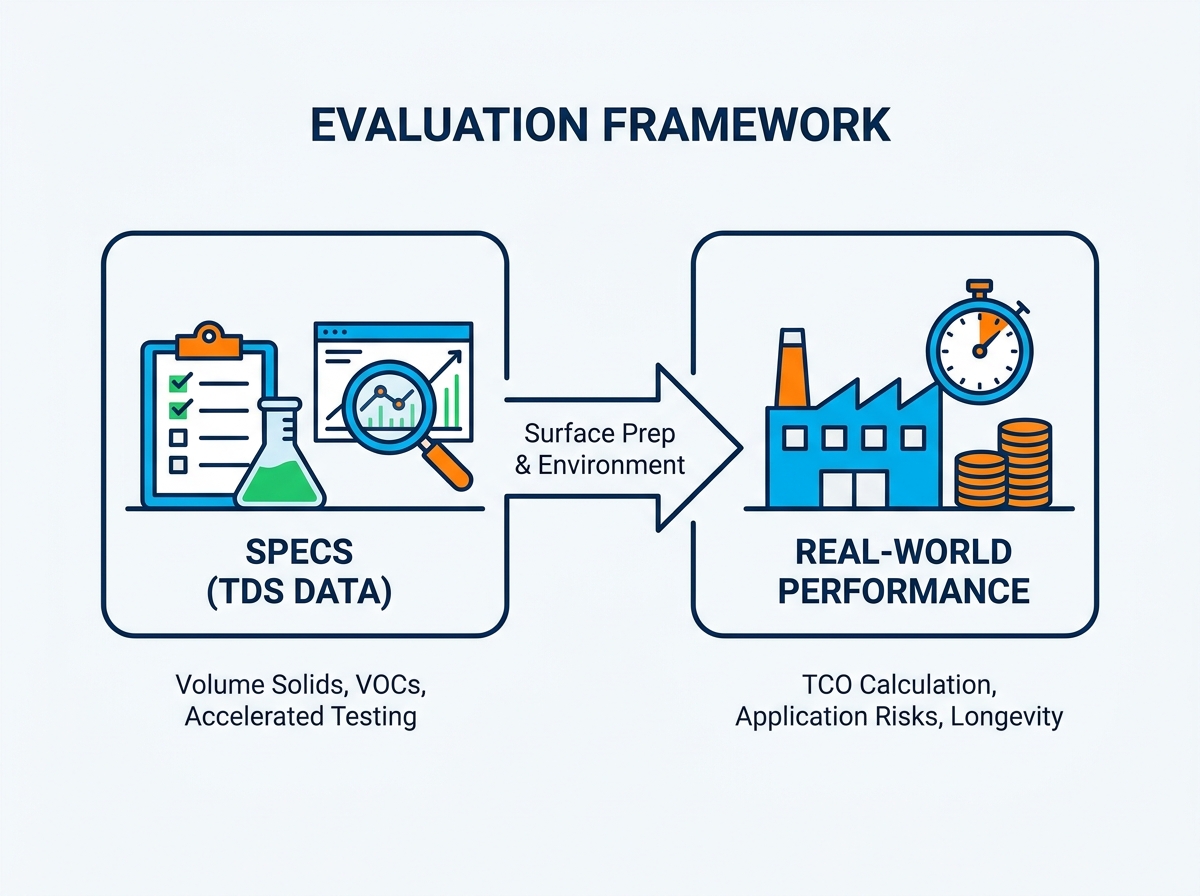
Vendors often highlight impressive technical specifications. You must translate these numbers into real-world performance. Reading a Technical Data Sheet (TDS) requires experience. We will explore key evaluation dimensions. This builds a trustworthy procurement process for finding the best Magic Paint.
Volume Solids vs. Volatile Organic Compounds (VOCs): Volume solids indicate the actual material left after curing. Higher volume solids generally indicate better build. They provide superior durability. However, they are often thicker and harder to spray. Volatile Organic Compounds evaporate into the atmosphere. You must check localized EPA and VOC restrictions. Regions like California have very strict limits. Always balance high solids against local environmental laws. Modern formulations increasingly favor low-VOC, high-solid chemistry.
Accelerated Testing Data: Ignore proprietary vendor charts. They often manipulate variables to look good. Look for independent, third-party testing instead. ASTM B117 salt spray tests provide standard benchmarks. ASTM D4541 measures pull-off adhesion strength. Third-party labs offer transparent testing conditions. They prove how long a coating resists failure under stress. Demand these test reports before buying.
Compatibility: Evaluate substrate requirements carefully. Some advanced coatings demand pristine surfaces. They require taking the substrate down to bare metal. Industry standards call this SSPC-SP 10 (Near-White Metal Blast). Other formulations act as surface-tolerant overcoats. They grip tightly to marginally prepared steel. Choosing a surface-tolerant option saves massive prep costs. But it might sacrifice some ultimate longevity. You must weigh this trade-off carefully.
The Lifecycle Value Calculation: You need a simple financial framework. Compare the initial material cost per gallon. Add application labor and operational downtime costs. Weigh this total against expected lifecycle longevity. Cheap paint fails quickly. It requires frequent repainting. Expensive, high-performance paint stays intact for decades. The higher upfront cost usually wins long-term financial models. It heavily reduces application downtime and maintenance cycles over ten years.
Implementation Realities: Hidden Risks in Application and Curing
Buying the right chemistry solves only half the problem. Implementation introduces massive hidden risks. You need experienced contractors to mitigate them. We see excellent products fail daily due to poor application.
The Surface Prep Trap: Acknowledge a harsh industry reality. Over 70% of advanced coating failures are due to poor surface preparation. They rarely fail because of the paint itself. Detail the required blast profiles. Different coatings need specific microscopic peaks and valleys. They need this anchor pattern to grip mechanically. Cleanliness standards are equally vital. Invisible salts or light oils cause immediate adhesion failure.
Environmental Constraints During Application: Monitor ambient conditions obsessively. Humidity dictates the dew point. If moisture condenses on steel, coatings will fail. Ambient temperature and substrate temperature windows are rigid. Many advanced formulas have narrow, unforgiving application parameters. Applying epoxy on cold steel retards the chemical cure. It ruins the final film properties.
Equipment Requirements: Assess your applicator equipment. Standard airless rigs work for many products. They pump single-component materials efficiently. However, extremely fast-curing formulas require specialized plural-component sprayers. These machines mix the resin and hardener right at the spray tip. This prevents the material from hardening inside the hoses. These machines are expensive and require trained operators.
Pot Life & Curing Speed: Pot life is the working time after mixing. Some advanced coatings have a 15-minute pot life. Crews must work rapidly. Curing speed dictates facility downtime. Ask for realistic timelines. When can you return the coated asset to full service? Faster cures minimize offline time significantly. They get your factory running again.
- Best Practice: Always measure surface profile depth using replica tape before spraying.
- Best Practice: Conduct environmental readings every two hours during application.
- Common Mistake: Ignoring the induction time required for certain epoxies to cross-link properly.
- Common Mistake: Over-thinning the paint to make it spray easier. This violates VOC laws and ruins film build.
How to Shortlist Magic Paint Vendors and Suppliers
You are buying a technical partnership. You are not just buying buckets of liquid. Evaluating vendors requires a strategic approach. Use these shortlisting criteria to find reliable partners.
Technical Support: Prioritize highly engaged vendors. They should deploy NACE or AMPP certified inspectors to your site. You want them to evaluate your specific failure modes in person. Avoid companies who just ship product blindly. Good technical support catches application errors early. They save you from disastrous project failures.
Warranty Transparency: Read the fine print on performance guarantees. Understand exactly what voids the warranty. Environmental application errors often nullify coverage. Improper mil-thickness is another common escape clause. Get these terms clearly defined in writing. Ensure your chosen contractor understands these rules.
Supply Chain & Batch Consistency: Evaluate the vendor carefully. Assess their ability to supply consistent formulations at scale. Industrial jobs require hundreds of gallons. Color and chemical consistency across batches is crucial. Ask about their lead times for specialized orders. Material delays halt your entire maintenance schedule. Reliable logistics are just as important as chemistry.
Next Step: Request a localized patch test. Ask for a physical mockup. Do this before committing to a facility-wide purchase order. A test patch proves adhesion on your actual substrate. It validates the visual appearance and curing time. It mitigates massive financial risk. Never skip this validation phase.
Conclusion
Selecting an industrial coating requires strict discipline. You must look past marketing jargon. Rigorously match chemical formulations to operational threats. Protect your assets proactively against daily environmental abuse.
Prioritize vendor transparency at all times. Insist on independent, third-party testing data. Over-invest in surface preparation. Excellent preparation guarantees long-term success. Even the most advanced Magic Paint fails on poorly prepared steel.
Audit your current coating failures today. Consult a NACE-certified inspector. Build a custom procurement specification. Stop wasting money on premature failures. Act decisively to secure your facility's future.
FAQ
Q: How much more expensive is "Magic Paint" compared to standard industrial epoxies?
A: Advanced functional formulations typically cost two to four times more per gallon. However, they offset this initial price through massive reductions in application labor and facility downtime. They offer superior long-term financial value by extending asset lifecycles significantly.
Q: Can advanced functional paints be applied over existing rust?
A: You must always remove loose, flaking rust. Surface-tolerant formulations can grip tightly to marginally prepared, tightly adhered rust. Traditional formulations demand bare metal. Regardless of the chemistry, completely failing paint or scale will cause the new coating to detach.
Q: How long does self-healing or smart industrial paint actually last?
A: Real-world longevity depends heavily on applied mil-thickness and environmental severity. In moderate conditions, they can last fifteen to twenty years. Avoid vendors making infinite lifecycle promises. Mechanical damage and chemical stress eventually degrade all coatings.
Q: Do I need specialized contractors to apply this paint?
A: Yes. Complex, plural-component systems require specialized, certified applicators. Fast-curing formulas and strict environmental parameters demand experienced professionals. Using uncertified crews often voids the manufacturer's performance warranty entirely.