Selecting the perfect hue goes far beyond simple aesthetic preferences. It is a precise exercise in chemistry, light reflection, and exact formulation. Many professionals underestimate this complexity during the initial decision stage. They treat the process like picking a pre-made swatch from a catalog. Inaccurate color matching or poor base quality leads directly to expensive rework. Mismatched touch-ups and unexpected project delays frequently destroy budgets. You must control these foundational variables from the very start.
This comprehensive guide provides a strict, evidence-based evaluation framework. We will teach you how to meticulously vet paint quality and accurately verify formulation. You will also learn the exact operational steps needed to successfully execute a large-scale rollout. By mastering these principles, you can eliminate guesswork and guarantee consistent results.
Key Takeaways
- Custom color accuracy relies as much on the quality of the base paint and the retailer's spectrophotometer calibration as it does on the initial color sample.
- Light Reflectance Value (LRV) and sheen levels physically alter how a custom mix presents in your specific environment.
- Physical testing via large drawdowns in native lighting is a mandatory risk-mitigation step before committing to high-volume purchases.
- Because custom-tinted paints are non-returnable, strict batch-consistency protocols (like "boxing" paint) are required during implementation.
The Science of Custom Color Matching: What You Are Actually Buying
You might assume modern computers eliminate human error in color selection. However, producing a precise custom shade requires controlling numerous physical variables. The technology relies on exact conditions to generate an accurate chemical recipe.
The Spectrophotometer Reality
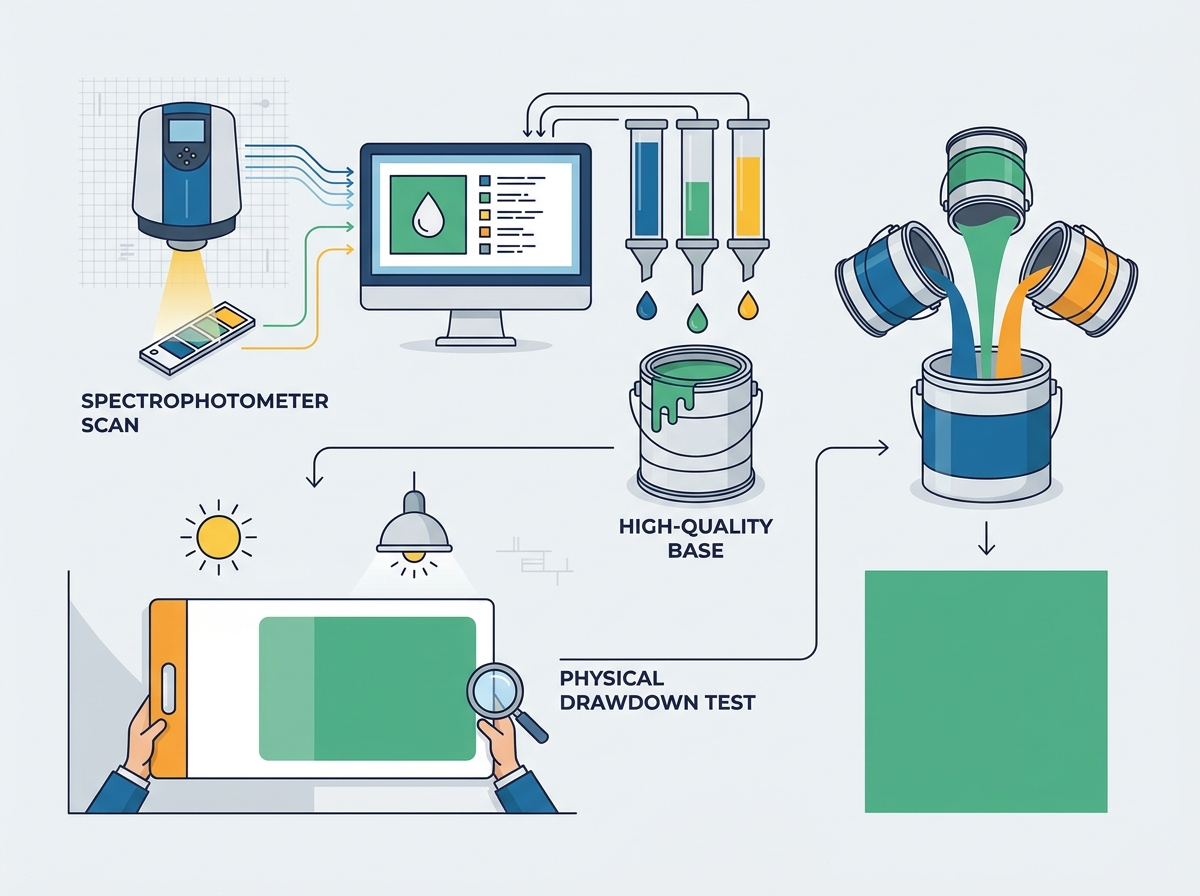
Retailers rely on an optical scanning device called a spectrophotometer. This machine bounces light off your physical sample to read its specific wavelengths. Accuracy depends entirely on the condition of the sample provided. You must provide a clean, flat object that is at least the size of a quarter. Textured surfaces create microscopic shadows. These shadows drastically skew the scanner readings.
Furthermore, accuracy hinges on the vendor's equipment calibration. A machine calibrated daily delivers exceptional precision. A machine neglected for weeks produces flawed formulas. You should always ask the vendor when they last calibrated their scanning hardware.
Base Paint Dependencies
Manufacturers do not create custom shades from scratch. They formulate them by injecting liquid tint into a pre-manufactured base. Paint stores utilize four primary bases: White, Pastel, Deep, and Clear. A high-quality base determines the ultimate hide, coverage, and durability of the application.
White bases contain high levels of titanium dioxide. This chemical provides excellent opacity for lighter shades. Conversely, Deep and Clear bases lack titanium dioxide. They rely entirely on the injected pigments to achieve coverage. Consequently, deep hues often require superior quality bases to hold heavy pigments without flashing or fading.
Brand-to-Brand Conversions
Contractors often try color-matching a competitor's proprietary hue to save money. You must understand the limitations of this common practice. Different manufacturers utilize entirely different proprietary colorants and resin chemistries. A "match" generated by a competitor is merely a close visual approximation.
It is never an exact chemical clone. The competing brand might use synthetic yellow while the original used organic yellow. These two pigments reflect artificial light differently. You should anticipate slight behavioral differences when crossing brand lines.
![Evaluating custom paint samples and finishes]()
Key Evaluation Dimensions for Custom Color Paint Products
Evaluating a product requires looking beyond the price tag. You need to assess the underlying chemistry and physical properties. The right Custom color paint balances coverage, environmental compliance, and long-term durability seamlessly.
Features-to-Outcomes
Understanding the link between product features and real-world outcomes prevents costly mistakes. We recommend focusing on two critical specifications:
- Feature: High-Volume Solids. Better paints contain a higher percentage of solid materials like binders and pigments. Once the liquid solvents evaporate, these solids remain on the wall. Outcome: You achieve superior coverage. This means fewer coats are required for deep or vibrant shades, significantly reducing labor time.
- Feature: Zero-VOC or Low-VOC Colorants. Volatile Organic Compounds (VOCs) off-gas into the air. Historically, adding heavy tint drastically increased the VOC levels of a bucket. Outcome: Modern low-VOC colorants maintain strict indoor air quality compliance. They achieve this without sacrificing tint strength or color depth.
Durability and Washability
Heavy tinting fundamentally alters the structural integrity of the liquid. Adding maximum ounces of colorant can weaken cheap binders. Deep custom shades mixed into low-grade bases frequently suffer from a phenomenon called "burnishing."
Burnishing occurs when physical friction creates a shiny mark on the surface. Simply brushing against the wall or wiping it with a cloth ruins the finish. You must select premium architectural lines designed specifically to lock in heavy pigments and resist mechanical wear.
Scalability for Large Projects
Phased projects demand strict lot-to-lot consistency. You must assess whether the supplier can accurately replicate your exact formula months down the line. Commercial suppliers maintain digital dispensing systems that guarantee exact micro-measurements. We advise ordering extra material upfront for highly critical phases to avoid slight variations later.
How Finishes and Light Reflectance Values (LRV) Alter Custom Hues
Color does not exist in a vacuum. It interacts constantly with surrounding light sources and surface textures. You can formulate the perfect hue, but the wrong sheen will ruin the final presentation.
The Sheen Factor
Sheen dictates how a surface handles ambient light. This physical manipulation directly alters perceived color saturation. You must carefully match the sheen to your specific aesthetic goals.
- Flat/Matte Finishes: These surfaces absorb ambient light. This absorption makes custom shades look deeper, richer, and truer to the original physical swatch. They hide surface imperfections beautifully.
- Eggshell/Satin Finishes: These offer a balanced middle ground. They bounce a small amount of light, slightly elevating the perceived brightness.
- Semi-Gloss/Gloss Finishes: These highly reflective surfaces bounce significant light into the room. This reflection makes the hue appear noticeably lighter. It also highlights underlying undertones aggressively.
Understanding LRV
Light Reflectance Value (LRV) measures the total quantity of visible light a surface reflects. The industry uses a strict 0-100 scale. Zero represents absolute black, absorbing all light. One hundred represents pure white, reflecting all light. Most residential and commercial colors fall between 10 and 90.
Choosing an appropriate LRV is absolutely critical. If your room features limited natural windows, choosing a shade with a low LRV will make the space feel cavernous. Conversely, applying a high-LRV shade in a sun-drenched atrium can cause uncomfortable glare.
Metamerism
Metamerism is the most common pitfall in custom tinting. This optical phenomenon occurs when two colors match under one light source but clash entirely under another. Your newly mixed bucket might match the swatch perfectly under the store's cool fluorescent bulbs.
However, once you apply it in a living room lit by 2700K warm LED bulbs, it may look entirely different. Warm lighting pulls forward yellow and red undertones. Cool lighting emphasizes blue and green undertones. You must evaluate all samples under their native environmental lighting.
Table: Finish Sheen and Light Reflection Characteristics
| Finish Type | Light Reflection Profile | Impact on Perceived Color | Best Use Case Environment |
| Flat / Matte | Minimal to None | Appears darker; true to swatch | Ceilings, low-traffic areas |
| Eggshell | Low Sheen | Slightly brighter; subtle depth | Living rooms, bedrooms |
| Satin | Medium Sheen | Brighter; highlights undertones | Hallways, high-traffic spaces |
| Semi-Gloss | High Reflection | Noticeably lighter; creates glare | Trim, doors, cabinetry |
Implementation Risks: Testing Protocols and Batch Consistency
Theoretical formulation only gets you halfway to a successful project. The implementation phase carries massive financial risks. You must institute strict testing protocols to protect your timeline and budget.
The Physical Drawdown Test
Never authorize a high-volume purchase based solely on a small paper swatch. You must purchase a single sample quart first. This is a mandatory risk-mitigation step. Use this quart to perform a physical drawdown test.
Paint a large, movable sample board. A two-foot by two-foot piece of primed drywall works perfectly. Do not paint directly onto the current wall surface. The existing color will bleed through and manipulate your perception. Move your painted board around the room. Observe it during the morning, at noon, and late in the evening.
The Touch-Up Dilemma
Custom shades are notoriously difficult to touch up seamlessly after the initial application. Modern tinting machines dispense pigments in microscopic fractions of an ounce. Even minor environmental changes during dispensing can alter the outcome slightly.
If you purchase a new gallon six months later, it will likely dry slightly lighter or darker than the original wall. The new spot will flash visibly. We strongly advise holding back a sealed, original gallon specifically for future touch-up work.
"Boxing" the Paint
Even identical gallons mixed on the same machine on the same day can vary slightly. You must follow the industry-standard implementation rule known as "boxing." Boxing eliminates these minor inconsistencies.
To box your product, open all individual gallons required for a contiguous wall. Pour them together into a single, larger five-gallon bucket. Stir the combined liquid thoroughly before application. This process guarantees absolute color uniformity across the entire architectural surface. Skipping this step often results in visible vertical bands on the finished wall.
Making the Final Call: Shortlisting and Procurement Steps
Procuring custom materials requires strategic planning. You need to establish clear rules before interacting with suppliers. Proper documentation and vendor selection define the ultimate success of the rollout.
Establish Success Criteria
Define exactly what makes the project successful before spending any money. Ask yourself what the primary objective is. Are you executing a strict historical preservation match? This requires exact chemical replication. Are you matching a specific corporate brand guideline? This demands precise Pantone alignment. Or is it a purely aesthetic vision for a residential space? Defining these criteria dictates how much tolerance you have for minor variations.
Selecting the Vendor
Where you purchase your product matters immensely. We strongly advise choosing a dedicated commercial supplier over a general big-box hardware store. Highly critical matches require specialized attention.
Dedicated commercial suppliers typically maintain tighter calibration schedules on their mixing equipment. They employ experienced staff who understand metamerism and base chemistry. Furthermore, specialized retailers offer superior architectural bases designed to handle complex pigment loads without compromising durability.
Documentation
Losing a custom formula creates a logistical nightmare down the road. You must document the final purchase meticulously. Instruct the buyer to photograph the specific formula sticker printed on the lid. Permanently file this photograph in a cloud drive or project folder.
The arbitrary name printed on the label is completely irrelevant. The precise tint drop formula listed below the name is the only data that matters. This code details the exact base type and the micro-ounces of each pigment injected. This string of numbers is the only guaranteed way to recreate the batch in the future.
Conclusion
Executing a successful custom rollout requires tightly controlling physical variables. A beautiful swatch means nothing without a quality base and exact scanning. You must remain highly aware of your specific lighting conditions and surface sheen requirements.
To ensure project success, prioritize these key action steps. First, invest the required time and minor upfront cost in physical sample quarts. Never skip the drawdown testing phase under any circumstances. The exorbitant cost of repainting a failed space vastly outweighs the cost of initial verification. Finally, implement strict boxing protocols on the job site and digitally archive your exact formula stickers. Taking these deliberate steps transforms a risky process into a predictable, highly professional outcome.
FAQ
Q: Can any color be perfectly matched as a custom paint?
A: Most solid, opaque colors can be matched with over 95% accuracy. However, standard optical scanners have hard limitations. They cannot accurately replicate metallic, pearlescent, or highly textured finishes. The scanner interprets reflections from these materials as dark spots, leading to flawed mixing formulas.
Q: Is custom color paint more expensive than standard colors?
A: The tinting process itself usually does not increase the retail price. The final cost is typically dictated by the quality of the base you select. However, highly saturated bespoke shades may require premium "deep" bases or demand additional coats, which indirectly increases overall project costs.
Q: Can I return custom-tinted paint if I don't like the color?
A: No. It is an established industry standard that custom mixes are strictly final sale. Since the retailer cannot resell your unique formulation, they will not accept returns. This policy heavily reinforces the necessity of the sample testing protocols outlined in our guide.
Q: How long does a supplier keep my custom paint formula on file?
A: Some modern retail systems save digital formulas locally under your phone number for a few years. However, retail systems crash, and databases get purged. It is solely the buyer's responsibility to retain a photograph of the physical formula label for future matching needs.