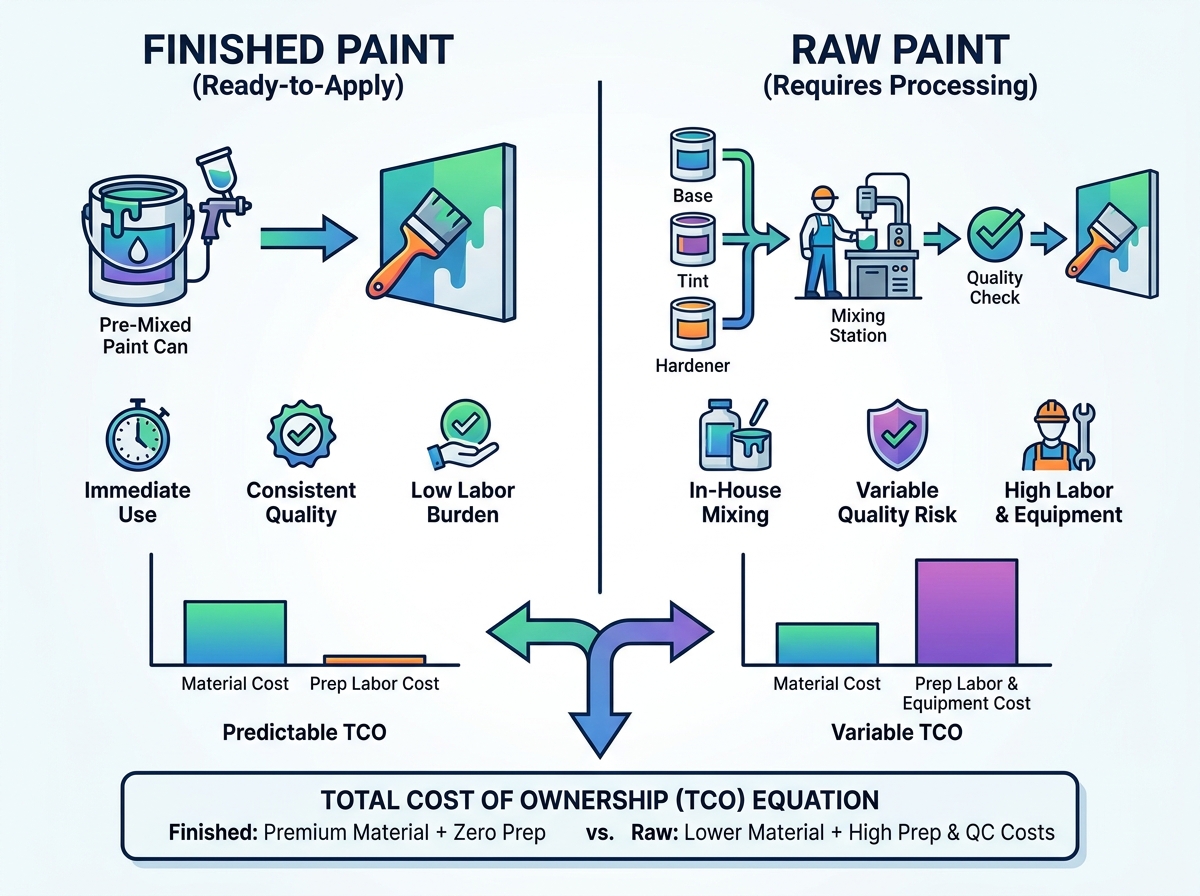
Procuring commercial coatings goes beyond the initial price per gallon. Every drop applied on a production line or facility wall carries hidden operational implications. The choice between ready-to-apply formulations and baseline components heavily impacts your production workflows. It also affects labor costs and strict quality control protocols. Making the wrong procurement decision often leads to unforeseen bottlenecks. It causes inconsistent finishes and wastes valuable man-hours on the shop floor. Procurement teams and facility managers desperately need clarity. You must balance upfront material costs against true process efficiency. This article provides an objective framework to evaluate these competing procurement strategies. We will explore how each system aligns with your specific operational capacity. You will also understand how labor availability and environmental compliance requirements shape this choice. Ultimately, you will learn to identify the exact tipping point for your business. This ensures you select the most efficient coating system for your unique manufacturing environment.
Key Takeaways
- Finished paint delivers batch-to-batch consistency and immediate application readiness, shifting quality control liability to the manufacturer.
- Raw paint (un-tinted bases or unmixed formulation components) offers lower upfront material costs but requires internal processing, tinting equipment, and strict in-house quality assurance.
- The optimal choice depends on volume predictability, labor availability, and required turnaround times.
Defining the Baselines: Finished Paint vs. Raw Paint in Industrial Procurement
Buyers must understand the fundamental material differences before overhauling procurement strategies. The industrial coatings market offers two distinct pathways. Each pathway dictates how your team operates on a daily basis. We must define these baselines clearly.
Finished Paint Characteristics
Manufacturers deliver Finished Paint fully formulated and pre-tinted. The product arrives chemically stabilized for immediate use. You bypass the mixing room entirely. It arrives with standardized viscosity. The sheen and performance metrics remain locked in right out of the container. This ready-to-spray nature minimizes prep time significantly. Factory operators simply open the container, stir briefly, and begin application. Manufacturers engineer these products to meet exact specifications before they ever leave the production facility.
Raw Paint (Bases/Components) Characteristics
Raw bases represent a completely different operational model. These products consist of un-tinted bases or un-catalyzed resins. They require secondary mixing before anyone can apply them. Operators must add tints. They might need to introduce chemical activators or hardeners prior to application. This material acts as a blank canvas. It allows for high-volume, on-site customization. In-line manufacturing processes often rely on these bases to produce dozens of different color variants from a single core stock. However, this flexibility demands robust internal infrastructure.
The Procurement Shift
Industry leaders are changing their procurement dialogue. Moving away from asking "Which is cheaper?" is essential. Modern buyers now ask, "Which system matches our operational bandwidth?" Your internal capabilities must dictate the material choice. If you lack automated mixing equipment, raw bases will cause production delays. Evaluating your team's actual capacity prevents expensive workflow disruptions.
| Characteristic | Ready-to-Apply Coatings | Raw Base Components |
| Application Readiness | Immediate (Ready-to-use) | Requires processing/mixing |
| Customization | Fixed at the manufacturer level | High flexibility on-site |
| Viscosity Stability | Pre-calibrated and stable | Dependent on internal mixing |
| Labor Requirement | Low (Minimal prep) | High (Dedicated mixing staff) |
![Industrial Paint Application and Mixing Comparison]()
Cost-to-Outcome Analysis: Material Savings vs. Processing Labor
Procurement professionals often focus heavily on the invoice price. This narrow view ignores the massive financial impact of processing labor. We must conduct a comprehensive cost-to-outcome analysis. This reveals the true financial burden of each coating strategy.
Material Cost Realities
Raw bases generally feature noticeably lower per-unit purchasing costs. You buy the core chemistry without the specialized labor attached. Conversely, Finished Paint carries a premium price tag. You pay the supplier for manufacturer-level mixing, precise tinting, and rigorous quality testing. On a spreadsheet, unmixed bases always look more attractive initially. However, these initial savings rarely reflect the final project expenditure.
Labor and Equipment Burden
The implementation reality paints a much different financial picture. Unmixed formulations require dedicated personnel. You must pay skilled operators for tinting and mixing duties. Furthermore, you must invest in expensive calibration equipment. Dispensers, shakers, and spectrophotometers require constant maintenance. This extends your overall prep time dramatically. Ready-to-use alternatives significantly reduce this prep labor. Crews or manufacturing lines can begin application faster. Faster application translates directly to higher daily throughput and increased revenue.
Comprehensive Operational Equation
You must evaluate the true operational expense rather than just the invoice. A complete financial assessment requires measuring multiple compounding variables. Consider the following cost factors when building your procurement model:
- Material Invoice Price: The base cost per gallon from the distributor.
- Processing Labor Hours: The wages paid to staff specifically for mixing and tinting.
- Equipment Amortization: The degrading value and maintenance costs of on-site mixing machinery.
- Waste and Spoilage: The cost of human error, mis-tints, and expired mixed batches.
Compare the sum of these four factors against the premium price of pre-mixed solutions. The zero prep time of a fully formulated product frequently negates the initial material savings of raw bases. High labor rates make internal mixing increasingly unprofitable for many mid-sized facilities.
Quality Control, Consistency, and Compliance Liability
Industrial applications demand strict adherence to visual and chemical standards. Transferring or absorbing quality control liability represents a major strategic decision. Product consistency directly impacts your brand reputation and customer satisfaction.
Batch-to-Batch Consistency
Fully formulated products utilize manufacturer-grade spectrophotometers. Production occurs within highly controlled environments. Manufacturers monitor ambient temperature and humidity constantly. This strict oversight ensures the Delta-E stays within extremely tight tolerances. Delta-E measures the visual color difference. A low Delta-E guarantees uniformity across large or phased projects. If you paint half a commercial building in May and the other half in October, the colors will match perfectly.
In-House Quality Assurance Risks
Tinting or mixing internally introduces significant human error. It also introduces volatile environmental variables. Consider the primary risks associated with in-house processing:
- Temperature Fluctuations: Mixing in a non-climate-controlled warehouse alters chemical bonding.
- Measurement Inaccuracies: Manual tint dispensing often leads to micro-variations in shade.
- Contamination: Dust or residual chemicals in mixing equipment ruin entire batches.
- Operator Turnover: Losing a skilled mixing technician immediately halts production quality.
Your facility must absorb the financial hit for every mis-tinted batch. Reworking a rejected project destroys profit margins.
Compliance and Safety
Environmental compliance carries heavy legal liabilities. Manufactured coatings arrive with standardized Safety Data Sheets (SDS). They feature fixed Volatile Organic Compound (VOC) levels. You know exactly what you are spraying. Processing raw bases on-site often alters these VOC profiles. Adding specific colorants or hardeners can push a compliant base over the legal VOC limit. You must then implement internal compliance tracking. You become responsible for proving your mixed formulas meet local environmental regulations. This adds a massive administrative burden to your safety department.
Supply Chain Predictability and Storage Shelf Life
Managing chemical inventory requires strategic foresight. Dead stock drains capital. Expired chemicals create hazardous waste disposal problems. Your procurement choice directly influences warehouse management and supply chain resilience.
Inventory Management
Stocking un-tinted bases allows for exceptional inventory flexibility. A single pallet of a deep base can become fifty different colors. This drastically reduces the risk of dead stock for niche or unpopular colors. You simply tint on demand. Stocking fully formulated options requires precise demand forecasting. You must predict exactly how many gallons of specific colors or sheens you need. Poor forecasting leads to over-ordering. You might end up with pallets of custom blue paint sitting unused in the warehouse.
Shelf Life Considerations
Chemical stability plays a crucial role in procurement volume. Consider these shelf-life dynamics:
- Raw Bases: These generally boast a longer, more stable shelf life. They remain inert before you introduce tints or hardeners. You can confidently buy them in bulk to secure volume discounts.
- Formulated Coatings: Once a manufacturer formulates a coating, the stability clock starts ticking. This applies intensely to two-part epoxies, polyurethanes, or specialized industrial coatings. The chemical components slowly degrade over time.
You risk applying degraded material if pre-mixed inventory sits too long. Always align your bulk purchasing with realistic application timelines. Never buy a two-year supply of a formulated product if its shelf life is only twelve months.
Decision Framework: Shortlisting the Right Paint System for Your Business
Choosing the correct system requires an honest audit of your operations. No single solution fits every industrial buyer. Use this targeted framework to guide your next procurement cycle.
When to Choose Finished Paint
Certain operational profiles benefit immensely from outsourcing formulation. You should choose this route if your primary constraint is labor availability. When skilled labor is scarce, you cannot afford to waste hours mixing. You also need this option if the project demands exact color matching across multiple locations over a long period. National retail rollouts require identical branding nationwide. Finally, choose this path if you lack a dedicated, climate-controlled facility. Precise mixing and quality control require specialized infrastructure. Do not attempt it in a dusty, unregulated warehouse corner.
When to Choose Raw Paint
Other business models thrive on internal processing. You should select baseline components if you operate a high-volume facility with highly variable color output. Custom furniture manufacturing or diverse tenant turnovers require hundreds of different shades weekly. You should also choose this route if you already own automated tinting infrastructure. If you have dispensing machines, gyroscopic shakers, and trained operators on staff, leverage them. Finally, choose this if you need to maintain flexible inventory without risking expired pre-mixed stock. It protects your cash flow from unpredictable market demands.
Next-Step Actions
Do not rely on assumptions. Audit your current prep-time labor costs immediately. Document exactly how many hours your team spends mixing daily. Review your equipment capabilities and maintenance logs. Request sample batches of ready-to-use products from a trusted supplier. Run a strict time-and-motion study against your current internal mixing process. Compare the actual labor hours saved against the material price premium. Data-driven time studies reveal the most profitable path forward.
Conclusion
The decision between fully formulated coatings and raw baseline components is critical. It fundamentally represents a choice between outsourcing preparation to the manufacturer or absorbing it internally for inventory flexibility. You must evaluate your team's actual capability to manage quality control effectively. Never base your procurement strategy solely on the initial invoice price per gallon. Factor in the hidden costs of application delays, mis-tints, and equipment maintenance. We recommend consulting a commercial coating specialist today. Audit your current supply chain strategy carefully. Test both methods on a small scale to measure real-world efficiency. Aligning your material choice with your operational reality guarantees smoother production and stronger profit margins.
FAQ
Q: Does finished paint have a shorter shelf life than raw base paint?
A: Yes, pre-mixed colors and specific formulations frequently settle or degrade faster than un-tinted bases. The exact timelines depend entirely on the specific chemistry, such as acrylic versus epoxy. Always check the manufacturer guidelines to ensure optimal storage durations and avoid applying expired materials.
Q: Can we achieve the same color consistency mixing raw paint in-house?
A: Yes, but it requires strict adherence to formulas. You must utilize automated dispensing equipment and maintain rigorous internal quality assurance protocols. Smaller operations often struggle to maintain this high level of precision across multiple batches or varying environmental conditions.
Q: How do VOC regulations impact the choice between formulation types?
A: Adding liquid colorants to a base can inadvertently increase total Volatile Organic Compounds (VOCs). Ready-to-use formulas provide a pre-certified, fixed VOC measurement directly from the manufacturer. This simplifies environmental compliance and reporting for the buyer, greatly reducing regulatory liabilities.