Engineering and facility teams constantly seek innovative ways to optimize budgets and accelerate prototyping. Recently, a rising trend involves exploring in-house, functional coatings to solve immediate environmental or operational challenges. We often colloquially call these functional solutions Magic Paint. Social media and DIY forums frequently highlight easy recipes for magnetic, conductive, or temperature-reactive paints. However, industrial environments face far stricter operational demands than residential craft projects.
Formulating these specialized coatings in-house is a viable strategy for low-stakes prototyping. Yet, scaling them for industrial applications introduces severe compliance, durability, and consistency risks. These risks usually necessitate commercial-grade procurement. In this article, you will learn how to categorize functional coatings and evaluate viable DIY options. We will also examine key decision dimensions to help you transition from temporary prototypes to reliable, commercially certified deployments.
Key Takeaways
- DIY has a ceiling: In-house blending of functional pigments (iron dust, graphite, thermochromic powders) is effective only for proof-of-concept testing, not long-term deployment.
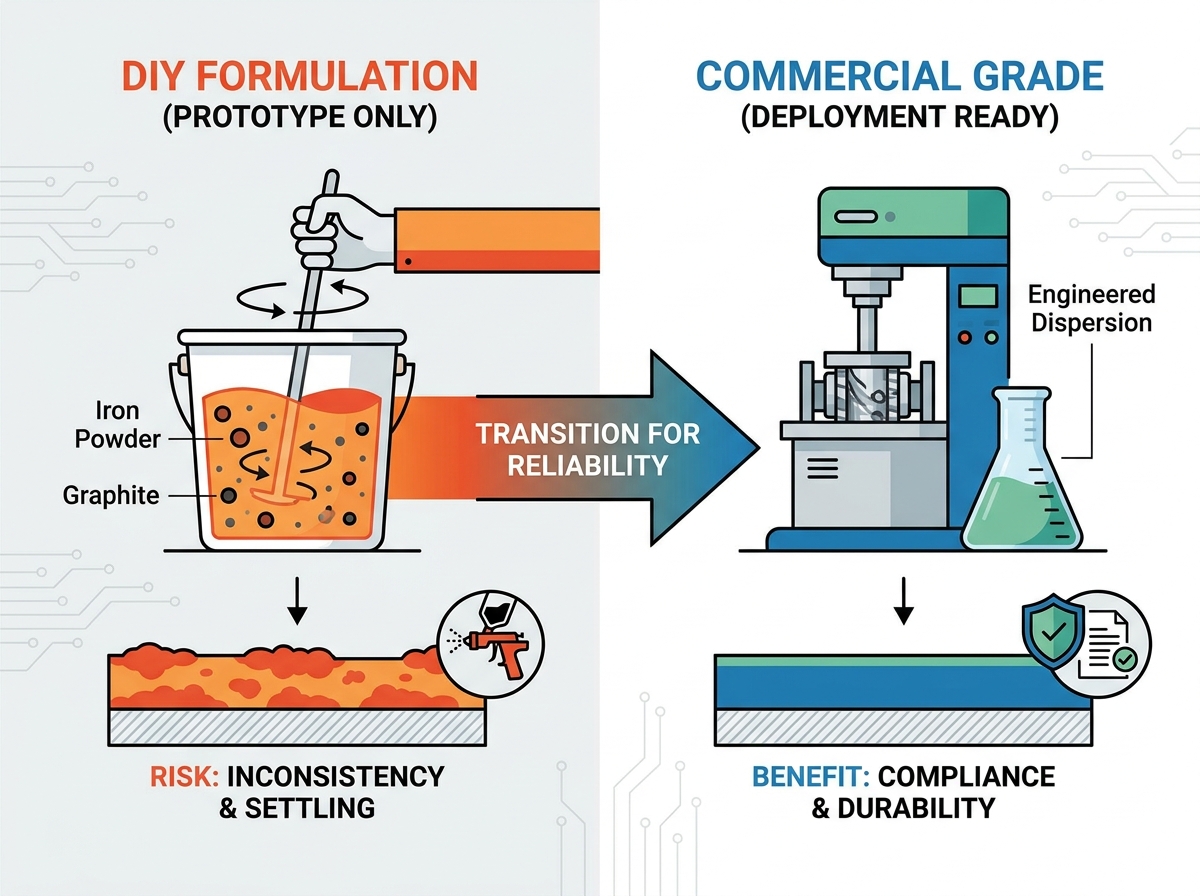
- Consistency is the main failure point: DIY mixing inherently lacks the high-shear milling required to keep heavy functional particles suspended, leading to patchy application and equipment damage.
- Compliance outweighs material savings: Commercial facilities must account for OSHA regulations, VOC limits, and standardized Material Safety Data Sheets (MSDS), which DIY concoctions cannot reliably provide.
- The Build vs. Buy verdict: Use DIY options to validate a use case, but transition to commercially certified functional coatings for deployment to ensure reliability and warranty protection.
Defining "Magic Paint" in an Industrial Context
Facilities often seek specialized coatings to solve distinct environmental problems. They want to avoid overhauling existing infrastructure entirely. Instead of expensive physical rebuilds, they turn to advanced chemical solutions. We must translate the broad concept of Magic Paint into concrete commercial realities. This approach bridges the gap between imagination and practical facility engineering.
You can generally categorize functional coatings into three distinct industrial applications:
- Magnetic/Receptive Paint: Teams use this for agile workspaces and temporary fixture mounting. It transforms standard drywall into interactive planning boards seamlessly.
- Conductive/RF-Shielding Paint: Engineers deploy this to prevent electromagnetic interference (EMI). It proves absolutely critical in server rooms or sensitive electronics manufacturing facilities. It blocks rogue frequencies efficiently.
- Thermochromic Paint: Safety managers apply this as a highly visible indicator. It highlights overheating machinery or stressed pipes instantly. It changes color rapidly when surface temperatures exceed safe operating limits.
Procurement and engineering teams often consider mixing these paints internally. They perceive lower upfront material costs. They also appreciate the immediate availability of raw household or hardware materials. DIY methods seemingly promise bespoke concentrations tailored to a specific task. You can mix exactly what you need immediately. However, these perceived benefits rarely translate well to large-scale facility applications. They ignore the hidden, complex realities of industrial polymer chemistry.
Viable DIY Formulations for Proof-of-Concept
You can theoretically construct these paints using off-the-shelf materials. They work remarkably well for temporary, small-scale testing. They allow engineers to validate a concept quickly before securing a budget. Let us explore the basic mechanics and inherent limitations of these initial mixtures.
Magnetic and Receptive Prototyping
The base mechanism involves suspending fine iron powder. Alternatively, you might use common iron oxide. You mix this active material into a standard acrylic or polyurethane binder. This manual process attempts to create a magnetically receptive surface. Engineers often test this on small drywall patches or temporary barriers.
However, you will face severe functional limitations quickly. The method requires applying multiple, incredibly thick coats. Only then can you achieve adequate magnetic attraction for basic fixtures. Heavy iron particles settle rapidly in standard commercial binders. This rapid settling forces constant, aggressive agitation during application. It makes painting large vertical surfaces nearly impossible without creating heavy drips.
Conductive and Shielding Mixtures
This base mechanism requires blending fine graphite powder. Some teams use copper particulates instead. You fold these highly conductive elements into standard industrial primers. This creates a basic Faraday cage effect. Facilities use this for early-stage prototyping in isolated equipment rooms.
The primary limitation lies in inconsistent electrical resistance. Industry standards measure this metric precisely as ohms per square. Manual mixing variances inevitably cause uneven particle distribution. This unevenness creates hidden weak spots in the shielding layer. Electromagnetic frequencies easily penetrate these compromised zones, rendering the shield useless.
Thermal Indicator Coatings
The mechanism centers on adding microencapsulated thermochromic pigments. You disperse these highly reactive powders into clear industrial epoxies. The coating then changes color at specific temperature thresholds. It helps monitor complex piping systems temporarily.
Unfortunately, these DIY mixtures suffer from rapid chemical degradation. They undergo intense UV breakdown almost immediately upon exposure. They quickly lose functionality without specialized chemical UV stabilizers. Standard clear coats cannot protect the delicate thermochromic microcapsules. The harsh environmental breakdown renders the safety indicator completely useless within weeks.
![Industrial functional coating application and testing procedures]()
Evaluating DIY vs. Commercial Grade: Key Decision Dimensions
You need a clear, objective evaluation framework. This criteria helps facility managers decide whether to scale an in-house recipe. It also justifies purchasing a certified commercial solution instead.
Batch Consistency and Scalability
DIY formulations exhibit remarkably high performance variance. A one-gallon test batch will perform entirely differently than a 50-gallon production batch. Hand-mixing simply cannot ensure uniform particle distribution. Gravity pulls heavy functional metallic elements downward constantly during application.
Commercial solutions guarantee proper, suspended pigment dispersion. Manufacturers utilize specialized industrial high-shear milling equipment. This machinery grinds and suspends functional particles flawlessly. It ensures absolute uniform functionality per square foot. It maintains this critical consistency across massive facility production runs.
Adhesion, Durability, and Lifecycle
In-house mixtures carry an exceptionally high risk of delamination. Adding foreign metallic powders to standard paints alters the binder-to-pigment ratio negatively. This disruption fundamentally destroys the paint's structural integrity. It causes peeling, flaking, and rapid surface deterioration under stress.
Commercial coatings utilize highly specialized chemical resins. Chemists design these unique resins specifically to carry heavy payloads. They hold functional particles tightly in suspension. They successfully withstand harsh industrial wear. They also endure rigorous chemical cleaning protocols without degrading over time.
Safety, Liability, and Compliance
DIY blending creates completely undocumented chemical mixtures. This careless practice severely complicates facility fire codes. It also triggers immediate OSHA compliance violations during routine inspections. Proper hazardous waste disposal becomes a massive regulatory headache for facility managers.
Commercial products arrive with full, standardized MSDS documentation. They guarantee strict VOC compliance for specific regional laws. They also feature independent third-party lab testing. They adhere strictly to established international ASTM standards, ensuring absolute safety.
| Evaluation Criteria | DIY Formulations | Commercial Grade Solutions |
| Batch Consistency | High variance; unreliable over large areas | Uniform functionality via industrial milling |
| Structural Integrity | High delamination and peeling risk | Specialized resins prevent failure |
| Regulatory Compliance | Undocumented mixtures; fails OSHA audits | Full MSDS, VOC, and ASTM certifications |
| Application Labor | Intensive; requires constant agitation | Standard; arrives ready to spray or roll |
| Equipment Wear | Severe; clogs nozzles quickly | Minimal; properly milled particles flow easily |
Hidden Costs and Implementation Risks of In-House Mixing
Rolling out a DIY solution on a facility floor presents massive practical downsides. These operational risks easily overshadow any initial raw material savings. You must consider the broader impact on your facility.
- Equipment Damage: Improperly ground particles ruin expensive application tools. DIY graphite or iron bits rapidly clog commercial HVLP spray nozzles. They also aggressively destroy sensitive fluid pump seals. Replacing these ruined parts halts production lines completely.
- Labor Overhead: Your maintenance team will spend countless hours sourcing raw powders online. They must then mix, agitate, and constantly troubleshoot failed batches manually. They will deal with clumps and uneven textures. This expensive labor time quickly eclipses any minor savings on hardware store materials.
- The Cost of Failure: Premature delamination leads to incredibly expensive facility downtime. Functional failure causes even bigger systemic problems. If an RF-shielding paint fails, it compromises vital server operations. You must then fund complete, highly disruptive surface remediation.
Shortlisting Commercial Magic Paint Alternatives
You must eventually transition from a DIY prototype to a permanent solution. You need a reliable, compliant vendor procurement process. Follow these specific next-step actions to secure high-quality industrial coatings.
Vendor Requirements: Look strictly for manufacturers providing exact technical data sheets (TDS). These documents must explicitly list particle suspension lifespans. They should also dictate the recommended mil-thickness for optimal performance. Never trust a vendor lacking transparent, third-party testing data.
Application Compatibility: Ensure the commercial coating fits your existing infrastructure. It must remain fully compatible with your current application equipment. Check the technical specifications thoroughly before purchasing. Look for brush, roller, or specific spray pressure requirements. You want to avoid purchasing brand-new application hardware unnecessarily.
Running a Pilot: Always request sample quarts from commercial vendors first. Test these rigorously against your initial DIY prototype. Evaluate them for long-term durability and ease of application. Measure their functional performance under actual facility conditions. Complete this testing phase before executing a full facility rollout.
Conclusion
Creating functional coatings in the shop validates ideas effectively. It offers a low-barrier method for testing a new concept. However, DIY mixing fundamentally lacks structural integrity. It cannot sustain the intense chemical and physical demands required for rigorous industrial use. Your maintenance teams will eventually lose the battle against particle settling and poor adhesion.
Treat DIY formulations strictly as temporary, low-risk prototypes. For actual facility upgrades, safety indicators, or electromagnetic shielding, investing in commercially formulated coatings is crucial. It remains the only financially and legally sound decision available to facility managers. Secure comprehensive warranties to protect your investments. Protect your expensive application equipment from preventable damage. Maintain strict environmental and safety compliance effortlessly. Moving away from unregulated workshop mixtures ultimately protects your entire operational infrastructure.
FAQ
Q: Can I just add iron powder to standard industrial primer to make magnetic paint?
A: Technically yes, but it immediately voids the primer's warranty. It weakens base adhesion severely and requires constant agitation. This continuous mixing is necessary to prevent the heavy iron from sinking to the bottom of the can during application.
Q: How much does commercial functional paint cost compared to DIY mixing?
A: Commercial products cost two to four times more upfront per gallon. However, overall long-term expenses drop significantly. This accounts for substantially reduced labor, less equipment wear, fewer failed batches, and a dramatically extended surface lifecycle.
Q: Are DIY conductive paints safe for industrial electrical grounding?
A: No. DIY mixtures cannot guarantee consistent ohms-per-square resistance across a surface. This creates severe safety and fire hazards in heavily regulated environments. Always use certified commercial products for critical electrical shielding or grounding applications.