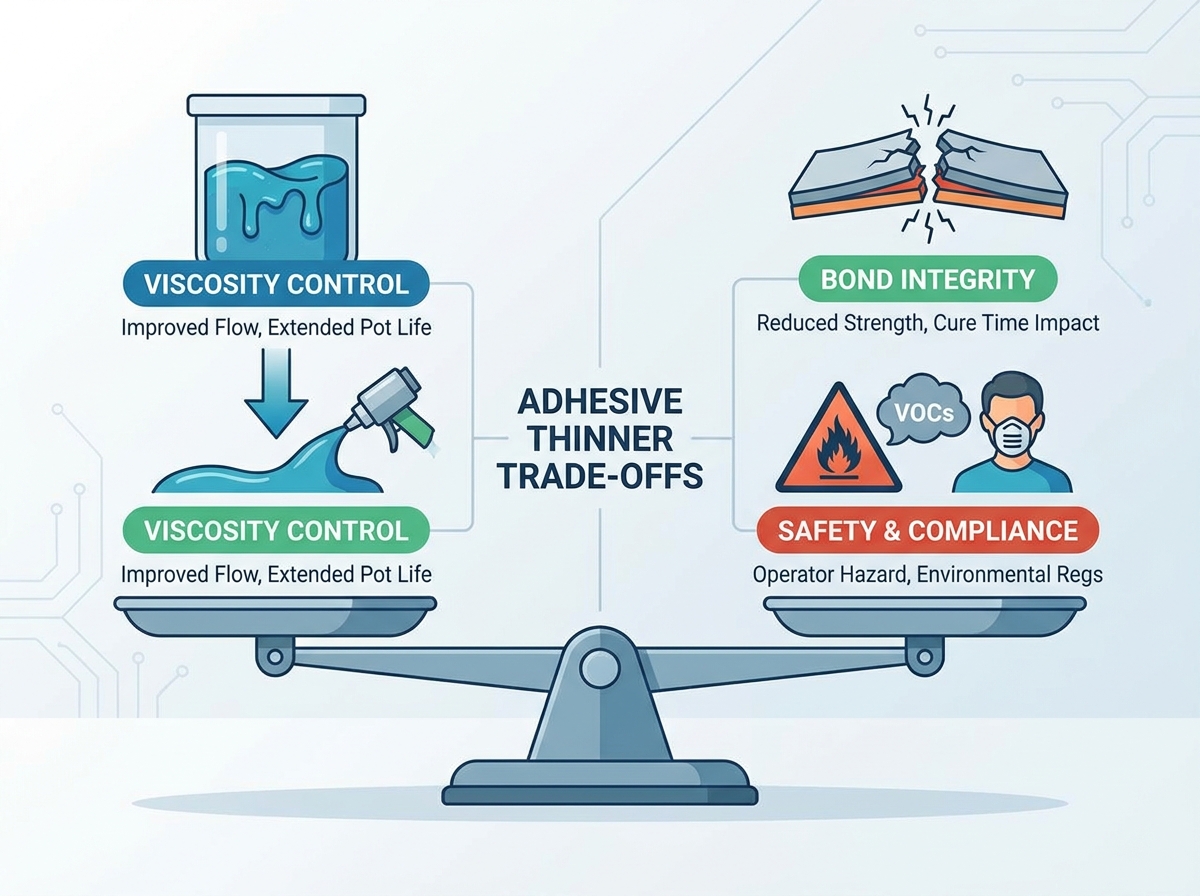
Industrial and commercial adhesive applications face a constant fundamental tension. Operators need to control viscosity and extend working life for optimal application. However, modifying adhesives introduces severe risks like bond degradation, operator hazards, and compliance violations. Unregulated dilution easily ruins foundational chemistry, leading to catastrophic structural failures. Workplace safety and environmental compliance also hang in the balance when introducing volatile solvents into production environments. Facilities cannot afford guesswork when modifying highly engineered chemical bonds.
We created this article to provide an evidence-based framework for your operations. You will learn how to evaluate, test, and safely implement an Adhesive thinner. We will show you how to optimize viscosity without compromising structural integrity or workplace safety. This guide delivers actionable steps to align your dilution strategies with both performance metrics and strict regulatory standards.
Key Takeaways
- Dilution directly impacts cure times, tensile strength, and substrate compatibility; thinners must be chemically matched to the base adhesive system.
- Efficacy evaluations must prioritize evaporation rates and residual solvent profiles to prevent long-term bond failure.
- Regulatory compliance (VOC limits, OSHA/REACH standards) and rigorous toxicological risk assessments are non-negotiable baselines for product shortlisting.
- Successful implementation requires controlled pilot testing, updated Safety Data Sheet (SDS) integration, and strict environmental controls during rollout.
The Business Case: Balancing Viscosity Control with Risk Management
Defining the Operational Need
Organizations rely on adhesive modifying agents to solve daily production bottlenecks. Fast-curing adhesives often thicken prematurely in the pot. This thickness creates uneven application layers. Operators need a way to reclaim these thickened adhesives before they become unusable waste. Modifying viscosity also optimizes the adhesive for specific equipment. Spray guns and roller coaters require precise fluid dynamics to function efficiently. Extending the pot life ensures workers have enough time to complete complex assembly tasks without rushing.
Success Criteria
You achieve success when you hit the target viscosity without altering the foundational chemistry. The modifying agent must evaporate or cross-link perfectly. It should leave the polymer chain intact. Real-world success means the final bonded assembly performs exactly like an undiluted application. You want a seamless drop in viscosity. You do not want a compromised chemical matrix.
The Cost of Misalignment
Incorrect thinning creates massive financial and operational risks. Adding the wrong solvent can permanently interrupt the curing process. This leads to catastrophic bond failure days or weeks after assembly. Furthermore, inappropriate dilution increases Volatile Organic Compound (VOC) emissions. High VOC levels invite steep regulatory fines. They also expose operators to severe respiratory hazards. These workplace safety liabilities often cost far more than the raw materials themselves.
Categorizing Adhesive Thinners: Formulation and Compatibility
You must match the chemical profile of the diluent to your specific adhesive system. Selecting the wrong category leads to immediate phase separation or compromised curing.
Solvent-Based Thinners
Traditional solvents include Methyl Ethyl Ketone (MEK), Toluene, and Acetone. These chemicals aggressively break down polymer chains for rapid viscosity reduction. They are ideal for neoprene, nitrile, and certain solvent-borne epoxies. However, they carry significant trade-offs. Their high volatility demands strict localized ventilation. They can also cause aggressive substrate reactions, melting sensitive plastics before the adhesive even cures.
Water-Based and Low-VOC Alternatives
Environmental regulations push many facilities toward water-based or low-VOC options. These formulas suit acrylics and dispersion adhesives perfectly. They improve workplace safety and reduce environmental impact. Yet, they have distinct limitations. Water-based options extend drying times significantly. They also suffer from poor freeze-thaw stability. If your facility experiences extreme temperature shifts, these formulas require climate-controlled storage.
Specialty and Reactive Diluents
Reactive diluents function differently than traditional evaporating solvents. Chemists design them to cross-link directly with the adhesive matrix. You will commonly find these in two-part epoxies and polyurethanes. Instead of flashing off into the atmosphere, they become part of the final cured plastic. This mechanism preserves structural integrity. It prevents the shrinkage commonly associated with heavy solvent evaporation.
The Diluent Compatibility Matrix below illustrates these core differences.
| Thinner Category | Ideal Adhesive Match | Primary Advantage | Major Limitation |
| Solvent-Based (MEK, Acetone) | Nitrile, Neoprene, Rubber | Rapid flash-off, high solvency | High VOCs, flammability risks |
| Water-Based / Low-VOC | Acrylics, Dispersions | Safe handling, regulatory compliance | Slow evaporation, freezing risks |
| Reactive Diluents | Epoxies, Polyurethanes | Zero shrinkage, structural integrity | Precise mix ratios required |
![Adhesive thinner application and testing in an industrial laboratory setting]()
Effectiveness Criteria: Evaluating Performance Trade-offs
Evaporation Rate and Open Time
An Adhesive thinner directly dictates your assembly window. We measure this through the evaporation rate. If a solvent flashes off too quickly, the adhesive skins over. This prevents proper substrate wetting. If it evaporates too slowly, the parts may shift during assembly. You must match the flash-off speed to your production line's exact pacing.
Impact on Mechanical Properties
Dilution always risks degrading the final bond. You need a testing framework to measure these potential reductions post-cure. Common industry tests evaluate shear strength, peel strength, and temperature resistance. For example, testing via ASTM D1002 standards reveals how much shear strength drops after a 10% dilution. Always establish an acceptable performance baseline. Never assume a thinned batch performs identically to the original formula.
Substrate Integrity
Solvents do not just interact with adhesives; they attack substrates. You must assess the risk of solvent entrapment. Entrapped solvents slowly degrade the bond from the inside out. In plastics like polycarbonate, aggressive chemicals cause crazing (micro-cracking). In elastomers, incorrect dilution causes severe swelling. Always test your diluted mixture on scrap substrate pieces before full production.
Common Mistakes
- Diluting adhesives past the manufacturer's recommended maximum ratio.
- Ignoring ambient humidity, which can trap moisture in solvent-based applications.
- Failing to test peel strength on actual production substrates.
Safety and Toxicological Risk Assessment
Interpreting Safety Data Sheets (SDS)
You must scrutinize the Safety Data Sheet before procurement. Look directly at the Hazard Identification section to understand immediate physical dangers. The Handling and Storage section dictates your facility requirements. Pay close attention to Toxicological Information. This section reveals long-term exposure risks, including carcinogenicity or reproductive harm. Never introduce a chemical without cross-referencing these sections against your current safety infrastructure.
Exposure Limits and Operator Safety
Baseline safety requires strict adherence to permissible exposure limits (PELs). Operators must wear appropriate Personal Protective Equipment (PPE), including solvent-resistant gloves and splash goggles. Localized exhaust ventilation (LEV) is mandatory for highly volatile formulas. If LEV cannot keep vapor concentrations below regulatory thresholds, operators require fitted respiratory protection. Regular air monitoring ensures your safety measures actually work.
Flammability and Storage Compliance
Volatile diluents pose extreme fire hazards. Best practices demand rigorous grounding protocols for all dispensing equipment to prevent static sparks. You must store these chemicals in specialized, fire-rated cabinets. Maintain temperature-controlled environments to prevent dangerous vapor accumulation. A poorly ventilated storage room can quickly become an explosive environment if a container leaks.
Regulatory Frameworks
Navigating environmental restrictions is a core part of facility management. The EPA heavily regulates VOCs and hazardous air pollutants (HAPs). In Europe, REACH standards restrict Substances of Very High Concern (SVHCs). Failing to track your facility's total chemical emissions invites severe penalties. Always audit your annual usage to ensure you remain below permitted environmental thresholds.
Best Practices
- Implement strict grounding wire usage on all metal transfer drums.
- Conduct quarterly respirator fit tests for all assembly line operators.
- Use automated dosing pumps to minimize open-air pouring and vapor release.
Implementation Realities: Rollout and Testing Protocols
Phase 1: Lab-Scale Validation
Implementation starts in the laboratory, not on the production floor. You must create a controlled baseline. Test specific viscosity drops against exact dilution percentages. Measure how this modification alters the cure profile. Finally, conduct destructive testing to capture bond strength metrics. This phase proves whether the chemical theory holds up under controlled conditions.
Phase 2: Environmental Stress Testing
Lab conditions rarely match production realities. You must evaluate the thinned adhesive under expected operational extremes. Place bonded samples into humidity chambers. Expose them to the highest and lowest temperatures your facility experiences. This stress testing reveals if the modified adhesive becomes brittle in the cold or loses cohesion in high heat.
Phase 3: Floor Integration
Moving to the production floor requires careful administration. First, update all standard operating procedures (SOPs) to reflect the new mixing ratios. Next, conduct comprehensive operator hazard training. Workers must understand the new SDS requirements. Finally, audit your waste disposal processes. Modified adhesives often require different hazardous waste manifests than the base materials.
- Validate in the lab: Confirm viscosity targets and shear strength.
- Stress test the bond: Apply heat, cold, and humidity extremes.
- Update facility SOPs: Train staff and secure waste disposal routes.
Vendor Selection: Shortlisting Your Adhesive Thinner Supplier
Formulation Transparency
Avoid vendors who obscure their chemical makeup behind vague labels. You need formulation transparency to ensure safety and compliance. Prioritize suppliers who provide comprehensive technical data sheets (TDS). If a vendor hides behind "trade secrets" when you ask for specific solvent percentages, find another supplier. You cannot conduct a proper risk assessment on an unknown chemical.
Technical Support Capacity
Purchasing raw chemicals is only half the transaction. Require suppliers capable of advising on precise dilution ratios. A strong vendor understands your specific adhesive system. They should offer titration guidance and custom mixing recommendations. If a supplier simply ships drums without offering engineering support, they become a liability during troubleshooting.
Supply Chain Consistency
Assess the manufacturer's quality control standards before signing a contract. You need strict batch-to-batch consistency. If a supplier's formula varies between shipments, your operators will constantly struggle to adjust SOPs. Inconsistent raw materials lead to inconsistent product quality. Request their ISO certifications and audit their quality assurance protocols upfront.
Conclusion
Choosing an adhesive diluent represents a complex technical formulation decision. It is never merely a purchasing commodity. The chemical you select dictates the mechanical strength of your assemblies and the safety of your workforce. Validating safety protocols and performance metrics upfront prevents costly production failures down the line. Take time to match evaporation rates with your assembly windows. Always prioritize rigorous environmental and toxicological risk assessments.
Your next steps should focus on immediate evaluation. Audit your current adhesive modification processes. Identify any undocumented dilution practices happening on the floor. Finally, request updated technical spec sheets and safety data from your shortlisted suppliers to ensure total operational compliance.
FAQ
Q: What is the difference between an adhesive thinner and an adhesive cleaner?
A: A thinner modifies the viscosity of an uncured adhesive for better application while maintaining the chemical bond. A cleaner contains highly aggressive solvents designed to completely dissolve and remove cured or uncured adhesives from tools and substrates. Cleaners should never be mixed into a functional adhesive batch.
Q: How much adhesive thinner can safely be added without compromising bond strength?
A: Most manufacturers recommend staying below a 10% dilution by weight or volume. Exceeding this threshold typically disrupts the polymer cross-linking process. It severely degrades shear and peel strength. Always consult the specific technical data sheet and perform lab-scale testing to confirm strength retention.
Q: Do low-VOC adhesive thinners perform as well as traditional solvent-based options?
A: They perform excellently when matched with compatible water-based or acrylic adhesives. However, they struggle to replace aggressive solvents like MEK in heavy-duty rubber or neoprene applications. Low-VOC options typically require longer open times and stricter climate control during the curing process.
Q: What are the storage shelf-life expectations for highly volatile thinners?
A: Most highly volatile thinners have a shelf life of 12 to 24 months if stored in unopened, factory-sealed containers. Once opened, evaporation and moisture contamination rapidly degrade efficacy. Store them in climate-controlled, fire-rated cabinets to prevent vapor pressure buildup and chemical degradation.
Q: How do adhesive thinners impact medical or skin-contact applications?
A: Thinners in medical applications require rigorous biocompatibility testing (such as ISO 10993). Residual solvents trapped in the adhesive can cause severe dermatitis, toxicity, or tissue damage. Only highly purified, medical-grade diluents with complete evaporation profiles are permissible for skin-contact adhesives.