Varnishing represents the final, most stressful step of any creative project. You spend weeks or even months perfecting every detail, only to face the ultimate test at the finish line. Applying the wrong topcoat can permanently ruin hours of meticulous work in seconds.
The core dilemma lies in choosing between modern formulations, like an Acrylic varnish, and traditional varnishes relying on oil or solvent-based resins. Pick incorrectly, and you risk cloudy finishes, yellowing artwork, or catastrophic paint lifting. Water-based polymers behave very differently from traditional resins.
We will explore the deep chemical differences between these topcoats and how they directly impact your workflow. You will discover an objective, evidence-based framework designed for artists, modelers, and DIY enthusiasts. Let us help you confidently evaluate which varnish chemistry aligns perfectly with your medium, workspace environment, and long-term archival goals.
Key Takeaways
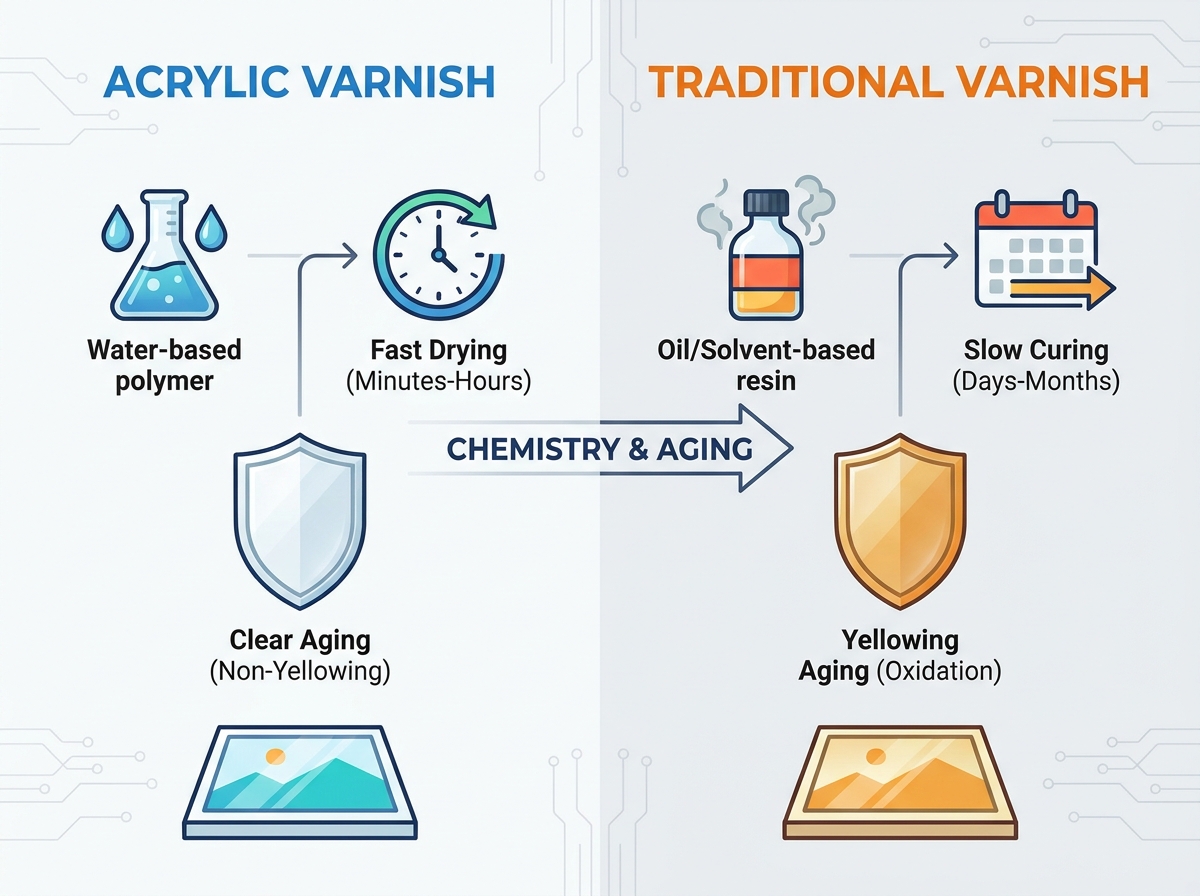
- Composition: Acrylic varnishes are water-based polymer emulsions; traditional varnishes rely on natural or synthetic resins dissolved in solvents.
- Archival Stability: Acrylic varnishes resist yellowing over time, whereas many traditional natural resin varnishes (like Damar) will amber or darken as they age.
- Application Risks: Acrylic varnishes dry rapidly but are prone to cloudiness and brushstrokes; traditional varnishes self-level beautifully but require strict ventilation and long curing times in dust-free zones.
- Removability: Both can be formulated for conservation (removability), but they require entirely different solvents and preparation steps (e.g., isolation coats).
![Applying acrylic varnish vs traditional varnish on an artwork]()
Framing the Problem: Why Varnish Chemistry Matters
A protective topcoat serves a vital functional role beyond simply making a surface look finished. Before comparing specific chemistries, we must define the baseline success criteria for any topcoat. First, it must unify the surface sheen. Paint often dries unevenly across a single project. Some areas appear glossy while others turn dull. A quality topcoat levels this out into a uniform gloss, matte, or satin finish. Second, it provides crucial UV protection to prevent colors from fading over time. Finally, it creates a sacrificial barrier against dust, smoke, and atmospheric pollutants. Dirt accumulates on the topcoat rather than the delicate paint below.
However, crossing mediums introduces serious risks. Chemistry dictates compatibility. A fundamental rule in classical painting is "fat over lean." This principle ensures flexible, oil-rich layers sit above faster-drying, leaner layers. Trapping uncured paint beneath the wrong topcoat violates this rule. If oil paint continues oxidizing underneath a rigid polymer film, it leads to severe cracking. Incompatible solvents can also cause blooming, delamination, or complete dissolution of the underlying pigments.
Professional art conservation adds another layer of complexity. The conservation standard demands removability. A professional-grade topcoat must be safely removable 50 or even 100 years from now. Conservators need to strip away the dirty, aged barrier without dissolving the underlying artwork. Choosing the wrong chemistry makes future restoration impossible. You must plan for the future life of your project from day one.
Core Evaluation Dimensions: Acrylic vs. Traditional
Understanding the fundamental chemical differences helps you anticipate how a product will behave in your studio. We evaluate these options across three primary dimensions: emissions, curing mechanics, and long-term optical clarity.
Chemical Base and VOC Emissions
An Acrylic varnish relies on a water-based polymer emulsion. The solid polymer particles stay suspended in water until application. This formulation produces a remarkably low odor. It also emits very low levels of Volatile Organic Compounds (VOCs). Artists and hobbyists can safely use these products in indoor studios. You do not need heavy industrial respirators or elaborate exhaust systems to work safely.
Traditional varnishes operate differently. They dissolve natural or synthetic resins in strong solvents like turpentine or mineral spirits. This creates high VOC emissions during application and curing. Working indoors requires dedicated ventilation. You must use caution, wear appropriate respiratory protection, and safely dispose of toxic, solvent-soaked rags to prevent spontaneous combustion.
Drying Mechanics and Curing Time
The drying process directly dictates your workflow speed. Water-based emulsions dry entirely through water evaporation. They become dry to the touch in just minutes or a few hours, depending on room humidity. The film typically cures completely within one to two weeks. This rapid turnaround allows for faster project completion and shipping.
Traditional resin formulations dry through a complex combination of solvent evaporation and oxidation. They remain tacky and vulnerable for hours or even days. More importantly, the underlying medium dictates when you can apply them. If you paint with traditional oils, you must wait up to six months before applying a traditional resin topcoat. Applying it too early traps the oxidizing oil, causing disastrous structural failures.
Optical Clarity and Aging (Yellowing)
Long-term optical clarity separates archival materials from craft-grade supplies. Water-based polymer emulsions are highly stable. These non-yellowing polymers maintain original color fidelity indefinitely. A blue sky painted today will look identically blue decades from now.
Natural traditional resins, such as Damar or Mastic, inherently oxidize. This chemical reality causes them to turn amber or yellow as they age. While some artists appreciate this warm, antiqued look, it drastically alters the original color balance. It is worth noting that synthetic solvent-based options, like Mineral Spirit Acrylics (MSA), offer a middle ground. They provide solvent-based application benefits without the severe yellowing associated with natural resins.
Varnish Chemistry Comparison Summary
| Feature |
Acrylic (Water-Based) |
Traditional (Solvent-Based) |
| Chemical Base |
Polymer emulsion in water |
Resins in mineral spirits/turpentine |
| VOC Levels |
Low (Indoor safe) |
High (Ventilation required) |
| Drying Time |
Minutes to hours |
Hours to days |
| Curing Requirement (Oils) |
Not recommended for oils |
Wait 3-6 months before applying |
| Aging / Yellowing |
Non-yellowing |
Ambers/yellows over time (natural resins) |
Implementation Realities: Application Risks and Troubleshooting
Theory meets reality during the application process. Both chemistries present distinct challenges. Mastering them requires understanding their specific physical behaviors during the wet phase.
The Acrylic Application Challenge
Water-based polymers are notoriously finicky during application. The primary issue stems from their rapid evaporation rate. You face several specific risks:
- Fast Drying and Drag: Because water evaporates quickly, the film begins setting up while you are still brushing. If you go back over a partially dry area, your brush will "drag." This permanently locks visible brushstrokes into the finish.
- Cloudiness and Blooming: Applying the liquid too thickly traps moisture beneath the surface skin. High humidity environments exacerbate this issue. The trapped moisture dries into a milky, frosted haze known as blooming.
- Foaming: Emulsions act somewhat like soap. Vigorous brushing or shaking the bottle introduces micro-bubbles. These bubbles dry directly into the film, creating a rough, cloudy texture.
Common Mistake: Never shake a water-based emulsion bottle before use. Always stir it gently to incorporate matting agents without introducing air.
The Traditional Application Challenge
Solvent-based resins feel much more forgiving under the brush, but they carry environmental and structural risks.
- Self-Leveling Advantage: Solvents evaporate slowly. This extended open time allows the liquid to self-level. Gravity pulls the brushstrokes flat, resulting in a flawless, glass-like finish.
- The Dust Trap: Slower drying times create an extended "tacky" phase. For several hours, the surface acts as a powerful magnet for airborne dust, pet hair, and workshop debris. You need a dedicated, dust-free drying zone.
- Solvent Sensitivity: Traditional formulations require precise solvent ratios. If you thin the mixture improperly or brush too aggressively, the aggressive solvents can reactivate and lift the underlying paint layers.
Best Practice: When drying a solvent-based piece, lean it against a wall facing inward. This simple trick prevents settling dust from landing on the wet surface.
The Removability Factor: Preparing for Future Conservation
Creating a piece of art or a high-end scale model involves thinking decades ahead. Archival practice requires that any final protective layer be reversible. Dust and pollutants will eventually embed themselves into the surface. Future conservators must be able to remove this dirty layer.
If you use water-based paints, you face a unique chemical problem. Water-based paints and water-based topcoats share the same polymer foundation. If a conservator tries to strip the topcoat later, the solvent will also strip the paint. To solve this, you must apply a permanent, non-removable isolation coat first. This clear barrier separates the paint layer from the final topcoat. It ensures future removal processes strip away only the dirty topcoat, leaving the artwork untouched.
Traditional solvent-based options function differently. They are removed using mineral spirits or turpentine. These specific solvents easily dissolve the natural resins. Crucially, they do not dissolve fully cured oil paint. This makes traditional removal generally safer for oil paintings, provided the oil oxidized completely before application.
You must avoid irreversible mistakes. Never use non-removable hardware store polyurethanes on fine art or delicate scale models. These industrial products cross-link permanently. They cannot be removed without physically sanding them off, which completely destroys the delicate work underneath.
Decision Framework: Which Varnish Should You Choose?
Selecting the right product does not have to be a guessing game. Use this practical framework to align your project needs with the correct chemistry.
- Choose an Acrylic Varnish If:
- You are working exclusively with water-based polymer paints.
- You work in a home studio, apartment, or poorly ventilated space.
- You prioritize a perfectly non-yellowing finish over application ease.
- You need a fast turnaround time for shipping or exhibition.
- Choose a Traditional Varnish If:
- You are protecting traditional oil paintings, which require a breathable surface.
- You demand a perfectly smooth, self-leveled, glass-like gloss finish.
- You have a dedicated, well-ventilated workspace and can control the dust environment.
- You do not mind waiting months for your underlying oils to cure properly.
If you find yourself torn between the two, consider the hybrid alternative. Mineral Spirit Acrylics (MSA) blend the best of both worlds. They use synthetic acrylic resins dissolved in mineral spirits. This gives you the smooth, self-leveling application feel of a traditional product, alongside the modern, non-yellowing stability of synthetic polymers. However, they still emit strong odors and require proper ventilation.
Conclusion
Neither chemistry is universally superior. The "best" choice depends entirely on your underlying medium, environmental constraints, and tolerance for application difficulty. Water-based emulsions offer incredible archival stability and safety, though they demand careful brushwork. Traditional solvent resins provide unmatched leveling and gloss, but they demand patience, ventilation, and long curing times.
Before you commit to a final coat on your masterpiece, take these action-oriented next steps:
- Always test your chosen product on a scrap piece or a hidden corner of your project first.
- Ensure your workspace temperature and humidity fall within the manufacturer's recommended guidelines.
- Verify that your underlying paint is fully cured, not just dry to the touch.
- Prepare a clean, dust-free drying area before you open the bottle.
FAQ
Q: Can you use acrylic varnish on an oil painting?
A: No. Water-based polymer emulsions will not adhere properly to an oily surface. Applying them over oils violates the "fat over lean" rule. This incompatibility can cause severe clouding, beading, or eventual delamination as the oil paint continues to shift and cure beneath the rigid polymer film.
Q: Why did my acrylic varnish dry cloudy?
A: Cloudiness is usually caused by applying the liquid layer too thickly, which traps moisture underneath the skin. It also occurs frequently if you work in high humidity environments, or if you overwork the brush and introduce microscopic air bubbles into the emulsion before it sets.
Q: Do I need an isolation coat before using traditional varnish?
A: On traditional oil paintings, no isolation coat is needed. However, on water-based polymer paintings, an isolation coat is highly recommended regardless of the final topcoat type. It serves as a permanent physical barrier to protect your delicate pigments during future conservation and varnish removal.
Q: How long should I wait before varnishing?
A: For water-based paints, wait 1 to 2 weeks to ensure all water and mediums have completely evaporated from the thickest areas. For oil paintings, you must wait 3 to 6 months to allow the deep layers to undergo full oxidation and curing before sealing them.