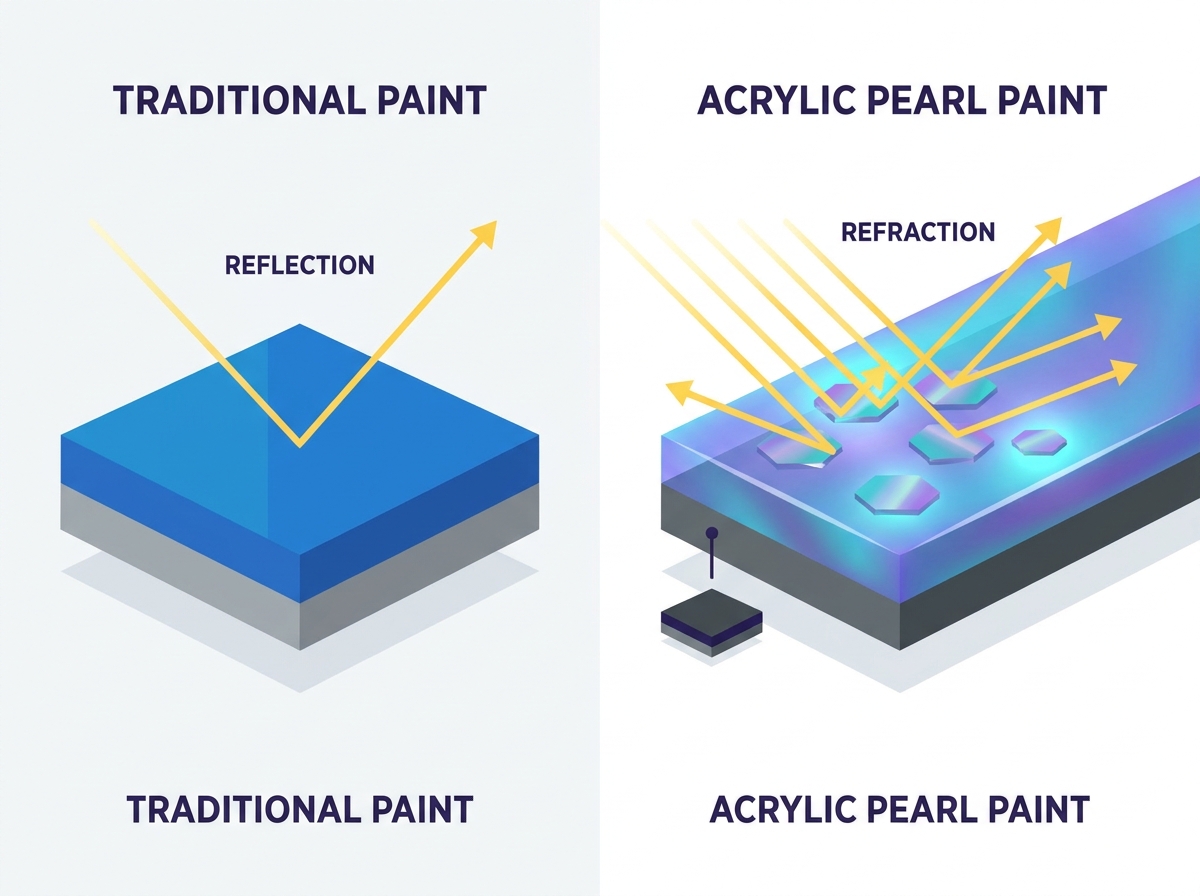
Artists and fabricators often chase the perfect luminous finish. They want their projects to stand out. Choosing the right medium transforms a piece entirely. Selecting between Acrylic pearl paint and traditional acrylics isn't just an aesthetic preference—it fundamentally changes your material costs, application techniques, and the physics of how light interacts with your finished surface.
A successful choice requires deep understanding. You must know the chemical composition of each paint. You also need to understand opacity limitations. Grasping the ideal use cases for each paint type prevents muddy mixtures. It also saves your project budgets.
This guide breaks down the structural differences between these mediums. It outlines application realities and evaluation criteria. We will help you decide when to invest in specialty pearl mediums. You will learn when to rely on standard pigmented paints instead. Follow these strategies to achieve stunning, professional results.
Key Takeaways
- Formulation: Traditional paints rely on light-absorbing solid pigments; acrylic pearl paint utilizes coated mica or synthetic platelets designed to refract light.
- Application Rules: Pearl paints are inherently translucent and usually require a solid traditional paint undercoat (often black or a complementary dark hue) to achieve their full effect.
- Mixing Limitations: Blending pearl acrylics directly with opaque traditional paints often destroys the pearlescent effect, resulting in a dull, chalky finish.
- Cost Efficiency: Reserve higher-cost pearl paints for top-level glazing, fluid art highlights, or accent stenciling rather than structural base layers.
Core Formulation: What Makes Acrylic Pearl Paint Different?
Paint formulation dictates how it behaves on your canvas or wall. Traditional paint composition relies on organic or inorganic pigments. Manufacturers suspend these pigments in an acrylic polymer emulsion. This structure serves one primary function. It ensures reliable light absorption and reflection. The result is a static, predictable color. When you apply standard cobalt blue, it looks blue from every angle. The solid pigment particles block light from passing through.
The science of "pearl" takes a completely different approach. Acrylic pearl paint replaces or supplements standard pigments. Instead of opaque solids, it uses mica flakes. Sometimes, manufacturers use synthetic borosilicate particles. They coat these microscopic platelets with titanium dioxide. The thickness of this titanium dioxide coating determines the specific color shift. These particles do not just absorb light. They interact with it actively.
Understanding refraction versus reflection is critical. Standard paint reflects a single color wavelength back to your eye. The mica platelets in pearl paint bounce light at multiple angles. Light enters the clear coating and bends. It bounces off the core particle and exits again. This creates a dynamic, color-shifting glow. We call this iridescence. The color changes depending on your viewing angle.
Transparency forms the baseline for this optical effect. Light must pass through the paint film to hit the mica. Because of this, the acrylic binder in pearl paints must remain highly transparent. This necessity inherently reduces the paint's overall opacity. It will never cover a surface as thickly as traditional colors. You cannot use it as a primary block-in color.
Formulation Comparison: Traditional vs. Pearl
| Feature | Traditional Acrylic Paint | Acrylic Pearl Paint |
| Pigment Type | Organic or inorganic solids | Coated mica or synthetic platelets |
| Light Interaction | Reflection (Absorption) | Refraction (Iridescence) |
| Binder Transparency | Variable (often opaque) | Highly transparent |
| Visual Result | Static, uniform color | Dynamic, color-shifting glow |
![Acrylic Pearl Paint vs Traditional Paint]()
Visual Outcomes and Finish Profiles
The visual outcomes of these two mediums contrast sharply. Standard acrylics dry to a uniform matte, satin, or gloss finish. They offer static aesthetics. The color remains identical regardless of your position in the room. Pearl acrylics possess a dynamic "flip" or color-shift. The visual profile changes constantly. As the viewer moves, the surface shifts. If the light source changes, the colors dance and alter. This dynamic quality breathes life into static objects.
Depth of field is another major distinction. Traditional paint sits "flat" on a surface. It builds a physical layer of color. Pearl paint behaves quite differently. It creates an optical illusion of depth. This happens especially when you glaze it in multiple thin layers. The transparent binder lets you see through the top coats. You see light bouncing off different levels of mica flakes. This multi-layered refraction creates a three-dimensional visual effect.
Many beginners confuse pearl finishes with metallic ones. We must clarify the pearl versus metallic distinctions. Metallic paints use actual metal powders. Manufacturers mix aluminum, bronze, or copper into the binder. These metal powders create a high-opacity sparkle. They mimic solid metal surfaces. Pearl paints use mica instead of metal. This results in a softer, luminous shimmer. They are much more translucent than heavy metallic paints. Pearl gives an ethereal glow rather than a harsh metallic gleam.
Application Realities: Handling, Layering, and Mixing
Applying specialty paints requires specific techniques. The most crucial experience factor is the underpainting requirement. This is the most common beginner mistake. Because pearl paints lack high opacity, they fail on bare canvases. Applying them to a plain white wall yields underwhelming results. The light simply washes out the subtle refraction.
To fix this, pearl paints require a cured, solid traditional paint base. Black is the industry standard base color. A deep black undercoat absorbs stray light. It forces the light to bounce exclusively off the mica flakes. This maximizes the pearl "pop." You can also use complementary dark hues. A dark navy base under a blue pearl creates incredible depth.
Here are the core rules for handling these mediums:
- Prepare a solid base: Always apply a fully opaque traditional paint first.
- Let the base cure: Ensure the underpainting is completely dry before adding pearl layers.
- Apply in thin layers: Use glazing techniques to build the pearl effect gradually.
- Isolate your layers: If painting multiple pearl colors, use a clear acrylic medium between them.
Mixing risks pose another major challenge. You must avoid "mudding" your colors. Resist the instinct to mix pearl and traditional paints directly on your palette. Adding an opaque standard pigment coats the mica flakes. The solid pigment blocks the light from reaching the mica. This instantly kills the refraction. You will end up with a chalky, expensive traditional paint. Keep them separate. Layer them instead of mixing them.
Viscosity and medium compatibility also require your attention. Pearl paints interact well with pouring mediums and glazing liquids. These transparent mediums stretch the paint without hiding the mica. However, over-thinning with plain water is dangerous. Excessive water breaks down the acrylic binder. When the binder fails, the heavier mica flakes sink. They will distribute unevenly across your surface. Always thin pearl paints with a proper acrylic medium.
Cost vs. Value: A Decision-Stage Framework
Budgeting for art supplies or fabrication materials requires strategy. Acrylic pearl paints are premium products. They are typically classified as Series 3, 4, or higher in professional paint lines. This higher pricing stems from the manufacturing process. The cost of synthetic mica is significant. Specialized milling required to keep platelets intact adds to the price. Traditional paints offer cost-effective Series 1 and 2 options. They are much cheaper to produce and purchase.
You must know when to choose traditional paint to protect your budget. Use standard paints for base coating. They are perfect for blocking in structural shapes. Use them for covering large surface areas like standard walls. They are the only choice for creating solid underpaintings. Wasting expensive pearl paint on these base layers makes no financial sense.
Conversely, you must know when to invest in pearl paint. Reserve these mediums for high-visibility areas.
- Top-coat glazing: Apply over dark bases for brilliant finishes.
- Fluid art: Use them for stunning acrylic pouring highlights.
- Fine art focal points: Draw the viewer's eye to specific canvas areas.
- Custom crafts: Mimic automotive-style finishes on scale models.
- Interior decor: Execute high-end decorative wall stenciling.
We highly recommend a hybrid approach. This strategy balances impact and budget perfectly. Plan your project using the 80/20 rule. Roughly 80% of your project should utilize traditional paint. Use it for structure, coverage, and opacity. Reserve your pearl paint budget strictly for the remaining 20%. Apply it only for high-impact finishing layers. This framework guarantees professional results without unnecessary spending.
Common Application Pitfalls & Risk Mitigation
Even experienced creators make mistakes with specialty mediums. Varnishing challenges ruin many beautiful projects. Standard matte varnishes are dangerous for pearl finishes. Matte varnishes contain microscopic matting agents. These agents scatter light to reduce glare. When you apply them over pearl paint, they flatten the light refraction. They kill the luminous effect entirely. We recommend specific gloss or satin isolation coats. These clear finishes protect the piece while maintaining the vibrant pearl effect.
Brushstroke retention is another frequent issue. The physical shape of mica flakes causes this problem. Because they are flat platelets, they align with the drag of your brush. This makes them highly prone to showing harsh brushstrokes. To mitigate this, change your application tools. Advise using soft-bristle synthetic brushes. Airbrushing provides the most flawless finish. If airbrushing isn't possible, use a high-density sponge. Sponging applies the paint in a random pattern, creating seamless gradients.
Scale and scalability present unique logistical hurdles. Color-matching pearl mixtures for large-scale projects is notoriously difficult. If you are painting a large wall, mixing multiple small batches is risky. Variations in pigment density will show clearly. The mica might align differently in each batch. We advocate for mixing large, single batches. Calculate your needed volume beforehand. Mix it all at once in a single bucket. This ensures consistent particle distribution across the entire surface.
Conclusion
Understanding your mediums unlocks your creative potential. The final verdict is clear. Acrylic pearl paint is a highly specialized finishing tool. It is never a direct replacement for traditional opaque paint. Each serves a distinct structural and aesthetic purpose. Combining them intelligently yields the best results.
Your next steps involve practical experimentation. We advise you to test your pearl paints before committing to a project. Create a swatch card featuring a gradient. Paint the card from solid black to solid white using traditional paint. Once dry, glaze your pearl paint over the entire gradient. This exercise helps you accurately gauge opacity. You will see exactly how the color shift reacts to dark versus light backgrounds. Master this interplay, and your future projects will truly shine.
Frequently Asked Questions (FAQ)
Q: Is acrylic pearl paint water-soluble like regular acrylic paint?
A: Yes, both utilize a water-based polymer emulsion. They are completely water-soluble when wet. You can clean your brushes with simple soap and water. Once the acrylic binder fully cures, both types of paint become highly water-resistant and permanent.
Q: Can I use craft-grade acrylic pearl paint for wall stenciling?
A: Yes, but craft paints have much lower binder-to-pigment ratios. They may lack durability. For high-traffic walls, professional heavy-body pearl acrylics are better. Alternatively, dedicated architectural pearl glazes offer superior durability, washability, and UV resistance.
Q: Does acrylic pearl paint take longer to dry than traditional paint?
A: Drying times are generally identical. The acrylic polymer binder dictates the drying speed, not the mica pigment. However, thick impasto applications of any acrylic, including pearl, will require significantly more time to cure completely than thin layers.
Q: Can I turn traditional paint into pearl paint?
A: You cannot convert opaque paint into true pearl paint. Opaque pigments block light. However, you can purchase transparent "pearl mediums" or dry mica powders. You can mix these into a clear glaze and apply them over your traditional paint, achieving a similar luminous result.