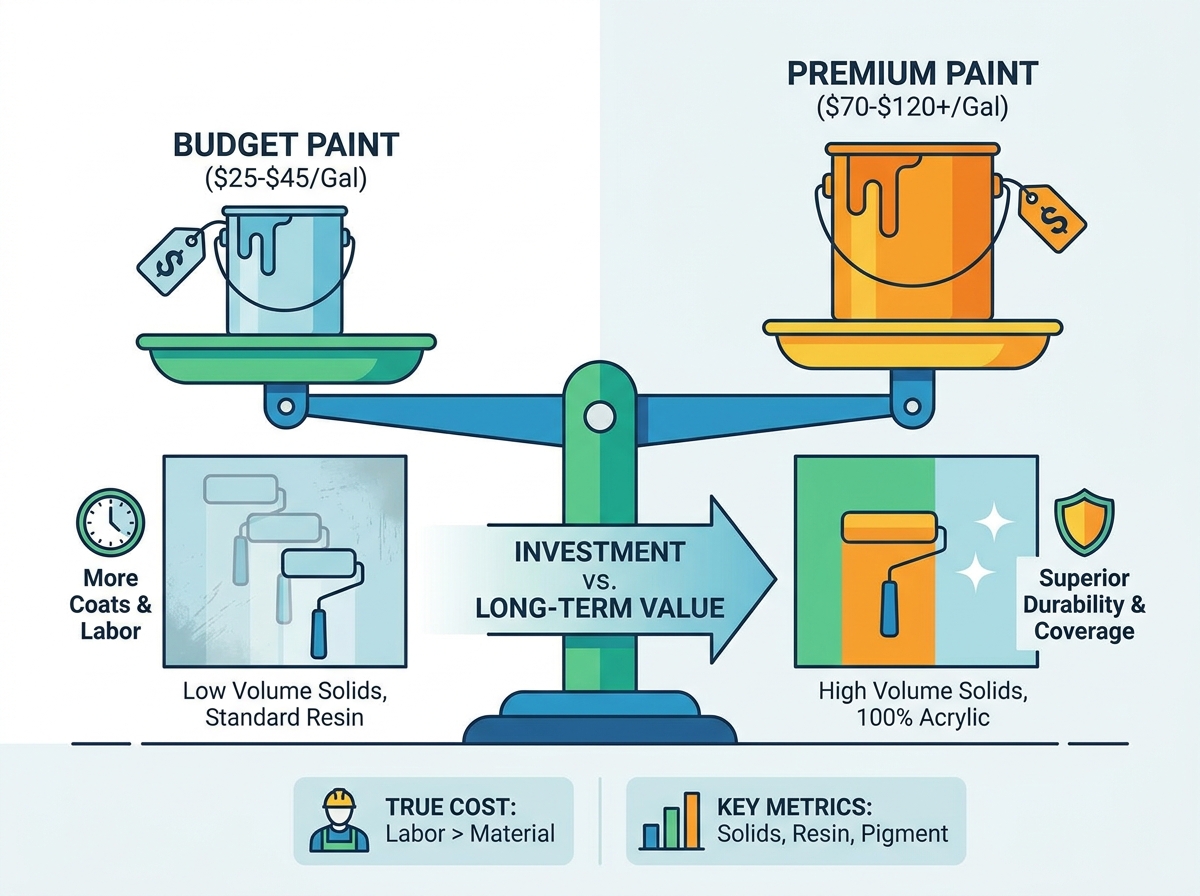
Walking down the paint aisle often feels like a confusing paradox. You stare at endless rows of identical-looking cans. Yet, their prices wildly range from $20 to well over $100 per gallon. Purchasing Finished Paint is much more than picking a pretty wall color. You are making an active investment in wall durability, maintenance reduction, and application efficiency. Poor choices routinely lead to endless touch-ups and wasted weekends.
Navigating this complex market requires you to look right past clever marketing claims. Buzzwords like the infamous "one-coat guarantee" often mislead consumers. We must carefully evaluate volume solids, assess resin quality, and uncover the actual cost-per-square-foot. You will learn exactly when to splurge on premium cans. You will also discover when budget options make perfect sense for your specific project.
Key Takeaways
- Pricing baselines: Standard finished paint ranges from $25–$45 per gallon, while premium architectural tiers span $60–$120+ based on resin quality and pigmentation.
- The true cost of budget paint: Lower-priced options contain more solvents/water and fewer solids, often requiring three coats to achieve the coverage of a two-coat premium option.
- Finish dictates function: Sheen selection (from flat to high-gloss) directly impacts washability, scuff resistance, and surface imperfection visibility.
- Application context matters: ROI on premium paint is highest for high-traffic areas and exterior facades; budget paints remain viable for low-impact applications like ceilings or quick real estate flips.
Framing the Investment: What Drives the Cost of Finished Paint?
Understanding paint pricing requires a look inside the can. Manufacturers blend various chemicals, minerals, and liquids to create their formulas. The quality and ratio of these ingredients dictate both the price and the performance of your final coat. Professional painters evaluate four core metrics before opening their wallets.
- Volume Solids (The True Metric of Quality)
Volume solids represent the ratio of active ingredients to liquid carriers. Paint consists of pigments and binders suspended in water or solvents. When you roll paint onto a wall, the liquid evaporates. The solids remain behind to form the protective film. Higher volume solids mean a thicker, more durable layer stays on your drywall. A cheap can might contain only 25% solids. You lose 75% of the product to evaporation. Premium cans often boast 40% to 50% solids, delivering vastly superior coverage. - Resin and Binder Types
Binders act as the glue holding the pigment to your wall. Economy paints typically use standard vinyl acrylic latex. This material works fine for low-impact areas but breaks down under heavy scrubbing. High-end alternatives utilize 100% acrylic binders. Pure acrylic remains highly flexible after drying. It actively prevents fading, cracking, and peeling over time. You should always demand 100% acrylic for moisture-heavy bathrooms or exterior projects. - Pigment Quality
Pigments provide the actual color and "hide" capability. Hide refers to how well the new layer covers old stains or dark colors. Manufacturers use cheap extenders like clay, silica, or talc to bulk up budget paints. These extenders offer very little hiding power. In contrast, premium formulas rely on prime pigments like titanium dioxide. Titanium dioxide is an expensive, brilliant white powder. It dictates the rich color depth and ultimate coverage strength of the product. - Regulatory Compliance and VOCs
Volatile Organic Compounds (VOCs) release harmful gases as paint dries. Historically, lowering VOCs meant sacrificing durability. Today, low-VOC or zero-VOC formulas represent the industry standard. However, achieving zero emissions without compromising scrub-ability requires advanced chemical engineering. Premium brands invest heavily in research to provide zero-VOC options. These advanced formulas protect your indoor air quality while maintaining a rock-hard finish.
![Finished Paint]()
Pricing Tiers and Realistic ROI (Cost Per Gallon)
The market offers distinct pricing categories. You must align your budget with your project goals. Buying the most expensive can is not always necessary. Buying the cheapest can is rarely a bargain. We break down the standard tiers below.
| Pricing Tier | Average Cost | Ideal Application | Primary Limitation |
| Economy / Big-Box | $20 – $35 / Gallon | Ceilings, closets, quick rental flips | Poor washability, requires extra coats |
| Mid-Grade / Contractor | $40 – $65 / Gallon | Living rooms, bedrooms, standard homes | Average color depth, standard longevity |
| Premium / Architectural | $70 – $120+ / Gallon | High-traffic areas, cabinets, exteriors | High upfront cost, requires good prep |
Economy and Big-Box Tier ($20 – $35 / Gallon)
Budget tiers attract buyers through low upfront material costs. They work perfectly for ceilings, interior closets, or rapid rental property refreshes. However, these formulas contain heavy amounts of water and clay. You will experience poor scrub-ability. Wiping a smudge off an economy-painted wall often removes the color entirely. Furthermore, these cans frequently require three coats to achieve uniform coverage. They remain highly susceptible to everyday scuffing.
Mid-Grade and Contractor Sweet Spot ($40 – $65 / Gallon)
Most residential living spaces benefit immensely from the mid-grade tier. These options offer the best balance of price to performance. You get excellent hide capability and reliable washability. A solid mid-grade Finished Paint withstands normal family wear and tear. The main drawback involves nuance. Mid-grade lines may lack the profound color depth found in luxury brands. They also might omit specialized environmental additives, like extreme mildewcides for poor ventilation zones.
Premium and Architectural Tier ($70 – $120+ / Gallon)
Luxury architectural paints deliver exceptional self-leveling properties. They smooth out minor brush strokes automatically as they dry. You also gain superior fade resistance and deeply complex undertones. These products are highly durable. A premium eggshell can withstand aggressive scrubbing without losing its luster. However, they carry diminishing returns if applied improperly. Using inexperienced labor or skipping the surface prep will ruin the benefits of a $100 gallon.
Evaluating Finished Paint Options by Sheen and Durability
Selecting the right color solves only half the puzzle. You must also choose the correct sheen. Sheen determines how much light reflects off the dried surface. This reflective quality directly dictates how the wall handles moisture, dirt, and cleaning attempts.
- Flat / Matte: This sheen offers a sophisticated, non-reflective finish. It absorbs light beautifully. This absorption hides drywall imperfections, patched holes, and uneven textures brilliantly. However, flat finishes are traditionally difficult to clean. Scrubbing them often leaves shiny burnish marks. Best for: Ceilings, adult bedrooms, and low-traffic areas.
- Eggshell / Satin: Consider this the default interior choice. Eggshell provides a slight, velvety luster. Satin offers a slightly higher glow. Both resist dirt far better than flat formulas. They stand up well to light scrubbing with a damp sponge. Crucially, they achieve this durability without highlighting every minor drywall flaw. Best for: Living rooms, dining rooms, hallways, and kids' bedrooms.
- Semi-Gloss / High-Gloss: These finishes are highly reflective and incredibly tough. They repel moisture naturally and remain aggressively scrubbable. You can wipe grease or grime right off them. The major downside is aesthetic unforgiveness. Glossy surfaces catch the light and reveal every underlying surface imperfection, bump, or bad sanding job. Best for: Trim, doors, baseboards, cabinets, and high-moisture bathrooms.
High-End vs. Budget: When is the Premium Price Justified?
Homeowners often struggle to justify spending $80 on a single can. You must look beyond the register receipt. Evaluating the true value requires analyzing labor costs, project lifespans, and environmental demands.
The Labor vs. Material Equation
Labor represents the most expensive part of any painting project. This remains true whether you hire a professional crew or sacrifice your own weekend. Saving $20 on a budget gallon is a mathematical net loss if that cheaper product requires a third coat. An extra coat demands an entire additional day of labor, drying time, and disruption. Premium paints routinely achieve full coverage in two coats. They save you massive amounts of time and physical effort.
Homeowners vs. Landlords and Sellers
Your relationship to the property should guide your budget.
- Sellers and Landlords: Mid-grade or high-budget options provide the best return on investment here. You want a quick, neutral turnover. There is no need to invest in 15-year durability if the new tenant will repaint in two years anyway.
- Forever Homes: Premium Finished Paint yields major long-term savings for permanent residents. You benefit from the extended lifespan. The high fade resistance keeps sunlit rooms looking fresh. The extreme washability means you can scrub away dog drool or child fingerprints instead of repainting the entire hallway.
Exterior Applications
We strongly caution against using budget finishes outdoors. The exterior of a house faces brutal conditions. High UV exposure, freezing temperatures, and torrential rain destroy cheap formulas quickly. Budget paints will blister, chalk, and peel within a few seasons. Exterior projects require premium 100% acrylics. These high-end resins remain flexible enough to expand and contract with the weather, preventing premature failure.
Implementation Risks: Avoiding Common Purchasing Mistakes
Even the finest materials fail if you mishandle the purchasing and prep phases. Avoid these widespread industry traps to ensure a flawless finish.
The "Paint and Primer in One" Myth
Marketing departments love the "self-priming" label. Many buyers assume this eliminates the priming step entirely. Clarify your expectations here. A "paint and primer in one" is simply a thicker formula with higher solids. It builds a heavier film per coat. However, it does not replace the need for a dedicated, separate primer on problematic surfaces. You must still use a true primer on bare drywall, newly patched areas, raw wood, or severe water stains. Skipping this step leads to flashing, where the sheen looks uneven across the wall.
Miscalculating Coverage
Running out of product halfway through a wall is a nightmare. Always assume a realistic coverage rate of 350 to 400 square feet per gallon for smooth interior walls. Textured walls or dry surfaces will consume much more. We advise buying all necessary gallons simultaneously. Once home, practice "boxing." Boxing means mixing all the identical gallons into one large five-gallon bucket. This technique completely eliminates the risk of minor batch-to-batch color variations.
Ignoring Lighting Assumptions
Never finalize a purchase based solely on fluorescent store lighting. Big-box lighting severely distorts color perception. A gray swatch might look perfect in the aisle but turn icy blue in your south-facing living room. This phenomenon is known as metamerism. Always test a physical sample. Paint a large square directly on the specific wall. Evaluate the undertone shifts throughout the day as natural light changes from morning to dusk.
Conclusion
Mastering the paint aisle comes down to a clear decision framework. You must match your chosen sheen to the room's specific traffic level. Match your price tier to the expected lifespan of the project. Always prioritize high-volume solids and 100% acrylic resins over flashy marketing buzzwords on the label.
Your next step requires immediate action before hitting the hardware store. First, calculate your exact square footage carefully. Second, narrow down your top two preferred sheens based on the room's function. Finally, purchase a small liquid sample or a large peel-and-stick swatch. Test it on your wall before committing to hundreds of dollars in bulk gallons. Smart preparation guarantees a stunning, enduring result.
FAQ
Q: How long does finished paint last on interior walls?
A: Typically, it lasts 5 to 10 years. Longevity depends heavily on household traffic, the chosen sheen, and routine maintenance. High-traffic hallways may need repainting sooner, while adult bedrooms often exceed a decade.
Q: Is it worth paying $80 for a gallon of paint?
A: Yes, for high-traffic areas, deep dark colors that require specialized bases, or exteriors where longevity offsets future labor costs. No, it is not worth it for low-impact areas like guest room ceilings or closets.
Q: What is the difference between interior and exterior finished paint?
A: Exterior paint contains specific flexible resins designed to handle severe temperature shifts without cracking. It also includes heavy additives for UV fading and mildew resistance. Interior and exterior formulas are not interchangeable.
Q: Does unopened finished paint expire?
A: Yes, it typically expires after 3 to 5 years even if stored in a climate-controlled environment. Before using old stock, it must be stirred vigorously and checked closely for permanent chemical separation or sour odors.