Automotive paint decisions carry incredibly high stakes. A poor choice often leads to peeling, rapid fading, or costly rework down the line. You want a finish looking flawless for years, not just weeks. The fundamental divide in the automotive refinishing world comes down to traditional 1K (single-component) paints versus chemically curing 2K car paint. Many enthusiasts and professionals struggle to balance budget constraints against the need for lasting durability. Making the wrong selection can ruin a restoration project or compromise a daily driver's exterior. This article provides an evidence-based comparison of durability, application requirements, safety compliance, and overall return on investment. We will break down exactly how these two systems operate. You will learn how to make the right choice for your specific project, whether you are a seasoned professional or a serious DIYer.
Key Takeaways
- **Chemical Curing vs. Evaporation:** 2K car paint cures via a chemical reaction (resin + hardener), offering a much harder, weather-resistant finish compared to traditional 1K paints that dry via solvent evaporation.
- **Safety and Compliance Realities:** 2K paints typically contain isocyanates, requiring strict adherence to safety protocols, including air-fed respirators and professional ventilation.
- **Application Compatibility:** A common industry standard is using a 1K base coat for color accuracy, sealed with a 2K clear coat for maximum protection.
- **Project ROI:** Traditional paint is cost-effective and forgiving for minor, temporary touch-ups, while 2K is the mandatory standard for full resprays, classic car restorations, and commercial auto body work.
The Core Difference: Chemical Curing vs. Evaporation
Defining Traditional (1K) Paint
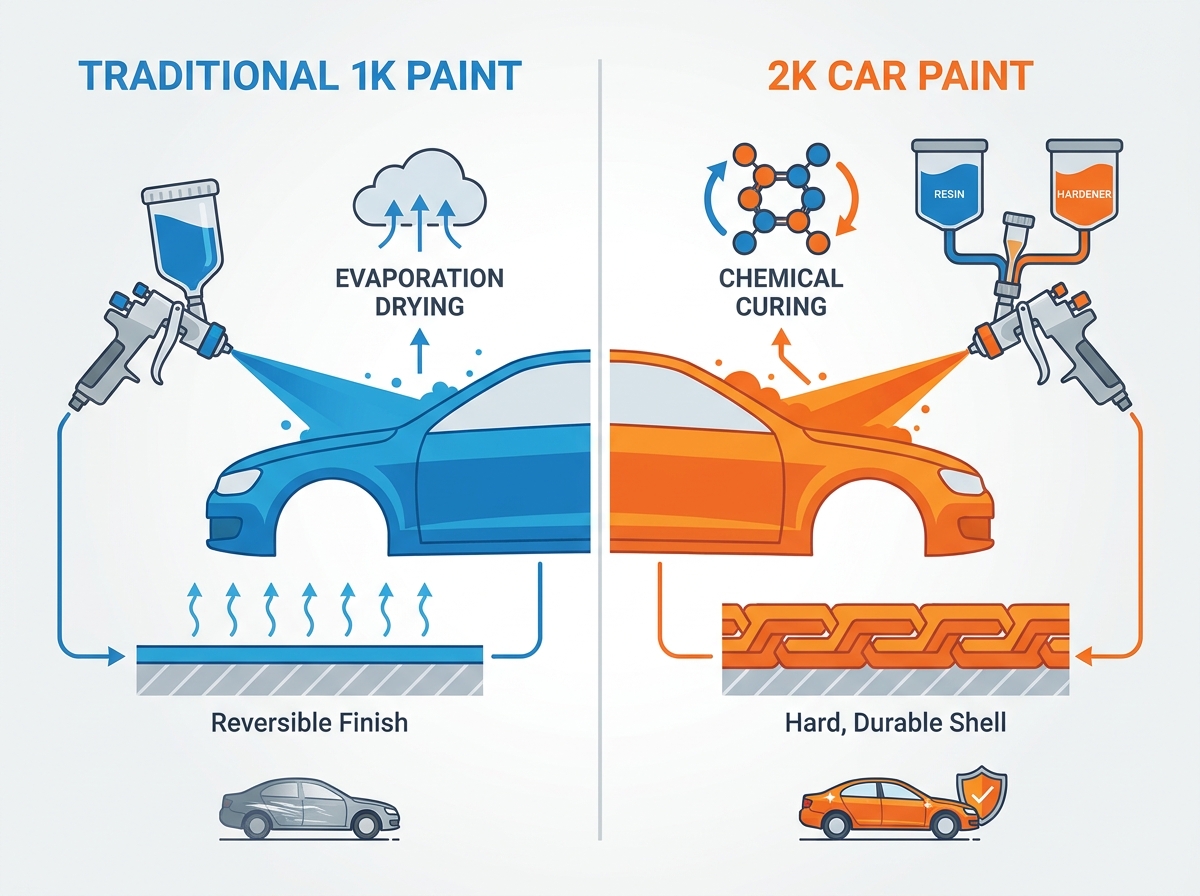
Traditional 1K paint refers to a single-component mixture. You do not need to add a hardener to make it dry. It dries purely through the evaporation of solvents. As the thinner escapes into the air, the remaining paint solids harden on the vehicle surface. You can usually spray these products straight out of the can or tin. They are incredibly convenient for quick jobs.
However, this evaporation process leaves a vulnerability. Because the paint never chemically alters its state, aggressive solvents can reactivate it. If you spill gasoline or harsh thinners on a 1K finish, the paint will often soften, wrinkle, or wipe away. This reversibility limits its long-term durability in demanding automotive environments.
Defining 2K Car Paint
A 2K car paint system consists of two distinct parts: the paint resin and a specific hardener or activator. When you mix these two components, an irreversible chemical cross-linking process begins. The paint does not merely dry; it cures. Polymer chains lock together to form a dense, impenetrable shell.
This chemical reaction introduces the concept of "pot life." Once you mix the resin and hardener, a countdown begins. You must use the mixed paint within a specific timeframe. If you wait too long, the material will harden directly inside your spray gun. Pot life varies based on the specific product and ambient temperature, demanding careful planning before you pull the trigger.
Clarifying the "Base Coat Confusion"
A common misunderstanding plagues the auto body industry regarding base coats. Many beginners assume they must choose between a fully 1K system or a fully 2K system. In reality, most modern automotive finishes use a hybrid approach. The industry standard utilizes a 1K base coat for the actual color layer. The 1K color flashes off quickly and lays down metallic flakes evenly. Painters then follow this color layer by applying a robust 2K clear coat. The 2K clear coat provides the necessary UV protection, chemical resistance, and high-gloss finish. Understanding this workflow prevents costly purchasing mistakes.
![2K Car Paint Application]()
Performance Evaluation: Durability, Finish, and Longevity
Chemical and Environmental Resistance
Vehicles face constant environmental assaults. 2K systems excel in these harsh conditions. The cross-linked polymer structure makes the finish highly resistant to UV degradation. It easily withstands bird droppings, harsh road salt, and accidental fuel spills. The chemical bonds simply do not break down easily under environmental stress.
Traditional 1K paints struggle in this arena. Because they lack cross-linked density, they are far more susceptible to chemical etching. Bird droppings can burn through a 1K finish in a matter of days. Prolonged sun exposure often leads to rapid oxidation and fading, requiring constant waxing to preserve the color.
Hardness and Scratch Resistance
Paint hardness dictates how well a vehicle resists daily wear. 2K products cure to a much harder shell. This extreme hardness significantly reduces micro-marring and swirl marks from standard car washing techniques. Debris simply bounces off the cured surface rather than digging into the clear coat.
Conversely, traditional paint yields a softer finish. This softness can be an advantage initially, as it is often easier to polish and buff out imperfections right after spraying. However, this trait becomes a liability over time. The softer surface collects scratches easily. You will find yourself performing frequent paint correction and maintenance to retain an acceptable gloss level.
Build and Coverage
The solid content of a paint determines its build thickness. 2K materials feature a much higher solid content than their 1K counterparts. This characteristic allows for a thicker build per coat. You can achieve a deeper, luxurious "wet look" finish using fewer layers. The high build also provides excellent leveling properties, smoothing out minor surface imperfections effortlessly.
Traditional paints contain a higher volume of solvents. When those solvents evaporate, the paint film shrinks considerably. Achieving a thick, protective layer requires spraying many thin coats. This increases labor time and raises the risk of trapping solvents between layers.
Performance Comparison Chart
| Performance Metric | Traditional (1K) Paint | 2K Car Paint |
| Curing Method | Solvent Evaporation | Chemical Cross-linking |
| Chemical Resistance | Low (Vulnerable to fuel/solvents) | High (Impervious to most chemicals) |
| UV Protection | Moderate (Fades over time) | Excellent (Long-lasting gloss) |
| Scratch Resistance | Low (Prone to swirl marks) | High (Hard, durable shell) |
| Build Thickness | Thin (Requires multiple coats) | Thick (High solids, fewer coats) |
Implementation Realities: Application, Equipment, and Safety Protocols
The Isocyanate Reality (Safety & Compliance)
You cannot discuss 2K products without addressing safety. Most 2K hardeners contain isocyanates. These are highly reactive chemicals known to cause severe respiratory issues, including occupational asthma. Exposure occurs through inhalation of spray mist and absorption through the skin or eyes.
Standard safety gear is entirely insufficient. A basic charcoal mask or P100 respirator will not filter out isocyanate vapors effectively. Safe application requires mandatory personal protective equipment (PPE). You must use a positive-pressure, air-fed respirator. This equipment supplies clean breathing air from an uncontaminated source outside the spraying area. Furthermore, you need a controlled environment, such as a professional spray booth, to manage overspray toxicity and protect others nearby.
Equipment and Setup Costs
The barrier to entry differs wildly between the two systems. Applying 2K materials demands a professional-grade setup. You must invest in specific tools to ensure success.
- Accurate Measuring Tools: Dedicated mixing cups with precise ratio markings are essential. Incorrect hardener ratios ruin the curing process.
- Specific Spray Guns: You need HVLP (High Volume Low Pressure) guns with appropriate nozzle sizes (typically 1.2mm to 1.4mm for clear coats) to atomize the thicker fluid.
- Robust Compressors: 2K spraying requires a high-capacity air compressor capable of delivering consistent CFM (Cubic Feet per Minute) without pressure drops.
- Moisture Traps: Clean, dry air is critical. Moisture reacting with the hardener causes severe paint defects.
Traditional 1K paint offers a much lower barrier to entry. It works reasonably well with standard DIY compressor setups. For very small jobs, you can even achieve acceptable results using high-quality aerosol cans. You do not need complex mixing cups or expensive air-fed hoods, making it highly accessible for weekend hobbyists.
Curing Times and Climate Sensitivity
Temperature and humidity dictate how paint behaves in the shop. 2K systems offer incredible flexibility here. You can manipulate the curing speed by selecting different hardener speeds. Paint suppliers offer fast, medium, and slow hardeners. If your shop is freezing, a fast hardener accelerates the chemical reaction. If you are painting in the middle of a hot summer, a slow hardener gives the paint enough time to flow out and level before it cross-links.
Traditional paint lacks this chemical adaptability. It relies entirely on ambient conditions. It is highly dependent on low humidity and warm temperatures for the solvents to evaporate properly. If you spray 1K paint in cold, damp conditions, moisture gets trapped in the evaporating solvent layer. This causes "blushing," a milky, cloudy defect ruining the finish.
Cost vs. Value: Short-Term Investment vs. Long-Term ROI
Upfront Material Costs
When you walk into an auto body supply store, the price tags tell an immediate story. 2K systems carry a significantly higher initial price point per liter. You are not just buying paint. You must purchase the base resin, the specific hardener, and the compatible reducer (thinner). This three-part system adds up quickly compared to a simple tin of traditional 1K acrylic or enamel.
Wastage Factors
Financial loss through wastage is a real concern with chemically curing products. Because 2K has a strict pot life, any un-sprayed mixed paint must be discarded. You cannot pour it back into the tin. It will turn into a solid block of plastic. This reality requires precise volume estimation. You must mix exactly what you need for the panel you are spraying to avoid pouring money into the waste bin.
Lifecycle ROI
Smart automotive investments look beyond the initial purchase price. You must analyze the cost of rework. 2K’s longevity means the cost per year of maintaining a pristine finish is significantly lower. A proper 2K job easily lasts a decade or more without degrading.
Traditional paint looks cheaper on day one, but it requires frequent maintenance. Under harsh daily driving conditions, a 1K finish often requires a complete respray within three to five years. When you factor in the labor, masking materials, and time required to repaint the vehicle multiple times, the long-term value of a 2K system heavily outweighs its upfront cost.
Decision Framework: When to Choose 2K vs. Traditional Paint
Use Cases for 2K Car Paint
Certain projects absolutely demand the durability of a chemically cured finish. You should always opt for a two-component system in the following scenarios:
- Classic Car Restorations: Vintage vehicles represent massive investments of time and money. Long-term investment protection is paramount. You need a finish lasting generations.
- Daily Drivers: Vehicles exposed to extreme weather, flying road debris, industrial fallout, or harsh UV rays need maximum protection.
- Professional Auto Body Repair: Any commercial shop performing collision repair or full panel resprays must use 2K to meet industry warranty standards.
- High-Traffic Areas: Bumpers, hoods, and side skirts take a beating. They require a hard shell to resist rock chips.
Use Cases for Traditional (1K) Paint
Despite its limitations, single-component paint still holds value in specific situations. It remains a practical choice for:
- Minor Cosmetic Touch-ups: Fixing a small scratch on an older, low-value vehicle does not justify the expense or setup of a two-part system.
- Hidden Areas: Interior metal panels, trunk floors, or engine bays not exposed to direct sunlight and harsh elements do perfectly well with 1K products.
- Residential Hobbyists: Enthusiasts working in home garages without access to required positive-pressure safety equipment must stick to safer 1K alternatives to protect their health.
Conclusion
The choice between 2K car paint and traditional paint is ultimately a trade-off. You must balance uncompromising durability against application accessibility. Traditional paint clearly has its place in low-stakes environments, offering a cheap and easy solution for minor touch-ups or hidden panels. However, 2K remains the undisputed industry standard for lasting automotive finishes. Its chemical resistance, brilliant gloss retention, and scratch resistance justify the higher upfront costs and stringent safety requirements.
To ensure a successful project, evaluate your workspace and budget carefully. Prioritize safety by acquiring the correct air-fed respiratory equipment before opening any chemical containers. Finally, consult with your paint supplier. They can help you match the right hardener speed and clear coat system to your specific shop environment and compressor capabilities. Taking these steps guarantees a professional, long-lasting finish.
FAQ
Q: Can I spray 2K car paint over old 1K traditional paint?
A: Spraying 2K over old 1K carries a high risk of "lifting" or wrinkling. The strong solvents present in 2K products aggressively attack the softer, underlying 1K paint. For the best results, strip the old paint completely. If stripping is impossible, apply an isolating barrier primer to seal the old 1K finish before applying the new topcoat.
Q: Do I absolutely need an air-fed mask for 2K paint?
A: Yes. Health and safety are non-negotiable here. Most 2K hardeners contain isocyanates. Standard P100, N95, or charcoal respirators do not filter these harmful, asthma-inducing vapors effectively. An air-fed, positive-pressure respirator is the only proven way to protect your lungs during application.
Q: How long does mixed 2K car paint last in the cup?
A: This is known as the "pot life." It varies significantly by product formulation and ambient temperature. Typically, pot life ranges from 1 to 4 hours. Once this window closes, the chemical cross-linking solidifies the mixture. If left in your equipment, it will harden and permanently ruin your spray gun.
Q: Is 2K paint harder to polish than traditional paint?
A: Yes, it is much harder once it fully cures. However, there is a distinct window of opportunity. Usually, 24 to 48 hours after application, the paint is dry enough to handle but hasn't reached maximum chemical hardness. This is the optimal time for color-sanding and buffing before the shell fully locks down.