Selecting the right automotive finish shifts a refinishing project from a standard cosmetic update to a long-term investment. You rely on these coatings for serious weather resistance. Unlike evaporative 1K paints, modern two-component systems rely on a chemical catalyst to cure. This fundamentally alters the material's durability, application requirements, and overall project budgeting.
Many shop owners and technicians struggle to calculate true material needs. Poor planning often leads to costly waste. It can also cause compromised panel durability. This guide evaluates technical specifications, real-world volume calculations, and safety compliance factors. You will learn how to make an informed, cost-effective procurement decision.
We detail the chemical differences that dictate performance out in the elements. We also break down exact mixing variables. These formulas maximize your sprayable materials and reduce application errors. Understanding these elements ensures your next refinishing job survives harsh daily driving conditions.
Key Takeaways
- Chemical Superiority: 2K car paint utilizes an activator/hardener to force chemical cross-linking, providing superior UV resistance, chemical resistance, and scratch durability compared to 1K alternatives.
- True Cost of Application: Evaluating 2K paint requires factoring in the "sprayable cost" (paint + hardener + reducer), not just the base product price.
- Volume Sensibilities: Purchasing accuracy depends on understanding vehicle square footage, the paint's solids content (High Solid vs. Medium Solid), and the specific mixing ratio (e.g., 4:1:1 or 2:1).
- Compliance & Safety: 2K hardeners contain isocyanates, making strict adherence to personal protective equipment (PPE)—specifically supplied-air respirators—a non-negotiable implementation reality.
The Technical Divide: 1K vs. 2K Car Paint Formulations
Mechanism of Cure
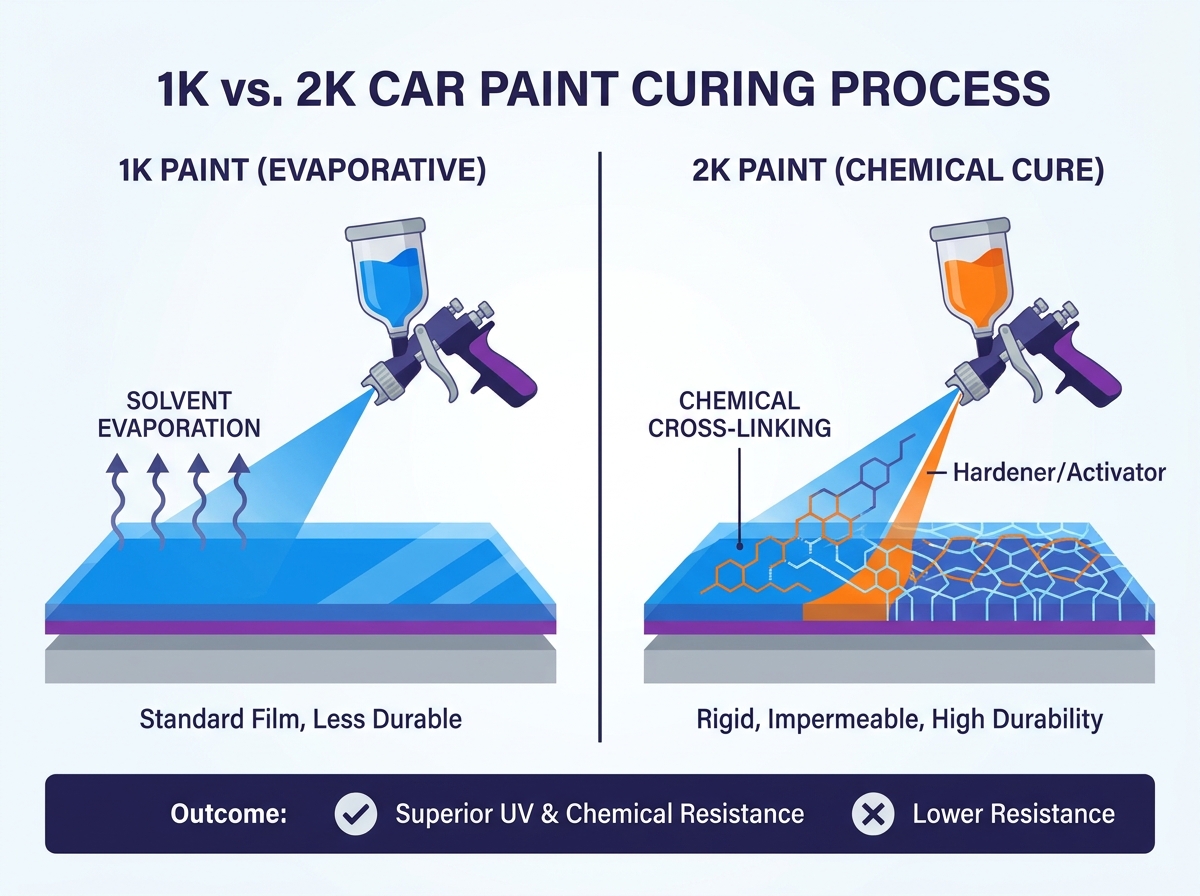
To understand automotive finishes, we must examine how they dry. Standard 1K paints cure through simple solvent evaporation. They leave behind a solid film once the liquids flash off into the air. This evaporative process offers distinct ease of use. However, it severely lacks deep structural integrity. In contrast, 2K car paint relies on intense chemical polymerization. You must introduce a polyisocyanate hardener into the base resin before spraying. This combination triggers irreversible cross-linking at a molecular level. The chemical bonds interlock tightly. They form a highly rigid, impermeable film across the vehicle surface.
Performance Outcomes
You can expect vastly different lifespans between the two technologies. Industry standards frame two-component systems as the mandatory choice for clear coats. They are essential for any high-wear exterior surfaces. The polymerized barrier actively resists fuel spills, harsh bird droppings, and severe UV degradation. A standard 1K alternative simply washes away or fades under these harsh environmental conditions. When you park a car outside year-round, chemical cross-linking provides the only reliable defense against clear coat failure.
Operational Limitations
Professional results require understanding specific application limitations. You face strict "pot life" constraints with mixed materials. Pot life defines your actual working time. Once you mix the hardener, the chemical reaction begins immediately. You cannot stop it or reverse it. The liquid will eventually harden solid inside your spray gun cup. Precise project staging becomes absolutely essential. You must prepare and mask panels fully before mixing your cup. This discipline helps you avoid catastrophic material waste and ruined equipment.
Evaluating 2K Car Paint Quality: High Solids (HS) vs. Medium Solids (MS)
Solids Content Explained
Paint formulas consist of solvents, resins, and pigments. We define "solids" as the actual material left on the panel after the solvents evaporate. Higher solids mean less filler liquid. You apply more usable resin per pass. Understanding this ratio helps you predict the final film build accurately.
High Solids (HS) Clear Coats
High Solids clear coats represent the premium tier of automotive refinishing. They contain a dense concentration of protective resins.
- Pros: You need fewer coats to achieve your target mil thickness. They emit significantly lower VOCs into the atmosphere. You also enjoy much deeper, longer-lasting gloss retention over the vehicle's lifespan.
- Implementation Risk: These thicker fluids feel heavier coming out of the gun. You risk solvent pop or nasty runs if applied incorrectly. You often need specific HVLP fluid tip sizes to atomize them properly. A 1.3mm or 1.4mm tip usually yields the best results.
Medium Solids (MS) Clear Coats
Medium Solids options offer a different spraying experience. They contain more solvent, making the fluid inherently thinner.
- Pros: Newer technicians find them much easier to spray. The material flows out smoothly across flat panels. They also forgive ambient temperature fluctuations much better than thicker HS alternatives.
- Cons: You must apply more coats for adequate film build. Expect a slightly higher shrinkage rate over time as the extra solvents evaporate.
UV Inhibitor Density
Budget options often skimp on expensive UV absorbers. You might save twenty percent on the upfront product cost. However, a cheap clear coat frequently delaminates or turns yellow after three years in the sun. Evaluate this trade-off carefully. The labor cost of stripping and repainting a failed hood always exceeds the price of premium clear coat.
High Solids vs. Medium Solids Performance Comparison
| Feature |
High Solids (HS) |
Medium Solids (MS) |
| Viscosity |
Thicker; requires careful atomization |
Thinner; flows out naturally |
| Coats Needed for Film Build |
Fewer (typically 2 full coats) |
More (typically 3 full coats) |
| VOC Emissions |
Lower compliance profile |
Higher solvent release |
| Application Difficulty |
Advanced technique required |
Beginner-friendly application |
Estimating 2K Paint Yield: Coverage and Mixing Ratios
The Mixing Ratio Impact
Your actual sprayable volume depends entirely on the mixing ratio. Ratios dictate how much Base, Hardener, and Reducer combine. A gallon of 2:1 formula yields 1.5 gallons of sprayable material. Conversely, a 4:1 ratio yields only 1.25 gallons of ready-to-spray fluid. You must calculate these specific yields before starting a large job.
Baseline Volume Frameworks
Vehicle size dictates your material procurement. We recommend using established volume guidelines to prevent mid-job shortages.
- Sedan / Mid-Size: These vehicles typically require 2 to 3 sprayable quarts of clear coat. This volume ensures standard coverage for two to three medium-wet coats.
- Large SUV / Truck: Larger panels demand significantly more material. You will typically require 1 full sprayable gallon up to 1.5 gallons for a complete exterior respray.
- Motorcycles / Small Parts: These compact projects usually need less than one sprayable quart. You can often mix smaller batches to avoid wasting activated clear.
Transfer Efficiency Variables
Not all fluid reaches the car. You must factor in HVLP spray gun transfer efficiency. Modern compliant guns typically achieve around 65 percent efficiency. The rest escapes as overspray. Panel complexity also matters. Spraying a flat hood wastes less fluid than spraying complex tubular bumpers. Finally, environmental conditions dictate your reducer choices. Fast, medium, or slow reducers impact how the fluid behaves. Slow reducers keep the surface wet longer, helping large SUV panels flow smoothly.
Procurement and Hidden Expenses
Price per Sprayable Quart
Calculate your material costs based on the mixed volume. Do not rely solely on the raw tin price. A cheaper tin might require an expensive activator. This approach accurately compares budget options against premium brands. When you buy 2K car paint, you buy an entire chemical system. Always calculate the price of the base, hardener, and reducer combined to find your true per-quart expense.
Ancillary Chemical Costs
You need a complete ecosystem of chemicals for proper application. Skipping these steps guarantees finish failure. You must purchase high-quality wax and grease removers for surface preparation. You also need appropriate grade reducers to match your shop temperature. Do not forget gun-wash solvents. Standard thinners will not dissolve cured two-component resins left inside your equipment.
Equipment Upgrades
Professional finishes demand professional air supply. Upgrading your equipment represents a significant expense.
- Compressor Specs: These thick paints require consistent atomization. We highly recommend a high-CFM air compressor. You need a minimum of 12 to 15 CFM at 40 PSI for a quality HVLP gun. Smaller DIY compressors cause pressure drops, leading to severe orange peel textures.
- Moisture Control: You must invest in inline desiccant filters and refrigerated dryers. Moisture instantly ruins chemical cross-linking. If water vapor hits the isocyanates, it causes micro-blistering and catastrophic clear coat failure.
Safety, Compliance, and Implementation Risks
The Isocyanate Reality
Two-component hardeners present severe health hazards. You must address the respiratory and dermal risks associated with isocyanate-based activators. These chemicals aggressively seek moisture. They can react with the moisture in your eyes, skin, and lungs. Long-term exposure leads to permanent sensitization. Once sensitized, even minor exposure triggers severe asthma-like attacks.
PPE Mandates
Standard N95 masks or basic charcoal respirators remain structurally insufficient for isocyanates. These hazardous compounds exist as vapors, not just airborne particulates. You must use a supplied-air respirator (SAR) system. An SAR pulls fresh air from outside the spray environment. In areas where legally permissible, you might use highly specific, strictly maintained dual-cartridge organic vapor masks. However, you must change these cartridges frequently to ensure ongoing protection.
Environmental Controls
Your spraying environment requires strict safety controls. You must install adequate cross-ventilation. We recommend explosion-proof exhaust fans to remove heavy solvent fumes safely. Proper particulate filtration protects both the environment and your wet panels. Meeting local VOC regulations keeps your operation legally compliant. Moreover, a clean, filtered booth ensures a completely uncontaminated finish free of dust nibs.
Conclusion
Selecting the correct automotive finish involves understanding chemical properties, volume requirements, and strict safety guidelines. Investing in premium two-component formulas acts as a crucial risk-mitigation strategy against premature finish failure. We advise evaluating clear coats based on their solids content rather than just their upfront price tag. Always verify your total material requirements, including the necessary activators and temperature-specific reducers. Finally, audit your facility’s compressor capacity and respiratory safety equipment before finalizing any purchase. Proper preparation guarantees a durable, high-gloss result.
FAQ
Q: Can I apply 2K car paint over an existing 1K paint job?
A: You face a high risk of lifting or wrinkling. The aggressive solvents in 2K formulas often attack and dissolve older 1K finishes. We strongly recommend isolating the old 1K paint first. Apply a high-quality 2K epoxy or urethane sealer before spraying your new base and clear. This barrier prevents solvent penetration.
Q: How long is the pot life of mixed 2K clear coat?
A: Pot life typically ranges from 1 to 4 hours. This timeframe depends entirely on the ambient temperature and the speed of the hardener used. Hotter environments and fast activators accelerate the curing process. Always mix only what you can spray within this specific window to avoid wasting material.
Q: What happens if my 2K paint mixing ratio is inaccurate?
A: Inaccurate ratios cause severe curing failures. Too much hardener causes the finish to become brittle, leading to premature cracking and peeling. Too little hardener prevents proper cross-linking. The paint remains perpetually soft, gummy, and highly susceptible to chemical damage or scratching.
Q: Are 2K paint aerosols (rattle cans) as durable as gun-sprayed 2K?
A: True 2K aerosols feature a button at the bottom to release an internal catalyst. They utilize the exact same chemical reactions as gun-sprayed paints. They offer excellent durability and UV resistance. However, their atomization quality and cost-per-ounce remain inferior to professional HVLP setups.


