Choosing the wrong paint system often leads to premature coating failure. You risk rapid asset degradation and severe operational bottlenecks. The ongoing debate between single-component and two-component paint systems forces a difficult choice for industrial contractors. Facility managers must constantly weigh operational convenience against maximum protective performance. Single-component options offer impressive application speed and zero pot-life limits. Conversely, two-component finishes deliver unmatched chemical resistance and superior mechanical hardness. This article provides a clear, evidence-based evaluation framework. We will help commercial body shops and maintenance teams select the correct coating system. You will learn how to accurately assess environmental exposure and evaluate your current equipment readiness. By understanding the underlying chemistry, you can confidently protect your assets and streamline your production cycles.
Key Takeaways
- 1K industrial paint cures via solvent evaporation or oxidation, offering ease of use and indefinite pot life, making it ideal for light-duty protection and rapid deployment.
- 2K systems require a chemical hardener (activator) to cross-link, delivering superior chemical, UV, and abrasion resistance at the cost of strict pot-life limitations and higher safety requirements.
- The ultimate decision hinges on the asset's lifecycle requirements: prioritize 1K for cost-effective maintenance and lower-exposure environments, and reserve 2K for heavy-wear assets and harsh industrial conditions.
- Upgrading to 2K introduces hidden operational costs, including specialized PPE (handling isocyanates) and strict mixing ratio compliance.
The Chemistry of Curing: How 1K and 2K Systems Differ
Understanding coating chemistry helps you predict long-term performance. The physical properties of any cured film depend entirely on its initial chemical transition. Paint systems transition from a liquid to a solid state through two distinctly different mechanisms. We categorize these as either thermoplastic or thermosetting reactions.
1K (One-Component) Mechanisms
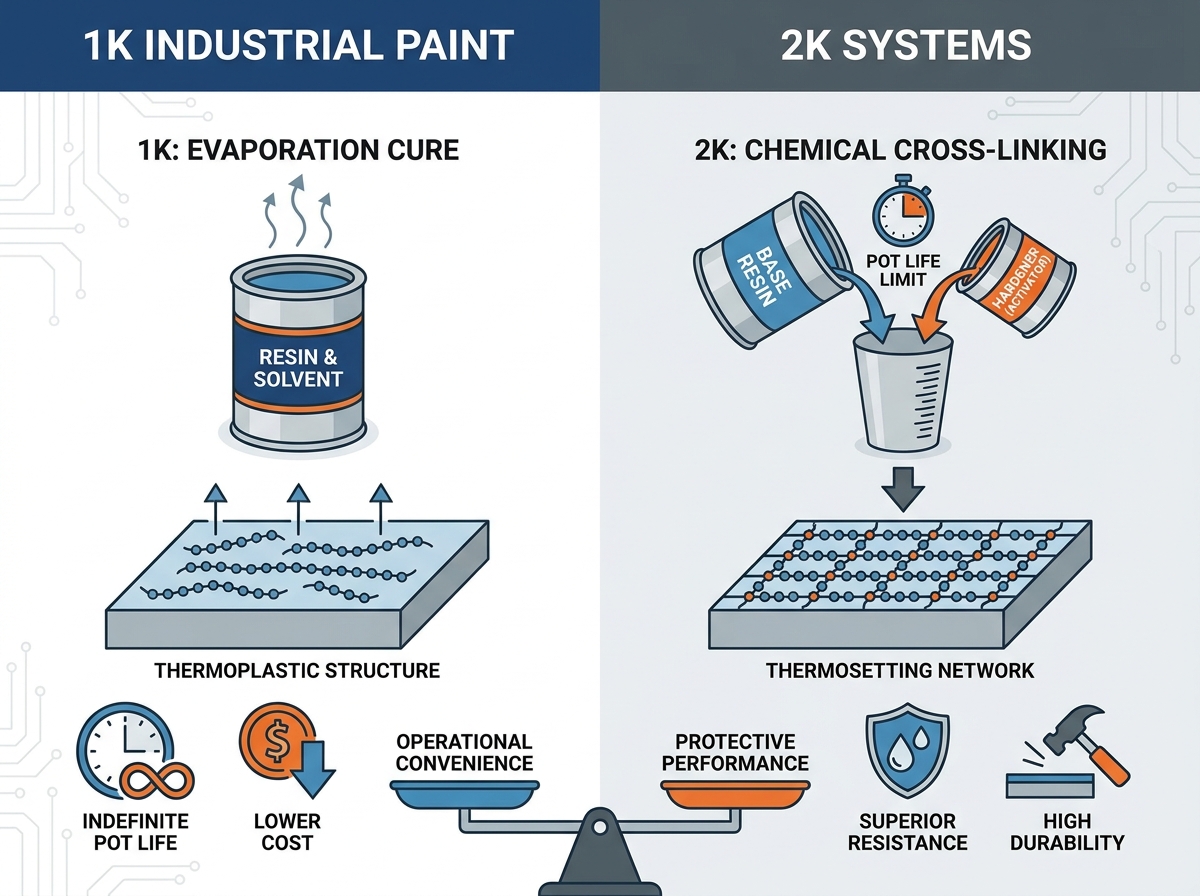
Single-component systems dry through relatively simple physical processes. The coating cures via solvent or water evaporation. In some formulations, it cures through atmospheric oxidation. These products rely heavily on ambient temperature and airflow. They possess a reversible or thermoplastic nature. This means aggressive chemicals can sometimes re-activate the cured film. If you wipe a harsh solvent across a fully dried single-component surface, it may soften or smear. The polymer chains entangle as the solvent leaves, but they never form permanent chemical bonds with one another.
2K (Two-Component) Mechanisms
Two-component systems behave completely differently at a molecular level. They cure via an irreversible chemical reaction. We call this cross-linking. You must mix a base resin with a specific hardener or activator. This initiates a thermosetting reaction. The polymer molecules bond together to form a dense, three-dimensional grid. Once fully cured, this grid becomes impervious to most solvents. You cannot melt or dissolve the finish back into a liquid state. The chemical structure is permanently locked.
Why This Matters for Decision-Makers
The curing mechanism directly dictates coating integrity. It defines your application window and influences facility compliance requirements. Facility managers must align the chosen chemistry with the physical demands of the workspace. A thermoplastic finish cannot survive in a chemical processing plant. Conversely, a thermosetting finish might overkill a simple warehouse rack. Knowing how paint dries prevents costly application failures.
Evaluating 1K Industrial Paint: Strengths and Bottlenecks
Single-component paints hold a massive share of the commercial coating market. They provide excellent utility for specific operational environments. Evaluating their strengths helps you streamline routine maintenance tasks.
Operational Advantages
- Zero Pot Life: Unused paint never hardens in the can. You can seal and store the remaining material indefinitely. It drastically reduces material waste across large facilities.
- Ease of Application: Most single-component products are ready to spray immediately. Others require only simple thinning. They offer a much lower barrier to entry for equipment setup. Operators require less specialized training to achieve smooth finishes.
- Cost-Efficiency: Upfront material costs are significantly lower. You also reduce labor time spent on complex mixing. Spray gun cleanup is remarkably fast and straightforward.
Performance Limitations
Despite their convenience, single-component finishes face distinct physical limitations. They are highly susceptible to aggressive chemicals. Fuels, harsh cleaners, and hydraulic fluids quickly degrade the surface. Furthermore, they exhibit lower mechanical hardness. They are prone to chipping or scratching under heavy industrial wear. Through-cure times can also present challenges. If operators apply excessively thick films, solvent entrapment becomes a major risk. The surface skins over, but the underlying layers remain soft for weeks. We call this common mistake "solvent popping."
To avoid these pitfalls, always follow recommended film builds when using 1K industrial paint. Layering multiple thin coats works better than applying one heavy coat.
![1K industrial paint versus 2K paint systems]()
Evaluating 2K Systems: When to Justify the Complexity
Two-component systems demand more effort, money, and safety gear. However, harsh industrial environments often mandate their use. You must understand both the rewards and the operational risks.
Performance Advantages
The primary advantage of two-component finishes is exceptional durability. They provide massive resistance to physical abrasion. They easily withstand extreme weathering and severe UV degradation. They also offer unmatched chemical imperviability. The cross-linked surface withstands harsh solvents, synthetic oils, and acidic cleaning agents. Furthermore, they provide a faster cure-to-handle time. Chemical curing accelerates stacking, assembly, or return-to-service timelines. Commercial shops rely on this speed to maximize booth throughput.
Implementation Risks & Complexities
- Strict Pot Life: Once mixed, you face a ticking clock. The material must be sprayed within a specific timeframe. This usually ranges from two to four hours. If ignored, the paint cures inside your equipment. This wastes expensive product and ruins expensive spray guns.
- Mixing Precision: You must follow exact mixing ratios. Incorrect ratios lead to catastrophic failures. The film may remain soft forever. Adhesion might fail entirely. You cannot guess or eyeball the hardener amount.
- Safety & Compliance: Two-component hardeners often contain isocyanates. These are highly hazardous respiratory sensitizers. You must use supplied-air respirators. Standard charcoal masks do not offer adequate protection. Facilities must adhere to rigorous VOC and environmental compliance protocols.
Head-to-Head Evaluation Matrix for Commercial Projects
Comparing these systems side-by-side clarifies the decision process. Facility managers must look beyond simple material costs. You should evaluate how the paint performs during and after application. The following summary illustrates where each system excels.
| Evaluation Metric | 1K Paint Systems | 2K Paint Systems |
| Durability & Wear Resistance | Suffices for static, low-impact assets. Susceptible to harsh solvents. | Mandatory for high-traffic or heavy-machinery environments. Excellent chemical resistance. |
| Throughput & Production Speed | Requires longer drying times before heavy handling. High risk of solvent entrapment if applied thick. | Accelerates final cure times. Ideal for commercial shops needing fast turnaround and rapid assembly. |
| Environmental & VOC Compliance | Traditional solvent-borne versions struggle with strict emissions limits. Waterborne options perform better. | Often feature higher volume solids. This aids in meeting strict commercial VOC compliance standards. |
For static indoor machinery, a high-quality 1K industrial paint delivers excellent results without complication. However, if your equipment faces daily physical abuse, two-component technology becomes absolutely necessary.
Scenario-Based Shortlisting: Which System Fits Your Use Case?
Abstract chemistry and charts only go so far. We must apply these principles to real-world commercial environments. Below are four common industrial scenarios. We provide a tailored recommendation for each specific use case.
- Scenario A: Commercial Automotive & Fleet Refinishing
Recommendation: 1K Base Coat paired with a 2K Clear Coat, or a 2K Single-Stage system.
Rationale: Maximum UV and fuel resistance are non-negotiable for commercial vehicles. The single-component base provides excellent color matching and metallic control. The two-component clear coat locks it down. It provides a glossy, impenetrable shield against road debris and harsh weather.
- Scenario B: Agricultural & Heavy Industrial Machinery
Recommendation: 2K Polyurethane or Epoxy.
Rationale: Tractors and excavators face brutal conditions. They endure rock impacts, hydraulic fluid leaks, and extreme sun exposure. A single-component finish would strip away within months. Cross-linked polyurethanes absorb impacts without shattering. They shrug off corrosive agricultural fertilizers.
- Scenario C: Light Manufacturing, Touch-Ups, & Maintenance
Recommendation: 1K industrial paint (Acrylic or Alkyd).
Rationale: Rapid deployment is essential here. These assets face minimal chemical exposure. Facility teams prioritize material savings and ease of application. Maintenance crews can open a can, spray a machine guard, and close the can. They generate zero waste. They avoid the complexities of measuring hardeners.
- Scenario D: Commercial Cabinet & Wood Refinishing
Recommendation: 2K Polyurethane.
Rationale: Kitchens and commercial interiors demand high mar-resistance. Cabinetry faces constant contact with skin oils, food acids, and household chemicals. Standard lacquers degrade rapidly under these conditions. Two-component polyurethanes far exceed single-component lacquers in longevity and stain resistance.
Conclusion
Base your final choice on the severity of the asset's environment. You must also evaluate your facility's safety infrastructure. Do not over-specify two-component systems for light-duty static assets. You will waste money and labor. Conversely, do not compromise with single-component finishes where chemical or mechanical stress is guaranteed. Coating failure costs far more than premium paint.
Audit your current spray equipment immediately. Ensure your spray booths have adequate airflow for safe application. Assess your local VOC regulations carefully before purchasing large batches. Finally, run a small-batch test panel. Verify adhesion and cure times before rolling out a new paint system across your entire production line.
FAQ
Q: Can I spray a 2K clear coat over a 1K industrial paint base coat?
A: Yes. This is a standard industry practice. It is especially common in auto and fleet refinishing. You combine the color-matching ease of a single-component base with the protective shell of a two-component clear. However, you must strictly follow flash-off times to prevent solvent pop or wrinkling.
Q: How long does 1K paint take to fully cure compared to 2K?
A: Single-component paint may dry to the touch quickly. However, it can take days or weeks to fully off-gas and harden. Two-component systems typically cross-link rapidly. They achieve full mechanical hardness within 24 to 72 hours, depending on ambient temperatures or baking schedules.
Q: What happens if I ignore the pot life on a 2K paint?
A: The chemical reaction will continue inside your spray equipment. The paint will thicken rapidly. It will ruin your finish quality. Eventually, it will turn into a solid block. This permanently destroys expensive spray guns and fluid lines. Always respect the manufacturer's pot life window.
Q: Are 1K paints VOC compliant?
A: It depends heavily on the specific formulation. Waterborne formulas and local regulations play a massive role. Many modern water-based single-component paints are highly compliant. They pass strict EPA standards. However, traditional solvent-heavy alkyds may easily exceed strict commercial VOC limits in regulated regions.